ND-120/CX Microcode
The complete microcode of the Norsk Data ND-120 "DELILAH" CPU - as EPROM dumps, as a 600 DPI scan of the original 1987 printed listing, and as fully reconstructed, compilable assembly source recovered from that scan and proven bit-for-bit against the silicon.
The reconstructed source
| File | Version | What it is |
|---|---|---|
| ND-120-DELILAH-K.LISTING.txt | K (oct 13) | The printed listing, re-typed from the scans - every line number, label, comment and instruction |
| nd-120-delilah-K.uc | K | The same source, compilable with the ND110Compile assembler |
| ND-120-DELILAH-L.LISTING.txt | L (oct 14) | Version L, derived from K by applying ND's own changes |
| nd-120-delilah-L-from-K.uc | L | Compiles bit-exact against the EPROM dump - all 4886 words |
The printed listing is version K; the EPROMs in the machines are version
L, so ND-120-DELILAH-L.LISTING.txt is the listing to cite for what the
ROMs hold. Its second column is the octal control-store address (the WCS
address, LUA): for example MACL3 is at 002003 in the listing and at word
0o2003 in the PROM images. The L listing has no symbol index; for that, use the
scanned PDF below.
It took a long OCR-correction campaign (every suspect line verified against the
page scans) to get here, and the payoff is the full K->L diff: Norsk Data bumped
the version word, inserted one COMM,SLOW word in the CPU-init sequence,
removed the P/B/X register-read delay (an assembler token-table change - no
source lines touched), adjusted six condition-false sequencing specs, and made
four small operand fixes. 13 changed source lines in total, and every jump
label identical - that is the entire difference between the two ROMs.
The reconstruction pipeline, gates and the full change-log live in the
ND120UC repo (external repository, not in this tree) (docs/K-to-L-source-changes.md).
The EPROMs
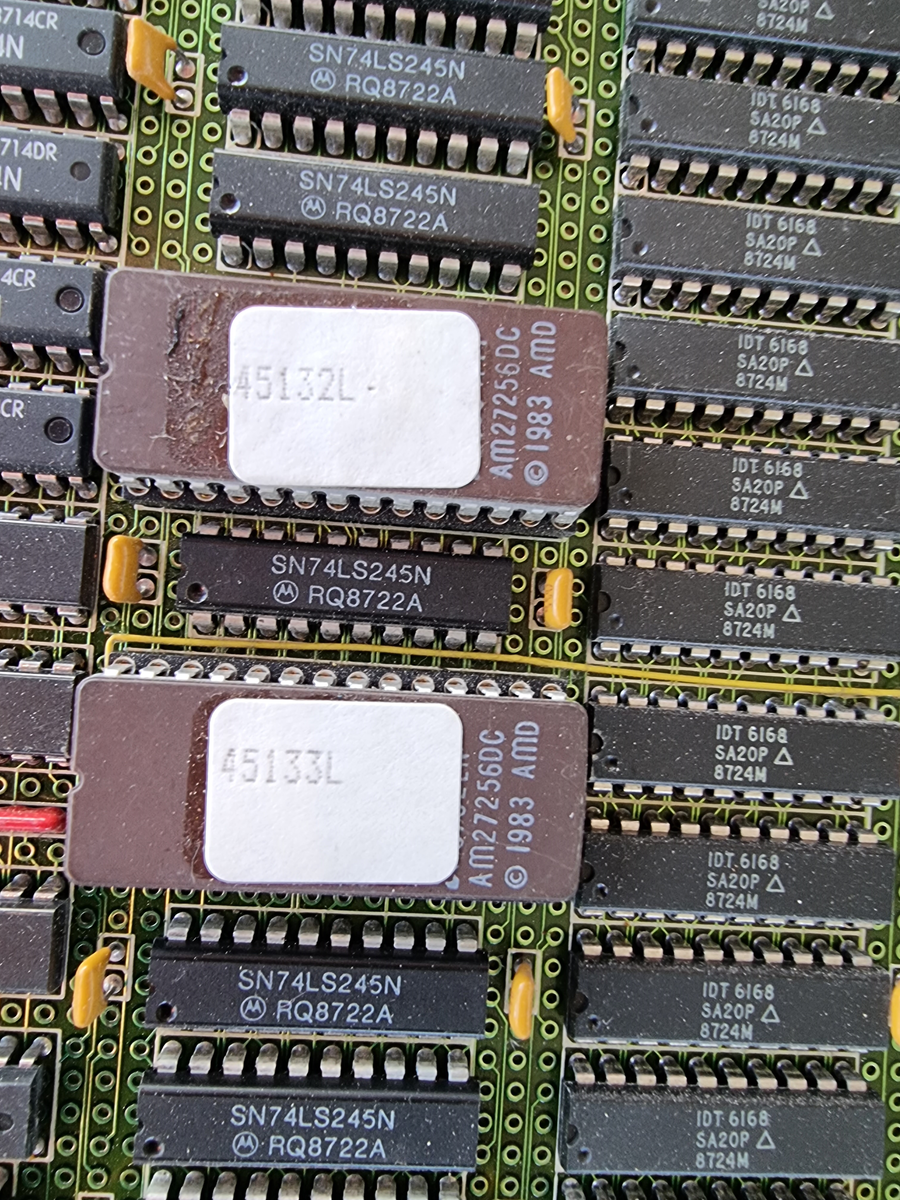
The microcode is stored in two 32 KByte EPROMs, each holding 8 bits of a 16-bit word:
- AM27256_45132L - LO 8 bits (0-7)
- AM27256_45133L - HI 8 bits (8-15)
The 45132/45133 pair contains the 32-bit floating point code; the 45148/45149 pair contains the 48-bit floating point code.
Each 64-bit microcode word is built from 4 consecutive 16-bit reads:
| EPROM Address | Microcode bits |
|---|---|
| 0 | Bits 48-63 |
| 1 | Bits 32-47 |
| 2 | Bits 16-31 |
| 3 | Bits 0-15 |
The low byte of the word at octal address 020 is the microcode version: oct 13 = K, oct 14 = L.
Careful: the C# example below and gen_wcs_image.py both put EPROM address 0
of a group in bits 0-15 and address 3 in bits 48-63 - the reverse of the table
above. gen_wcs_image.py names the four reads RF=0..3 (RF=0 -> bits 15:0,
PROM byte index = LUA*4 + RF), and the WCS images the boards run are built
that way.
Files in this folder that the builds use
| File | What it is |
|---|---|
AM27256_45132L.bin, AM27256_45133L.bin |
The raw EPROM dumps. The truth. |
AM27256_45133L.hex |
The HI EPROM as text for $readmemh. Same bytes as its .bin. |
AM27256_45132L.hex |
The LO EPROM as text for $readmemh. Not the same as its .bin - it carries the 002003 patch below. |
AM27256_45132L.hex.bak |
The LO EPROM as text, unpatched (same bytes as AM27256_45132L.bin). |
gen_wcs_image.py |
Builds a ready-loaded control-store (WCS) image from the two .hex files, so a build can skip the runtime PROM->WCS load. Writes wcs/ (default) or wcs-sim/ (--sim); both folders are git-ignored and made again by running the script. |
wcs/ |
33 files: wcs_image.hex (8192 x 64-bit words) and one nibble file per IDT6168A chip (wcs_16C.hex ... wcs_31D.hex). The board builds preload these. |
wcs-sim/ |
The same, with the 002002 simulator patch applied (for SKIP_WCS simulation runs). |
Copies of the .hex files and of the WCS images sit next to the harnesses and
board builds that $readmemh them; make test-microcode-sync (in
Verilog/tests/) checks every copy against the variant its folder must hold.
The two patched microwords (measured 28-SEP-2026 against the .bin files)
Neither patch changes the .bin dumps. Both are in the master-clear wait loop,
listing lines 5105-5123 of ND-120-DELILAH-L.LISTING.txt
(% WAITING LOOP 0.5 - 1 SECOND).
| Word (octal) | Listing | PROM byte | Raw | Patched | Where the patched byte is |
|---|---|---|---|---|---|
| 002003 (MACL3) | line 5121-5123, MACL3: B,1 ... MACL4 CONDENABL |
AM27256_45132L, byte 0o10015 (RF=1) |
0o201 | 0o001 | AM27256_45132L.hex here (commit d6799aa, 07-DEC-2024, "Patched microcode address 002003 to disable waiting loop") and so in every copy made from it, including wcs/ and Verilog/Shared/support/wcs_*.hex, which the boards preload. Only AM27256_45132L.hex.bak and Verilog/CPU-BOARD-3202/circuit/BIF_BCTL_SYNC_8/sim/AM27256_45132L.hex hold the raw byte. |
| 002002 (MACL+1) | line 5117-5119, A,6 B,R1 ... IDBS,BMG |
AM27256_45133L, byte 0o10010 (RF=0) |
0o140 | 0o000 | Only the simulator copies of AM27256_45133L.hex (Verilog/sim, runSim, dmaSim, ND-120-Yosys; commit 895f360) and gen_wcs_image.py --sim (wcs-sim/). |
What each bit is, read from the ND110Compile token table (ND120Tokens.cs),
not from a simulation:
- 002003: the cleared bit is RF1 0o200, the
CONDENABLbit (CONDENABL= RF1 0o002200; the 0o002000 part, DLY0, stays set). Without it, MACL3 takes its true specT,NEXTto 002004 instead of entering the MACL4 loop. - 002002: the cleared bits are RF0 0o060000, the A-operand
A,6->A,0. The bit-mask generator then loads R1 (the outer loop count) with 1 instead of 64.
Reading the binary microcode in C
C# code to read the microcode into a 64-bit wide array named chip_microcode:
        byte[] LOBits = File.ReadAllBytes("AM27256_45132L.bin");
        byte[] HiBits = File.ReadAllBytes("AM27256_45133L.bin");


        ulong[] chip_microcode = new ulong[1024 * 64];
        int cnt = 0;
        for (int i = 0; i < HiBits.Length; i += 4)
        {
            ulong uc = 0;
            for (int b = 3; b >= 0; b--)
            {
                ushort w = (ushort)(HiBits[b + i] << 8 | LOBits[b + i]);
                uc = uc << 16;
                uc |= (ushort)w;
            }


            string ucHex = $"{uc:X16}".PadLeft(16, '0');
            string addr = Convert.ToString(cnt, 8).PadLeft(6, '0');

            Console.WriteLine($"i={i}, uC[{addr}]: {ucHex}");
            chip_microcode[cnt++] = uc;
        }

        ushort version = (ushort)(chip_microcode[0x10] & 0xFF);
        Console.WriteLine($"Version is {Convert.ToString(version,8)}  (octal)");
Documentation
- ND-120 Mikroprogramlisting-L-ocr.pdf
- the original printed listing (version K), 249 pages, scanned at 600 DPI. The source of truth the reconstruction was verified against. It also holds the symbol index (label -> address) that the re-typed listings leave out.
- ND-06.031.1 EN ND-110 and ND-120 Microprogrammer's Guide
- the reference for understanding the microcode word format and tokens.
Schematic
Here you can see how the EPROMs were connected to the internal data bus (IDB):
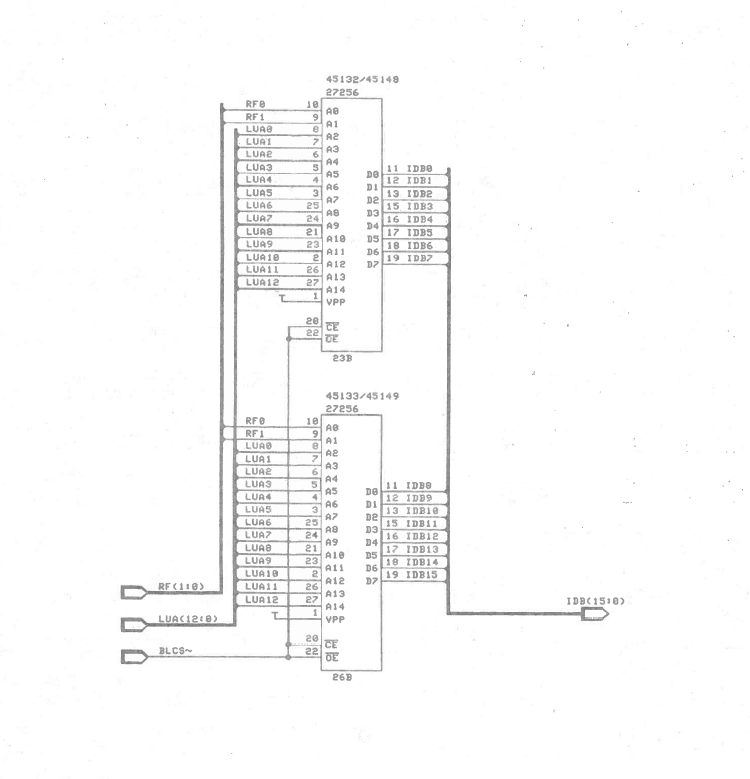
EPROM on CPU board 3202