ND-120 MiSTer core (DE10-Nano / MiSTer Pi)
Full path: Verilog/fpga/mister/
The ND-120 CPU board running on the MiSTer FPGA platform. SINTRAN III boots on real hardware (DE10-Nano), verified 02-SEP-2026.
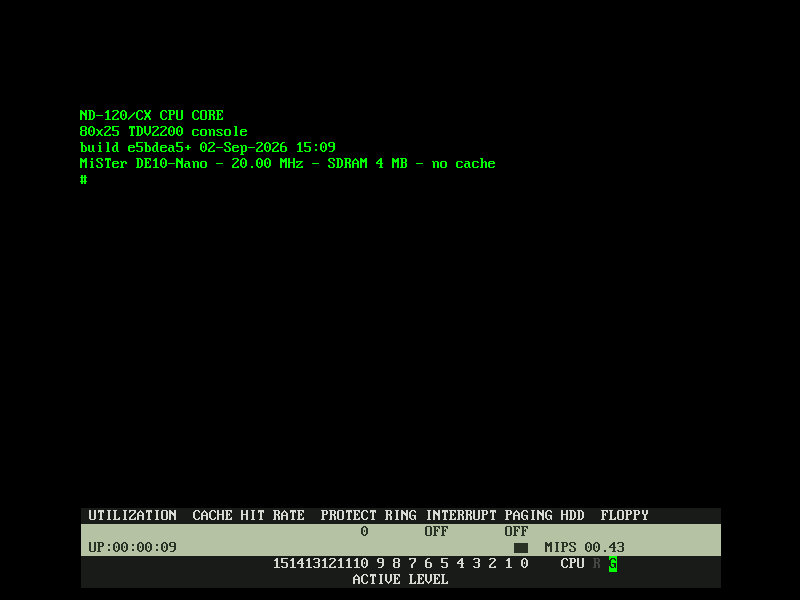
The core on real hardware (DE10-Nano, 02-SEP-2026), at the # MOPC monitor
before SINTRAN is loaded: the four-line power-on banner (core / console / build
stamp / board+clock+memory), the operator panel across the bottom, and the CPU
G lamp lit green (self-test passed). Mount a Winchester image in the OSD and
type & at # to boot SINTRAN.
For a user quickstart (copy the ready-built .rbf, load it, boot SINTRAN) see
../QUICKSTART-mister.md. The docs/ folder is
the developer reference (building, deploy, OSD menu, block/char devices,
debugging, links); docs/07-links.md is the full validated link collection.
- Board: Terasic DE10-Nano, or the Retro Remake MiSTer Pi clone - same
Intel Cyclone V SoC
5CSEBA6U23I7(~110K LE fabric + dual-core ARM Cortex-A9 "HPS" running Linux, 1 GB DDR3 on the HPS side). SDRAM is an add-on module on both (128 MB; the MiSTer Pi "Turbo Pack" bundles it). The core is the same.rbfeither way - nothing in this folder is DE10- or Pi-specific. - What it is: the full ND-120 CPU board, with floppy/Winchester/tape images
served as files from the Linux (HPS) side over the MiSTer
hps_ioblock-device protocol, the console on the machine's own screen and keyboard (a TDV2200 terminal), and microcode uploaded from the HPS at core load.
Status (02-SEP-2026)
SINTRAN III boots on real hardware (DE10-Nano). The whole ND-120 machine
is in the build and running on silicon: it comes up at the # MOPC monitor
(the screenshot above), and with a Winchester image mounted in the OSD, &
boots SINTRAN. Verified this day on the board.
Shipping configuration of that build (stamp e5bdea5+):
| Item | Value |
|---|---|
| CPU clock | 20 MHz (PLL output) |
| Main memory | 4 MB (2M words) in the DE10-Nano SDRAM module, WCS in block RAM |
| Cache | off |
| Console | TDV2200, on the MiSTer's own screen + keyboard; also on the HPS /dev/ttyS1 at 115200 7E1 (7 data bits, even parity, 1 stop bit) |
| Storage | floppy 0/1, Winchester 0/1, paper tape - mounted from the OSD |
output_files/nd120.rbf |
3,173,376 bytes |
Confirmed working on the board: boot to OPCOM, SINTRAN boot from a mounted
Winchester, CPU self-test (green G lamp), the TDV2200 box-drawing font, and
the keyboard. This .rbf is the hardware-verified MiSTer artifact in
Release 2 (../RELEASE-NOTES-release2.md).
Build
Quartus Prime Lite 17.0.2 exactly - MiSTer standardizes on it; newer
Quartus breaks the project files and buys nothing on Cyclone V. Nothing needs
installing on the host: the community image raetro/quartus:17.0
(https://github.com/raetro/sdk-docker-fpga) carries that version.
# from Verilog/fpga/mister/, in WSL (needs the docker daemon running)
make check     # is docker up, is the image pulled, is the project intact
make build     # font + microcode + banner, then -> $ND120_BUILD_DIR/mister/nd120.rbf
make load      # scp the .rbf to the MiSTer  (MISTER=root@... to override)
The build folder ND120_BUILD_DIR comes from local.mk at the repository
root (python3 configure.py, see
CONTRIBUTING.md - Local settings).
Quartus writes db/, output_files/ and more next to the .qpf, so the
build keeps a copy of this folder in $ND120_BUILD_DIR/mister/project/ and
runs Quartus there, with the repository's Verilog/ tree mounted read-only
in the container; the finished core is copied to
$ND120_BUILD_DIR/mister/nd120.rbf. Nothing is written into this folder.
The Quartus GUI is needed for adding PLL output clocks (that changes the
port list) and for SignalTap. It is NOT needed to change a PLL frequency -
that is a string parameter in the PLL IP under rtl/pll/ which altera_pll
turns into counter settings at synthesis.
Deploy detail (scp + hot-load over /dev/MiSTer_cmd, JTAG, SD-card folders) is
in docs/03-deploy-and-test.md; the user-facing
copy-and-boot steps are in ../QUICKSTART-mister.md.
Framework cost, for reference (measured 27-AUG-2026 from the bare template, before any ND-120 RTL - the floor every figure sits on):
| Resource | Framework alone | Device |
|---|---|---|
| ALMs | 7,232 | 41,910 (17%) |
| Block RAM | 59 | 553 |
| DSP | 33 | 112 |
| PLLs | 3 | 6 |
Licence note (decided 27-AUG-2026, Ronny): this repo is MIT; the MiSTer
framework in sys/ is GPL-2.0 (LICENSE-MiSTer-framework-GPLv2), and every
MiSTer core must ship sys/ as-is, so the two licences sit in one repo. That is
accepted for now - it keeps the work in one place. Standard MiSTer practice is
one repo per core, so if this core is ever released standalone, split it out
then. The framework in sys/ is copied as-is from Template_MiSTer and must
never be edited - framework updates erase changes.
Reference cores
- PDP2011_MiSTer - a maintained MiSTer core of a 1970s minicomputer with disk images, a serial console AND a built-in VT100/VT105 terminal, switched by an OSD bit. The closest thing to what we built; dissected in docs/05-devices-block-char.md. Its terminal files are non-free (personal/non-commercial only) - reference only, never vendored. Our TDV2200 terminal was re-implemented clean-room, shared with the MEGA65 port.
- ao486 - the DDR3 main-memory pattern.
- Template: https://github.com/MiSTer-devel/Template_MiSTer
- emu module: https://mister-devel.github.io/MkDocs_MiSTer/developer/emu/
Bring-up history
The port was brought up in stages on Ronny's call (28-AUG-2026): this board was made the priority because it sits on his desk, so a bad bitstream costs minutes rather than the days a remote board (MEGA65) would cost, and because its SDRAM add-on is ordinary SDR SDRAM on FPGA pins - the same interface shape as the MEGA65's, so the memory backend (where the silicon-only bugs live) was debugged here first and the MEGA65 inherits a path that has met real silicon.
The first build was the terminal console alone with no ND-120 in it, so a black
screen had one possible cause at a time; the full machine followed. That whole
sequence is done - SINTRAN boots on silicon (02-SEP-2026, HISTORY.md). The
WCS read-latency fix that made the CPU run is written up in
Verilog/docs/mister-microcode-loop.md; the other bring-up fixes are recorded
only in git history.