nd120_storage_probe
Source: Verilog/fpga/mister/rtl/nd120_storage_probe.v
Hierarchy: not instantiated by any of the 9 build tops (elaborated by yosys).
Module hierarchy - All modules
Schematic
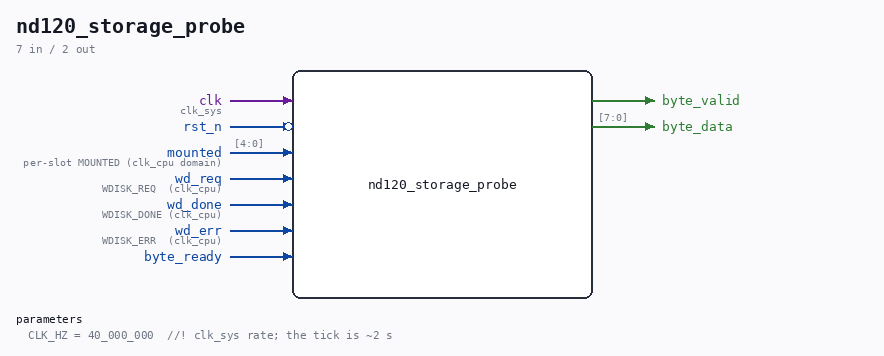
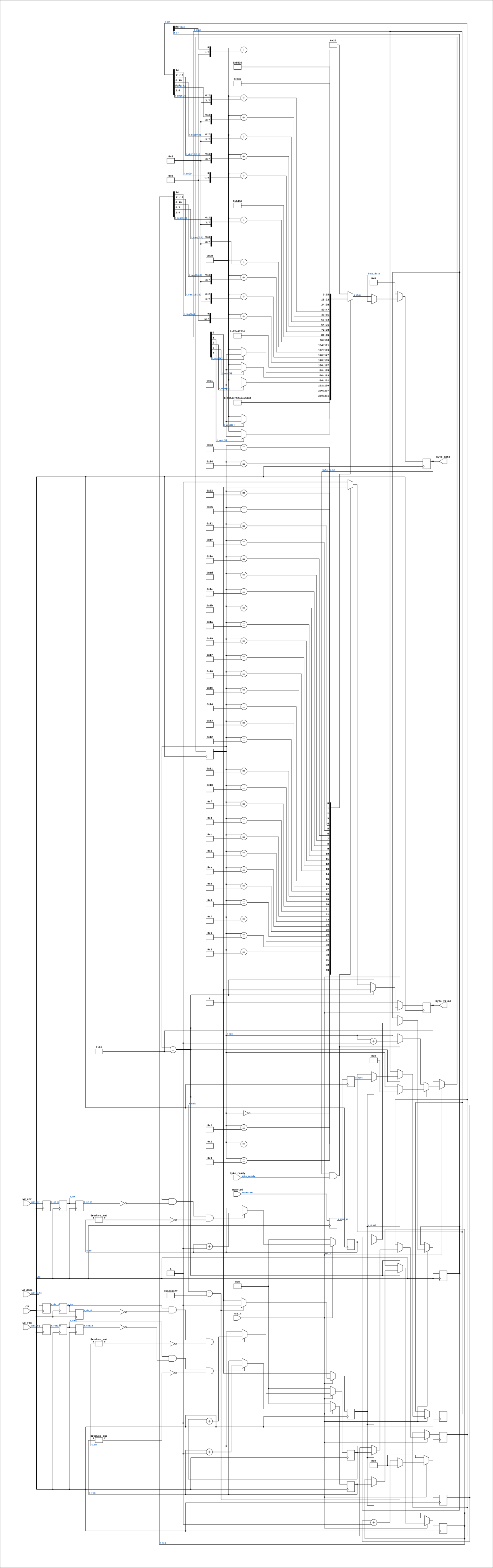
Drawn from the Verilog: no build top uses this module, so it was elaborated from its own file with no defines and default parameters. Sub-modules are boxes (click the picture to open it full size; there every sub-module box links to its page, and every wire shows its Verilog name).
Description
nd120_storage_probe.v - storage mount + Winchester activity, on the console WHY (02-SEP-2026). An automounted WD0 hangs on the first Winchester read (R lamp stuck), while an OSD-mounted WD0 boots. Sim ruled out the RTL reset CDC (test-storage-reset), so the difference is on the real ARM's mount service, which only the board can show. This prints, once every two seconds, exactly the two facts that separate the theories: STOR MNT=fwWt WDr=nnnnn WDd=nnnnn WDe=nnnnn MNT the five per-slot MOUNTED flags as 0/1 (floppy0 floppy1 WD0 WD1 tape), so we see whether the automounted slot is actually open. WDr sticky count of WDISK_REQ rising edges (a read/write was issued) WDd sticky count of WDISK_DONE rising edges (the backend completed one) WDe sticky count of WDISK_ERR pulses (completed WITH an error) If the read hangs: MNT shows whether WD0 mounted, and WDr > WDd with WDe = 0 is a request that never completed - the stuck-read signature. If instead WDd tracks WDr with WDe climbing, the reads complete but error. Counts are OCTAL (this is an octal machine), 15-bit, 5 digits, saturating. It runs on clk_sys and samples the clk_cpu-domain seam through two flops - enough for a display (a torn count for one line is harmless), not a synchroniser for control. It drives nothing but text, at a priority BELOW the CPU's own console output (see the mux in nd120.sv), so it fills the quiet the hang creates and never fights live output. DIAGNOSTIC SCAFFOLDING, compiled only when ND120_STORAGE_PROBE is defined.
Parameters
| Parameter | Default |
|---|---|
CLK_HZ |
40_000_000 //! clk_sys rate; the tick is ~2 s |
Ports
| Direction | Width | Name | Description |
|---|---|---|---|
| input | 1 |
clk |
clk_sys |
| input | 1 |
rst_n (active low) |
|
| input | [4:0] |
mounted |
per-slot MOUNTED (clk_cpu domain) |
| input | 1 |
wd_req |
WDISK_REQ (clk_cpu) |
| input | 1 |
wd_done |
WDISK_DONE (clk_cpu) |
| input | 1 |
wd_err |
WDISK_ERR (clk_cpu) |
| output | 1 |
byte_valid |
|
| output | [7:0] |
byte_data |
|
| input | 1 |
byte_ready |
Verilog source
Verilog/fpga/mister/rtl/nd120_storage_probe.v on GitHub.
Show the Verilog of nd120_storage_probe (150 lines)
/*****************************************************************************
 *  nd120_storage_probe.v - storage mount + Winchester activity, on the       *
 *  console                                                                    *
 *                                                                             *
 *  WHY (02-SEP-2026). An automounted WD0 hangs on the first Winchester read   *
 *  (R lamp stuck), while an OSD-mounted WD0 boots. Sim ruled out the RTL      *
 *  reset CDC (test-storage-reset), so the difference is on the real ARM's     *
 *  mount service, which only the board can show. This prints, once every two  *
 *  seconds, exactly the two facts that separate the theories:                 *
 *                                                                             *
 *    STOR MNT=fwWt WDr=nnnnn WDd=nnnnn WDe=nnnnn                              *
 *                                                                             *
 *  MNT   the five per-slot MOUNTED flags as 0/1 (floppy0 floppy1 WD0 WD1      *
 *        tape), so we see whether the automounted slot is actually open.      *
 *  WDr   sticky count of WDISK_REQ rising edges  (a read/write was issued)    *
 *  WDd   sticky count of WDISK_DONE rising edges (the backend completed one)  *
 *  WDe   sticky count of WDISK_ERR pulses        (completed WITH an error)    *
 *                                                                             *
 *  If the read hangs: MNT shows whether WD0 mounted, and WDr > WDd with       *
 *  WDe = 0 is a request that never completed - the stuck-read signature. If   *
 *  instead WDd tracks WDr with WDe climbing, the reads complete but error.    *
 *  Counts are OCTAL (this is an octal machine), 15-bit, 5 digits, saturating. *
 *                                                                             *
 *  It runs on clk_sys and samples the clk_cpu-domain seam through two flops - *
 *  enough for a display (a torn count for one line is harmless), not a        *
 *  synchroniser for control. It drives nothing but text, at a priority BELOW  *
 *  the CPU's own console output (see the mux in nd120.sv), so it fills the    *
 *  quiet the hang creates and never fights live output.                       *
 *                                                                             *
 *  DIAGNOSTIC SCAFFOLDING, compiled only when ND120_STORAGE_PROBE is defined. *
 *****************************************************************************/
`default_nettype none
module nd120_storage_probe #(
    parameter integer CLK_HZ = 40_000_000  //! clk_sys rate; the tick is ~2 s
) (
    input  wire       clk,        //! clk_sys
    input  wire       rst_n,

    input  wire [4:0] mounted,    //! per-slot MOUNTED (clk_cpu domain)
    input  wire       wd_req,     //! WDISK_REQ  (clk_cpu)
    input  wire       wd_done,    //! WDISK_DONE (clk_cpu)
    input  wire       wd_err,     //! WDISK_ERR  (clk_cpu)

    output reg        byte_valid,
    output reg  [7:0] byte_data,
    input  wire       byte_ready
);
  // ---- sample the clk_cpu seam through two flops ----------------------------
  reg [4:0] s_mnt_m, s_mnt;
  reg s_req_m, s_req, s_req_d;
  reg s_dn_m,  s_dn,  s_dn_d;
  reg s_er_m,  s_er,  s_er_d;
  always @(posedge clk) begin
    s_mnt_m <= mounted; s_mnt <= s_mnt_m;
    s_req_m <= wd_req;  s_req <= s_req_m; s_req_d <= s_req;
    s_dn_m  <= wd_done; s_dn  <= s_dn_m;  s_dn_d  <= s_dn;
    s_er_m  <= wd_err;  s_er  <= s_er_m;  s_er_d  <= s_er;
  end

  // ---- sticky rising-edge counters, saturating at 15 bits -------------------
  reg [14:0] c_req, c_dn, c_er;
  always @(posedge clk) begin
    if (!rst_n) begin
      c_req <= 0; c_dn <= 0; c_er <= 0;
    end else begin
      if (s_req & ~s_req_d & ~(&c_req)) c_req <= c_req + 1'b1;
      if (s_dn  & ~s_dn_d  & ~(&c_dn )) c_dn  <= c_dn  + 1'b1;
      if (s_er  & ~s_er_d  & ~(&c_er )) c_er  <= c_er  + 1'b1;
    end
  end

  // ---- ~2-second tick -------------------------------------------------------
  localparam integer TICK_MAX = (CLK_HZ * 2) - 1;
  reg [26:0] r_tick;
  reg        r_start;
  always @(posedge clk) begin
    if (!rst_n) begin r_tick <= 0; r_start <= 0; end
    else begin
      r_start <= 0;
      if (r_tick == TICK_MAX[26:0]) begin r_tick <= 0; r_start <= 1; end
      else r_tick <= r_tick + 1'b1;
    end
  end

  // ---- one line, one character per accepted handshake -----------------------
  localparam integer LEN = 38;
  reg [4:0]  l_mnt;
  reg [14:0] l_req, l_dn, l_er;
  reg [5:0]  r_idx;   // 0..LEN-1 sending, LEN = idle
  reg [7:0]  s_char;

  function [7:0] oct(input [2:0] v); oct = 8'h30 + {5'b0, v}; endfunction
  function [7:0] b01(input b);       b01 = b ? "1" : "0";     endfunction

  always @(*) begin
    case (r_idx)
      6'd0:  s_char = "S";  6'd1:  s_char = "T";  6'd2:  s_char = "O";
      6'd3:  s_char = "R";  6'd4:  s_char = " ";
      6'd5:  s_char = "M";  6'd6:  s_char = "N";  6'd7:  s_char = "T";
      6'd8:  s_char = "=";
      6'd9:  s_char = b01(l_mnt[0]);   // floppy 0
      6'd10: s_char = b01(l_mnt[1]);   // floppy 1
      6'd11: s_char = b01(l_mnt[2]);   // WD0
      6'd12: s_char = b01(l_mnt[3]);   // WD1
      6'd13: s_char = b01(l_mnt[4]);   // tape
      6'd14: s_char = " ";
      6'd15: s_char = "W"; 6'd16: s_char = "D"; 6'd17: s_char = "r"; 6'd18: s_char = "=";
      6'd19: s_char = oct({2'b0, l_req[14]});
      6'd20: s_char = oct(l_req[13:11]);
      6'd21: s_char = oct(l_req[10:8]);
      6'd22: s_char = oct(l_req[7:5]);
      6'd23: s_char = oct(l_req[4:2]);   // (last 2 bits dropped - 5 digits is plenty)
      6'd24: s_char = " ";
      6'd25: s_char = "d"; 6'd26: s_char = "=";
      6'd27: s_char = oct({2'b0, l_dn[14]});
      6'd28: s_char = oct(l_dn[13:11]);
      6'd29: s_char = oct(l_dn[10:8]);
      6'd30: s_char = oct(l_dn[7:5]);
      6'd31: s_char = oct(l_dn[4:2]);
      6'd32: s_char = " ";
      6'd33: s_char = "e"; 6'd34: s_char = "=";
      6'd35: s_char = oct({2'b0, l_er[14]});
      6'd36: s_char = 8'h0D;
      6'd37: s_char = 8'h0A;
      default: s_char = " ";
    endcase
  end

  always @(posedge clk) begin
    if (!rst_n) begin
      byte_valid <= 0; byte_data <= 0; r_idx <= LEN;
    end else begin
      if (r_idx == LEN) begin
        byte_valid <= 0;
        if (r_start) begin
          l_mnt <= s_mnt; l_req <= c_req; l_dn <= c_dn; l_er <= c_er;
          r_idx <= 0;
        end
      end else begin
        byte_valid <= 1;
        byte_data  <= s_char;
        if (byte_valid && byte_ready) begin
          byte_valid <= 0;
          r_idx <= r_idx + 1'b1;
        end
      end
    end
  end
endmodule
`default_nettype wire