byte_fifo
Source: Verilog/Terminals/rtl/byte_fifo.v
Where it sits (Nexys): nd120_nexys4ddr_top > terminal_top > byte_fifo
- instance path: TERMINAL.FIFO
Used in: terminal_top (Nexys, MiSTer, MEGA65 R6, MEGA65 R3)
Contains: no other modules.
Module hierarchy - All modules
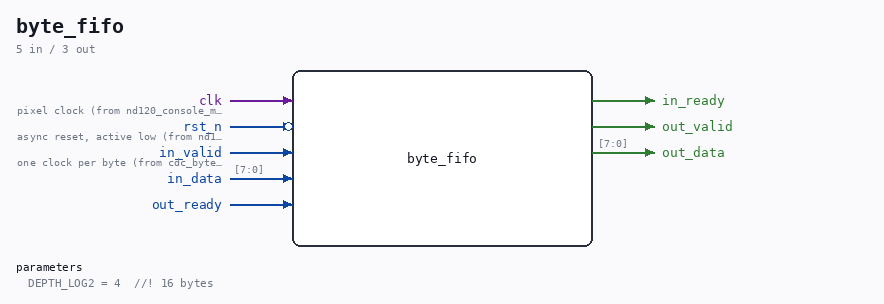
Schematic
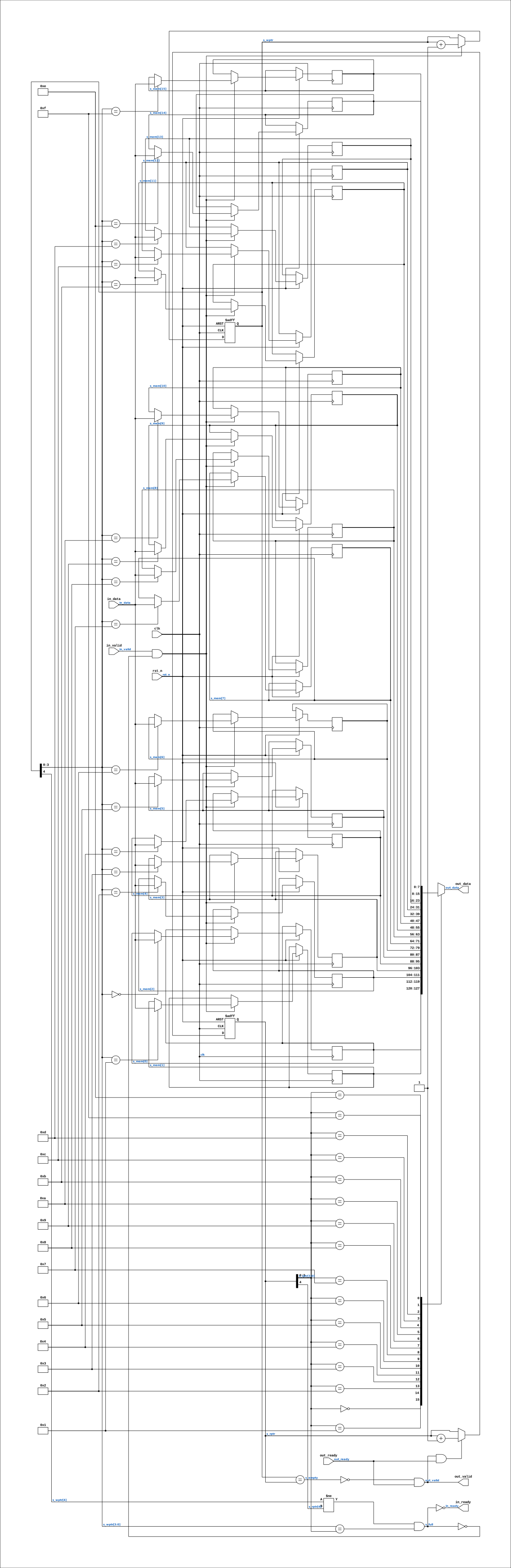
Drawn from the Verilog: the yosys netlist of the Nexys 4 DDR build, instance TERMINAL.FIFO. Sub-modules are boxes (click the picture to open it full size; there every sub-module box links to its page, and every wire shows its Verilog name).
Parameters
| Parameter | Default |
|---|---|
DEPTH_LOG2 |
4 //! 16 bytes |
Ports
| Direction | Width | Name | Description |
|---|---|---|---|
| input | 1 |
clk |
pixel clock (from nd120_console_mega65.clk and others) |
| input | 1 |
rst_n (active low) |
async reset, active low (from nd120_console_mega65.rst_n and others) |
| input | 1 |
in_valid |
one clock per byte (from cdc_byte.dst_valid) |
| input | [7:0] |
in_data |
|
| output | 1 |
in_ready |
|
| output | 1 |
out_valid |
|
| output | [7:0] |
out_data |
|
| input | 1 |
out_ready |
Verilog source
Verilog/Terminals/rtl/byte_fifo.v on GitHub.
Show the Verilog of byte_fifo (77 lines)
//============================================================================
//! Byte FIFO - a small synchronous elastic buffer in front of terminal_ctrl
//!
//! Part of the board-independent terminal core (Verilog/Terminals/).
//!
//! WHY IT EXISTS - measured need, not tidiness. terminal_ctrl holds `ready`
//! low while a screen engine runs. The longest engine run is a VT100 scroll
//! inside a DECSTBM region: two clocks per cell, 160 per row, ~3.8k clocks
//! for a 23-row region - about 96 us at a 40 MHz pixel clock. One byte at
//! 115200 baud takes ~87 us, and the console UART receiver does not respect
//! ready - a byte that arrives while the engine runs would simply be lost.
//! (The old TDV controller already had this hole: its full-screen clear took
//! 50 us and won the race only because 50 < 87.) Sixteen bytes of slack
//! covers every engine this terminal has, with an order of magnitude spare.
//!
//! Synchronous, one clock domain (the pixel clock) - the clock CROSSING is
//! cdc_byte's job and stays upstream of this. Standard valid/ready on both
//! faces. `in_ready` falls only when genuinely full.
//!
//! Written 30-AUG-2026.
//============================================================================

`default_nettype none

module byte_fifo #(
    parameter integer DEPTH_LOG2 = 4  //! 16 bytes
) (
    input wire clk,  //! pixel clock (from nd120_console_mega65.clk and others)
    input wire rst_n,  //! async reset, active low (from nd120_console_mega65.rst_n and others)

    input  wire       in_valid,  //! one clock per byte (from cdc_byte.dst_valid)
    input  wire [7:0] in_data,
    output wire       in_ready,

    output wire       out_valid,
    output wire [7:0] out_data,
    input  wire       out_ready
);

  localparam integer DEPTH = 1 << DEPTH_LOG2;

  reg [7:0] s_mem[0:DEPTH-1];
  //! One extra bit so full (count == DEPTH) and empty (count == 0) are
  //! distinct without comparing pointers.
  reg [DEPTH_LOG2:0] s_wptr, s_rptr;

  wire s_empty = (s_wptr == s_rptr);
  wire s_full  = (s_wptr[DEPTH_LOG2] != s_rptr[DEPTH_LOG2]) &&
                 (s_wptr[DEPTH_LOG2-1:0] == s_rptr[DEPTH_LOG2-1:0]);

  assign in_ready  = !s_full;
  //! Gated with out_ready ON PURPOSE: terminal_ctrl treats every cycle of
  //! byte_valid as a new byte (that is its contract - "one clock per byte"),
  //! so this output must only be high on a cycle the byte is simultaneously
  //! popped. out_ready comes from a state register, never from out_valid, so
  //! this is not a combinational loop.
  assign out_valid = !s_empty && out_ready;
  assign out_data  = s_mem[s_rptr[DEPTH_LOG2-1:0]];

  always @(posedge clk or negedge rst_n) begin
    if (!rst_n) begin
      s_wptr <= {(DEPTH_LOG2 + 1) {1'b0}};
      s_rptr <= {(DEPTH_LOG2 + 1) {1'b0}};
    end else begin
      if (in_valid && !s_full) begin
        s_mem[s_wptr[DEPTH_LOG2-1:0]] <= in_data;
        s_wptr <= s_wptr + 1'b1;
      end
      if (out_valid && out_ready) begin
        s_rptr <= s_rptr + 1'b1;
      end
    end
  end

endmodule

`default_nettype wire