ps2_keyboard_tdv
Source: Verilog/Terminals/rtl/ps2_keyboard_tdv.v
Where it sits (Nexys): nd120_nexys4ddr_top > ps2_keyboard_tdv
- instance path: KEYBOARD
Used in: nd120_nexys4ddr_top (Nexys)
Contains: ps2_decoder_tdv
Module hierarchy - All modules
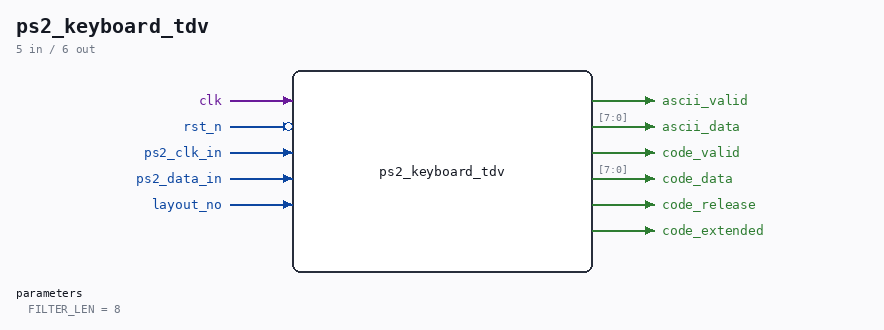
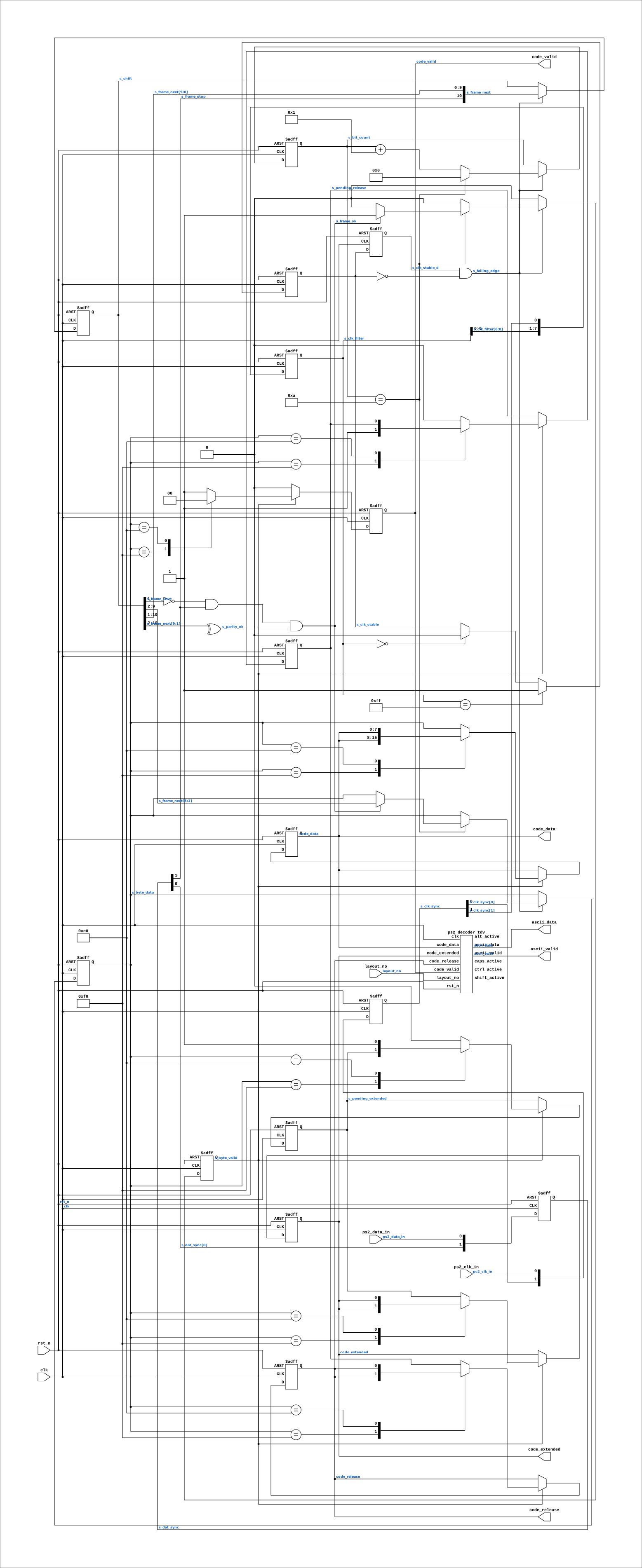
Schematic
Drawn from the Verilog: the yosys netlist of the Nexys 4 DDR build, instance KEYBOARD. Sub-modules are boxes (click the picture to open it full size; there every sub-module box links to its page, and every wire shows its Verilog name).
Parameters
| Parameter | Default |
|---|---|
FILTER_LEN |
8 |
Ports
| Direction | Width | Name | Description |
|---|---|---|---|
| input | 1 |
clk |
|
| input | 1 |
rst_n (active low) |
|
| input | 1 |
ps2_clk_in |
|
| input | 1 |
ps2_data_in |
|
| input | 1 |
layout_no |
|
| output | 1 |
ascii_valid |
|
| output | [7:0] |
ascii_data |
|
| output | 1 |
code_valid |
|
| output | [7:0] |
code_data |
|
| output | 1 |
code_release |
|
| output | 1 |
code_extended |
Verilog source
Verilog/Terminals/rtl/ps2_keyboard_tdv.v on GitHub.
Show the Verilog of ps2_keyboard_tdv (177 lines)
//============================================================================
//! PS/2 keyboard receiver + scancode-set-2 to TDV2200 decoder
//!
//! Part of the board-independent terminal core (Verilog/Terminals/).
//! Thin sibling of ps2_keyboard.v (VT100) - the 11-bit PS/2 framing and
//! E0/F0 prefix handling are IDENTICAL (that part is board wiring, not
//! terminal-type logic); the only difference is instantiating
//! ps2_decoder_tdv instead of ps2_decoder, per the decision to keep VT100
//! and TDV2200 as two separate, compile-time-selected modules.
//!
//! Written 31-AUG-2026.
//============================================================================

`default_nettype none

module ps2_keyboard_tdv #(
    parameter integer FILTER_LEN = 8
) (
    input wire clk,
    input wire rst_n,

    input wire ps2_clk_in,
    input wire ps2_data_in,

    input wire layout_no,

    output wire       ascii_valid,
    output wire [7:0] ascii_data,

    output reg       code_valid,
    output reg [7:0] code_data,
    output reg       code_release,
    output reg       code_extended
);

  //--------------------------------------------------------------------------
  // Input conditioning: synchronize, then require FILTER_LEN stable samples
  //--------------------------------------------------------------------------

  reg [1:0] s_clk_sync;
  reg [1:0] s_dat_sync;

  reg [FILTER_LEN-1:0] s_clk_filter;
  reg                  s_clk_stable;
  reg                  s_clk_stable_d;

  always @(posedge clk or negedge rst_n) begin
    if (!rst_n) begin
      s_clk_sync     <= 2'b11;
      s_dat_sync     <= 2'b11;
      s_clk_filter   <= {FILTER_LEN{1'b1}};
      s_clk_stable   <= 1'b1;
      s_clk_stable_d <= 1'b1;
    end else begin
      s_clk_sync <= {s_clk_sync[0], ps2_clk_in};
      s_dat_sync <= {s_dat_sync[0], ps2_data_in};

      s_clk_filter <= {s_clk_filter[FILTER_LEN-2:0], s_clk_sync[1]};

      if (s_clk_filter == {FILTER_LEN{1'b1}}) s_clk_stable <= 1'b1;
      else if (s_clk_filter == {FILTER_LEN{1'b0}}) s_clk_stable <= 1'b0;

      s_clk_stable_d <= s_clk_stable;
    end
  end

  wire s_falling_edge = s_clk_stable_d && !s_clk_stable;

  //--------------------------------------------------------------------------
  // Frame receiver - 11 bits, LSB first
  //--------------------------------------------------------------------------

  reg  [3:0] s_bit_count;
  reg [10:0] s_shift;

  wire [10:0] s_frame_next = {s_dat_sync[1], s_shift[10:1]};

  wire s_frame_start  = s_frame_next[0];
  wire s_frame_stop   = s_frame_next[10];
  wire s_parity_ok    = (^s_frame_next[9:1]) == 1'b1;
  wire s_frame_ok     = (s_frame_start == 1'b0) && (s_frame_stop == 1'b1) && s_parity_ok;

  reg s_byte_valid;
  reg [7:0] s_byte_data;

  always @(posedge clk or negedge rst_n) begin
    if (!rst_n) begin
      s_bit_count  <= 4'd0;
      s_shift      <= 11'd0;
      s_byte_valid <= 1'b0;
      s_byte_data  <= 8'h00;
    end else begin
      s_byte_valid <= 1'b0;

      if (s_falling_edge) begin
        s_shift <= s_frame_next;

        if (s_bit_count == 4'd10) begin
          s_bit_count <= 4'd0;
          if (s_frame_ok) begin
            s_byte_valid <= 1'b1;
            s_byte_data  <= s_frame_next[8:1];
          end
        end else begin
          s_bit_count <= s_bit_count + 4'd1;
        end
      end
    end
  end

  //--------------------------------------------------------------------------
  // Prefix handling - E0 (extended) and F0 (release)
  //--------------------------------------------------------------------------

  localparam [7:0] SC_RELEASE  = 8'hF0;
  localparam [7:0] SC_EXTENDED = 8'hE0;

  reg s_pending_release;
  reg s_pending_extended;

  always @(posedge clk or negedge rst_n) begin
    if (!rst_n) begin
      s_pending_release  <= 1'b0;
      s_pending_extended <= 1'b0;
      code_valid         <= 1'b0;
      code_data          <= 8'h00;
      code_release       <= 1'b0;
      code_extended      <= 1'b0;
    end else begin
      code_valid <= 1'b0;

      if (s_byte_valid) begin
        case (s_byte_data)
          SC_RELEASE:  s_pending_release  <= 1'b1;
          SC_EXTENDED: s_pending_extended <= 1'b1;

          default: begin
            code_valid    <= 1'b1;
            code_data     <= s_byte_data;
            code_release  <= s_pending_release;
            code_extended <= s_pending_extended;

            s_pending_release  <= 1'b0;
            s_pending_extended <= 1'b0;
          end
        endcase
      end
    end
  end

  //--------------------------------------------------------------------------
  // The TDV2200 decoder
  //--------------------------------------------------------------------------

  ps2_decoder_tdv DECODER (
      .clk  (clk),
      .rst_n(rst_n),

      .code_valid   (code_valid),
      .code_data    (code_data),
      .code_release (code_release),
      .code_extended(code_extended),

      .layout_no(layout_no),

      .ascii_valid(ascii_valid),
      .ascii_data (ascii_data),

      .shift_active(),
      .ctrl_active (),
      .caps_active (),
      .alt_active  ()
  );

endmodule

`default_nettype wire