terminal_ctrl_tdv
Source: Verilog/Terminals/rtl/terminal_ctrl_tdv.v
Where it sits (Nexys): nd120_nexys4ddr_top > terminal_top > terminal_ctrl_tdv
- instance path: TERMINAL.CTRL
Used in: terminal_top (Nexys, MiSTer, MEGA65 R6, MEGA65 R3)
Contains: no other modules.
Module hierarchy - All modules
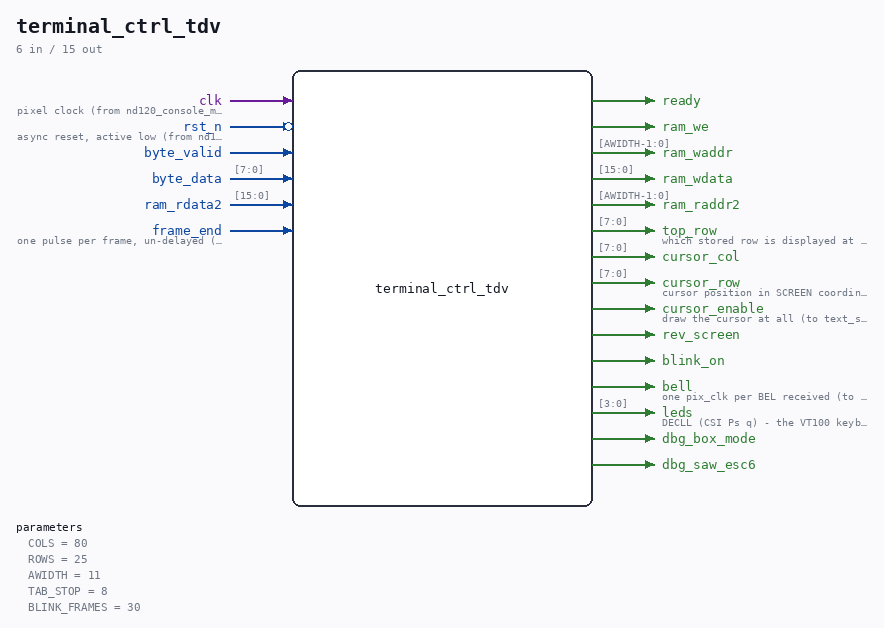
Schematic
Drawn from the Verilog: the yosys netlist of the Nexys 4 DDR build, instance TERMINAL.CTRL. Sub-modules are boxes (click the picture to open it full size; there every sub-module box links to its page, and every wire shows its Verilog name).

Parameters
| Parameter | Default |
|---|---|
COLS |
80 |
ROWS |
25 |
AWIDTH |
11 |
TAB_STOP |
8 |
BLINK_FRAMES |
30 |
Ports
| Direction | Width | Name | Description |
|---|---|---|---|
| input | 1 |
clk |
pixel clock (from nd120_console_mega65.clk and others) |
| input | 1 |
rst_n (active low) |
async reset, active low (from nd120_console_mega65.rst_n and others) |
| input | 1 |
byte_valid |
|
| input | [7:0] |
byte_data |
|
| output | 1 |
ready |
|
| output | 1 |
ram_we |
|
| output | [AWIDTH-1:0] |
ram_waddr |
|
| output | [15:0] |
ram_wdata |
|
| output | [AWIDTH-1:0] |
ram_raddr2 |
|
| input | [15:0] |
ram_rdata2 |
|
| output | [7:0] |
top_row |
which stored row is displayed at the top (to text_screen.top_row) |
| output | [7:0] |
cursor_col |
|
| output | [7:0] |
cursor_row |
cursor position in SCREEN coordinates (to text_screen.cursor_row) |
| output | 1 |
cursor_enable |
draw the cursor at all (to text_screen.cursor_enable) |
| output | 1 |
rev_screen |
|
| output | 1 |
blink_on |
|
| input | 1 |
frame_end |
one pulse per frame, un-delayed (for blink) (from text_screen.frame_end) |
| output | 1 |
bell |
one pix_clk per BEL received (to terminal_top.bell) |
| output | [3:0] |
leds |
DECLL (CSI Ps q) - the VT100 keyboard lamps L1-L4 (to terminal_top.leds) |
| output | 1 |
dbg_box_mode |
|
| output | 1 |
dbg_saw_esc6 |
Verilog source
Verilog/Terminals/rtl/terminal_ctrl_tdv.v on GitHub.
Show the Verilog of terminal_ctrl_tdv (818 lines)
//============================================================================
//! Terminal control - TDV2200 (terminal type 93, Tandberg TDV-2200/9S
//! ND-NOTIS)
//!
//! Part of the board-independent terminal core (Verilog/Terminals/).
//! Sibling of terminal_ctrl.v (VT100, type 6) - same engine (clear/scroll/
//! copy/apply state machines, cursor-move arithmetic, address functions are
//! IDENTICAL, terminal-type-agnostic screen mechanics), different PARSER:
//! a TDV does not speak ECMA-48 C0 meanings or DEC CSI cursor letters for
//! input, and neither does SINTRAN when it thinks it is talking to one.
//!
//! GROUND TRUTH (see ps2_ascii_table_tdv.v's header for the full source
//! list) and the REAL CAPTURED PED-at-type-93 startup this parser is built
//! to survive byte-exact (Verilog/Terminals/docs/SPEC-tdv2200.md has the
//! full account):
//! ESC Q exit/enable EC switch - swallowed
//! ESC[30;7;80l ESC[62;62h mode set/reset, UNMARKED (no '?'),
//! function unknown - swallowed generically
//! ESC P L10 ESC\ (x4) DCS soft-key programming - SKIPPED AS A
//! UNIT, never rendered (matches RetroTerm's
//! own TDV2200Emulator, which does not
//! implement DCS soft-key programming either)
//! ESC[001;001H CUP, ZERO-PADDED parameters
//! ESC[2J ED, standard
//!
//! C0 CONTROL CODES have TDV-native meanings, not ASCII/ECMA-48 ones - this
//! is the single biggest difference from terminal_ctrl.v. Cursor movement is
//! C0 bytes (BS=left, VT=down, CAN=right, FS=up, GS=home), NOT escape
//! sequences - confirmed on real hardware (FINDINGS-2026-08-20.md: SENDKEY
//! HOME transmitted GS 0x1D, cursor landed on the PED: line, "exactly the
//! documented behaviour").
//!
//! DLE (0x10) starts 2-byte BINARY cursor addressing: row byte masked to 5
//! bits (0-24), column byte masked to 7 bits (0-79) - 7, not 5: 5 bits
//! cannot address column 79, and the RetroTerm source code comment disputes
//! the 5-bit claim some docs make on exactly this basis. The same masking
//! is tolerant of BOTH a raw 0-based encoding and SINTRAN's 0x7F+n 1-based
//! biased encoding - masking off the low 5/7 bits collapses both cases to
//! the same result, so no mode flag is needed to pick which one arrived.
//!
//! CHARACTER SETS: "ESC <digit>" (NDSS1-9, e.g. "ESC 6" for Box) - a bare
//! TWO-byte designation, NOT VT100's three-byte "ESC ( <final>". Only NDSS6
//! (Box, font page 3 - see font/make_font.py) actually renders differently;
//! every other digit falls back to plain ASCII (page 0), same conservative
//! choice terminal_ctrl.v makes for any VT100 charset it does not implement.
//! Found missing and fixed 31-AUG-2026 against a live SCONF capture: cell
//! 0x60 printed as a literal backtick instead of a top-left corner, because
//! this parser only recognised VT100's ESC( form, which a TDV never sends.
//!
//! DEFERRED, NOT IMPLEMENTED (no evidence PED/LED use them; add only if a
//! live capture shows otherwise): ND private rectangle ops (z { } u v ~ | p
//! q s t), Tektronix/ND graphics, DCS soft-key/PUSH-key PROGRAMMING (only
//! skip-and-discard is implemented), 132-column mode (no TDV terminal type
//! supports it), NDSS1-5/7-9 (Graphics I/II, Math, Greek, Diacritics, NIX,
//! T, ND private) and the ISO 646 national-variant switch (ESC %).
//!
//! CELL LAYOUT, clock domain, blink: identical to terminal_ctrl.v - see
//! that file's header.
//!
//! Written 31-AUG-2026.
//============================================================================
`default_nettype none
module terminal_ctrl_tdv #(
parameter integer COLS = 80,
//! 80x25 is TDV2200 geometry - one more row than VT100's 80x24, the
//! 25th row PED's status line uses (confirmed: FINDINGS-2026-08-20.md,
//! "PED as a TDV gets one more text line... Line: 1-21... 25th row").
parameter integer ROWS = 25,
parameter integer AWIDTH = 11,
parameter integer TAB_STOP = 8,
parameter integer BLINK_FRAMES = 30
) (
input wire clk, //! pixel clock (from nd120_console_mega65.clk and others)
input wire rst_n, //! async reset, active low (from nd120_console_mega65.rst_n and others)
input wire byte_valid,
input wire [7:0] byte_data,
output wire ready,
output reg ram_we,
output reg [AWIDTH-1:0] ram_waddr,
output reg [ 15:0] ram_wdata,
output wire [AWIDTH-1:0] ram_raddr2,
input wire [ 15:0] ram_rdata2,
output reg [7:0] top_row, //! which stored row is displayed at the top (to text_screen.top_row)
output reg [7:0] cursor_col,
output reg [7:0] cursor_row, //! cursor position in SCREEN coordinates (to text_screen.cursor_row)
output wire cursor_enable, //! draw the cursor at all (to text_screen.cursor_enable)
output reg rev_screen,
output wire blink_on,
input wire frame_end, //! one pulse per frame, un-delayed (for blink) (from text_screen.frame_end)
output reg bell, //! one pix_clk per BEL received (to terminal_top.bell)
output reg [3:0] leds, //! DECLL (CSI Ps q) - the VT100 keyboard lamps L1-L4 (to terminal_top.leds)
//! Box-charset debug taps (01-SEP-2026): live s_g0_gfx state, and a
//! STICKY latch set the first time ESC 6 (NDSS6/Box) is ever received
//! and never cleared by anything but rst_n - directly answers "has
//! SINTRAN ever sent the box designation at all" without racing a
//! live snapshot against a designation that toggles back off.
output wire dbg_box_mode,
output reg dbg_saw_esc6
);
assign dbg_box_mode = s_g0_gfx;
localparam [15:0] BLANK_CELL = {8'h00, 8'h20};
//--------------------------------------------------------------------------
// Engine states - identical shape to terminal_ctrl.v (terminal-type-
// agnostic screen mechanics).
//--------------------------------------------------------------------------
localparam [2:0] ST_RUN = 3'd0;
localparam [2:0] ST_CLEAR = 3'd1;
localparam [2:0] ST_COPY_RD = 3'd2;
localparam [2:0] ST_COPY_WR = 3'd3;
localparam [2:0] ST_APPLY = 3'd4;
reg [2:0] s_state;
//--------------------------------------------------------------------------
// Parser states. P_DLE1/P_DLE2 (binary cursor addressing) and P_DCS/
// P_DCS_ESC (skip a soft-key programming block) are new; P_ESC/P_ESCINT/
// P_CSI carry the same shape as terminal_ctrl.v, dispatching different
// finals.
//--------------------------------------------------------------------------
localparam [2:0] P_GROUND = 3'd0;
localparam [2:0] P_ESC = 3'd1;
localparam [2:0] P_ESCINT = 3'd2;
localparam [2:0] P_CSI = 3'd3;
localparam [2:0] P_DLE1 = 3'd4; //! DLE seen, awaiting the row byte
localparam [2:0] P_DLE2 = 3'd5; //! row byte seen, awaiting the column byte
localparam [2:0] P_DCS = 3'd6; //! inside ESC P ... - discard until ESC \
localparam [2:0] P_DCS_ESC = 3'd7; //! saw ESC while skipping a DCS block
reg [2:0] p_state;
reg [7:0] s_par [0:3];
reg [2:0] s_npar;
reg s_priv;
reg s_ign;
reg [7:0] s_escint;
reg [4:0] s_dle_row; //! latched between P_DLE1 and P_DLE2
//--------------------------------------------------------------------------
// Terminal modes and rendition state - the subset TDV mode actually uses.
// No DECOM/DECAWM/DECSTBM/LNM: not confirmed in any TDV capture, and an
// unimplemented mode already swallows safely (see dispatch_csi).
//--------------------------------------------------------------------------
reg s_cursor_vis;
reg s_at_rev, s_at_bold, s_at_ul, s_at_blink;
reg s_shift; //! SO/SI: 0 = G0 active, 1 = G1 active
reg s_g0_gfx; //! G0 designated NDSS6/Box (ESC 6) - cell bit 12, font
//! page 3 (TDV2200 character set 2). SCONF draws with it
//! (live capture 31-AUG-2026). A locking designation.
reg s_g1_gfx; //! G1's own designation - never set (no NDSS G1 form
//! implemented yet), so G1 always reads as plain ASCII
//! SS2 (ESC N) - single-shift the NEXT character only through the
//! TDV2200's CHARACTER SET 2 (cell bit 12, font page 3 - the SAME set the
//! ESC 6 Box designation selects; on a real TDV2200 they are one alphabet,
//! and RetroCore maps both to bank 2). This is the mechanism PED's
//! box-drawing (frame/fullbar in PLANC-SCREEN-H, per NDInsight's
//! VTM-TERMINAL-INTERFACES.md) actually uses: RetroTerm's own
//! TDVEmulatorBase.cs hardwires G2 to set 2 PERMANENTLY (no designation
//! escape at all - see _g2CharacterSet's initializer), so ESC N + a data
//! byte is the box-drawing character right there, not a delayed G0 mode
//! change. Confirmed against a live capture 01-SEP-2026: PED repeats
//! `ESC N <char>` once per graphics cell (e.g. the position ruler), never
//! a lasting SO. One-shot: cleared the instant put_char consumes it.
//!
//! Set 2 is NOT the VT100 DEC Special Graphics alphabet. Measured on the
//! Nexys 01-SEP-2026: with SS2 pointed at the DEC page, PED's frames came
//! out as DIAMONDS, because in set 2 code 0x60 is the horizontal line
//! (DEC: diamond) and the corners/tees sit at 0x61-0x6A. Page 3 carries
//! the real TDV2200 character ROM as dumped in RetroCore's FontTDV2200.cs
//! (font/tdv2200_set2_from_retrocore.py).
reg s_ss2_armed;
reg s_pending; //! last-column flag - same VT100-derived autowrap behavior;
//! a TDV wraps too, and nothing in the captures says otherwise.
reg [7:0] s_cl_row, s_cl_col, s_cl_erow, s_cl_ecol;
reg [7:0] s_cp_dst;
reg [7:0] s_cp_col;
reg s_cp_down;
//! Deferred cursor-move commit - same two-phase reasoning as
//! terminal_ctrl.v (latch operands one cycle, commit the next) to keep
//! the combinational cone off the cursor registers short. TDV has no
//! scroll region, so there is no floor/ceiling clamp to register
//! separately - every move clamps straight to the screen edges.
//!
//! CUU/CUD/CUF/CUB exist because SINTRAN's own cursor-move ECHO for an
//! arrow keypress is standard VT100 CSI (ESC[A/B/C/D), not another bare
//! TDV byte - measured on real hardware (RetroCore trace, 31-AUG-2026):
//! sending TDV-native FS (cursor up) got ESC[A back, sending BS (cursor
//! left) got ESC[D back, and so on for all four. Found missing here:
//! this parser only handled H/f (CUP) - A/B/C/D fell through the
//! `default: ;` and never moved the cursor, which is why arrows looked
//! completely dead in PED even though the keyboard side was correct all
//! along and SINTRAN was receiving and processing every keypress.
localparam [3:0] AP_CUP = 4'd0;
localparam [3:0] AP_CUU = 4'd1;
localparam [3:0] AP_CUD = 4'd2;
localparam [3:0] AP_CUF = 4'd3;
localparam [3:0] AP_CUB = 4'd4;
//! CHA (col-absolute) and VPA (row-absolute) - ported from terminal_ctrl.v
//! along with the cursor moves above: SINTRAN's type-93 line speaks the
//! same base ECMA-48 CSI set VT100 does (RetroTerm's own class hierarchy
//! has TDV2200Emulator derive from the identical core VT100Emulator
//! uses, adding ND extensions on top - not a separate protocol), so this
//! parser should carry the same base set terminal_ctrl.v already proved,
//! not reinvent a narrower one.
localparam [3:0] AP_CHA = 4'd5;
localparam [3:0] AP_VPA = 4'd6;
//! SGR walks s_par like AP_MODE/AP_LED do in terminal_ctrl.v - one
//! parameter per clock via s_ap_idx, not the two-phase latch above.
localparam [3:0] AP_SGR = 4'd7;
reg [3:0] s_ap_kind;
reg s_ap_phase;
reg [7:0] s_ap_row_q; //! CUP/VPA's row operand, or CUU/CUD/CUF/CUB/CHA's count/column
reg [7:0] s_ap_col_q; //! CUP's column operand only
reg [2:0] s_ap_idx; //! SGR parameter walk index
assign ready = (s_state == ST_RUN) && !s_wr_hold;
reg s_wr_hold;
reg [7:0] s_wr_char;
//--------------------------------------------------------------------------
// Address arithmetic - identical to terminal_ctrl.v.
//--------------------------------------------------------------------------
function automatic [7:0] stored_row;
input [7:0] top;
input [7:0] screen;
reg [8:0] sum;
begin
sum = {1'b0, top} + {1'b0, screen};
stored_row = (sum >= ROWS) ? (sum[7:0] - ROWS[7:0]) : sum[7:0];
end
endfunction
function automatic [AWIDTH-1:0] cell_addr;
input [7:0] row;
input [7:0] col;
begin
cell_addr = {row, 6'b0} + {row, 4'b0} + col;
end
endfunction
//! A CSI parameter with its default: 0 or absent means `dflt` (ECMA-48).
function automatic [7:0] par_or;
input [7:0] value;
input [7:0] dflt;
begin
par_or = (value == 8'd0) ? dflt : value;
end
endfunction
function automatic [7:0] dig_acc;
input [7:0] cur;
input [7:0] digit;
reg [11:0] wide;
begin
wide = {4'd0, cur} * 12'd10 + {8'd0, digit[3:0]};
dig_acc = (wide > 12'd255) ? 8'd255 : wide[7:0];
end
endfunction
wire [7:0] s_cp_src = s_cp_down ? (s_cp_dst - 8'd1) : (s_cp_dst + 8'd1);
assign ram_raddr2 = cell_addr(stored_row(top_row, s_cp_src), s_cp_col);
//--------------------------------------------------------------------------
// Cursor / attribute blink - identical to terminal_ctrl.v.
//--------------------------------------------------------------------------
reg [7:0] s_blink_count;
reg s_blink_on;
always @(posedge clk or negedge rst_n) begin
if (!rst_n) begin
s_blink_count <= 8'd0;
s_blink_on <= 1'b1;
end else if (frame_end) begin
if (s_blink_count == BLINK_FRAMES - 1) begin
s_blink_count <= 8'd0;
s_blink_on <= ~s_blink_on;
end else begin
s_blink_count <= s_blink_count + 8'd1;
end
end
end
assign cursor_enable = s_blink_on && s_cursor_vis;
assign blink_on = s_blink_on;
//--------------------------------------------------------------------------
// Screen movers - identical mechanics to terminal_ctrl.v, no DECSTBM
// region (a TDV capture has never shown one; the ring always covers the
// whole screen, which is the same code path terminal_ctrl.v uses for its
// no-region case).
//--------------------------------------------------------------------------
task automatic start_clear;
input [7:0] r1; input [7:0] c1;
input [7:0] r2; input [7:0] c2;
begin
s_cl_row <= r1;
s_cl_col <= c1;
s_cl_erow <= r2;
s_cl_ecol <= c2;
s_state <= ST_CLEAR;
end
endtask
task automatic scroll_up;
begin
top_row <= (top_row == ROWS - 1) ? 8'd0 : (top_row + 8'd1);
start_clear(ROWS[7:0] - 8'd1, 8'd0, ROWS[7:0] - 8'd1, COLS[7:0] - 8'd1);
end
endtask
task automatic scroll_down;
begin
top_row <= (top_row == 8'd0) ? (ROWS[7:0] - 8'd1) : (top_row - 8'd1);
start_clear(8'd0, 8'd0, 8'd0, COLS[7:0] - 8'd1);
end
endtask
//! Cursor down (VT/LF); scrolls at the bottom row.
task automatic do_index;
begin
if (cursor_row == ROWS - 1) scroll_up;
else cursor_row <= cursor_row + 8'd1;
end
endtask
//! Cursor up (FS); scrolls at the top row.
task automatic do_rev_index;
begin
if (cursor_row == 8'd0) scroll_down;
else cursor_row <= cursor_row - 8'd1;
end
endtask
task automatic put_char;
input [7:0] ch;
begin
ram_we <= 1'b1;
ram_waddr <= cell_addr(stored_row(top_row, cursor_row), cursor_col);
// ONE graphics bit (cell bit 12 -> font page 3, the TDV2200 character
// set 2). It is set by EITHER of the two things that select that set on
// a real TDV2200, which are the same alphabet:
// - SS2 (ESC N): a single shift, so s_ss2_armed is true for exactly
// THIS character, whatever G0/G1 is invoked; and
// - the invoked set being NDSS6/Box (ESC 6): s_g0_gfx / s_g1_gfx, a
// locking designation that stays until the program changes it.
// s_ss2_armed wins and is cleared here, unconditionally, the instant
// this character is consumed - true single-shift semantics (one
// character only). Bits 15:13 are spare.
//
// This is the build-24 structure, which synthesised and rendered
// correctly on the Nexys; a two-bit / five-page variant (SS2 on its own
// page) was dropped by Vivado's optimiser and aliased to page 0 - see
// font_rom.v's header.
ram_wdata <= {3'b000, (s_ss2_armed ? 1'b1 : (s_shift ? s_g1_gfx : s_g0_gfx)),
s_at_blink, s_at_ul, s_at_bold, s_at_rev, ch};
s_ss2_armed <= 1'b0;
if (cursor_col == COLS - 1) begin
s_pending <= 1'b1;
end else begin
cursor_col <= cursor_col + 8'd1;
end
end
endtask
task automatic reset_modes;
begin
top_row <= 8'd0;
cursor_col <= 8'd0;
cursor_row <= 8'd0;
s_cursor_vis <= 1'b1;
rev_screen <= 1'b0;
s_at_rev <= 1'b0;
s_at_bold <= 1'b0;
s_at_ul <= 1'b0;
s_at_blink <= 1'b0;
s_shift <= 1'b0;
s_g0_gfx <= 1'b0;
s_g1_gfx <= 1'b0;
s_ss2_armed <= 1'b0;
s_pending <= 1'b0;
leds <= 4'b0000;
p_state <= P_GROUND;
end
endtask
//--------------------------------------------------------------------------
// CSI final dispatch. A/B/C/D (cursor moves), G/d (CHA/VPA), H/f (CUP),
// J (ED), K (EL) and m (SGR) are the base ECMA-48/VT100 set, ported from
// terminal_ctrl.v - see the AP_CHA/AP_VPA declaration above for why: a
// type-93 line speaks this same base set, confirmed on real hardware
// for A/B/C/D (SINTRAN's cursor-move ECHO for a TDV keypress) and for m
// (the captured PED startup's own "ESC[2;7m" dim-reverse status line).
// Every other final, INCLUDING every h/l mode set/reset (mode 62 among
// them, "function unknown" per the real TDV2200 termcap's own init
// string) is the existing `default: ;` - swallowed, never printed,
// never corrupts parser state. That is deliberate: it is what lets an
// unknown mode number arrive safely instead of needing to be enumerated
// first, and it is also why DECSTBM/scroll-region CSI (`r`) and the DEC
// private modes stay out - no capture has shown TDV mode using them.
//--------------------------------------------------------------------------
task automatic dispatch_csi;
input [7:0] fin;
begin
case (fin)
"A": begin s_pending<=1'b0; s_ap_kind<=AP_CUU; s_ap_phase<=1'b0; s_state<=ST_APPLY; end
"B": begin s_pending<=1'b0; s_ap_kind<=AP_CUD; s_ap_phase<=1'b0; s_state<=ST_APPLY; end
"C": begin s_pending<=1'b0; s_ap_kind<=AP_CUF; s_ap_phase<=1'b0; s_state<=ST_APPLY; end
"D": begin s_pending<=1'b0; s_ap_kind<=AP_CUB; s_ap_phase<=1'b0; s_state<=ST_APPLY; end
"G": begin s_pending<=1'b0; s_ap_kind<=AP_CHA; s_ap_phase<=1'b0; s_state<=ST_APPLY; end
"d": begin s_pending<=1'b0; s_ap_kind<=AP_VPA; s_ap_phase<=1'b0; s_state<=ST_APPLY; end
"H", "f": begin
s_pending <= 1'b0;
s_ap_kind <= AP_CUP;
s_ap_phase <= 1'b0;
s_state <= ST_APPLY;
end
"m": begin // SGR - walk the parameter list, one per clock
s_ap_kind <= AP_SGR;
s_ap_idx <= 3'd0;
if (s_npar == 3'd0) s_npar <= 3'd1; // no params = SGR 0 (reset)
s_state <= ST_APPLY;
end
"J": begin
s_pending <= 1'b0;
case (s_par[0])
8'd1: start_clear(8'd0, 8'd0, cursor_row, cursor_col);
8'd2: start_clear(8'd0, 8'd0, ROWS[7:0] - 8'd1, COLS[7:0] - 8'd1);
default: start_clear(cursor_row, cursor_col,
ROWS[7:0] - 8'd1, COLS[7:0] - 8'd1);
endcase
end
"K": begin
s_pending <= 1'b0;
case (s_par[0])
8'd1: start_clear(cursor_row, 8'd0, cursor_row, cursor_col);
8'd2: start_clear(cursor_row, 8'd0, cursor_row, COLS[7:0] - 8'd1);
default: start_clear(cursor_row, cursor_col,
cursor_row, COLS[7:0] - 8'd1);
endcase
end
default: ; // every h/l mode, every ND-private final: swallowed
endcase
end
endtask
//--------------------------------------------------------------------------
// Main sequencer
//--------------------------------------------------------------------------
always @(posedge clk or negedge rst_n) begin
if (!rst_n) begin
s_state <= ST_CLEAR;
s_cl_row <= 8'd0;
s_cl_col <= 8'd0;
s_cl_erow <= ROWS[7:0] - 8'd1;
s_cl_ecol <= COLS[7:0] - 8'd1;
ram_we <= 1'b0;
ram_waddr <= {AWIDTH{1'b0}};
ram_wdata <= BLANK_CELL;
bell <= 1'b0;
s_wr_hold <= 1'b0;
s_wr_char <= 8'd0;
s_npar <= 3'd0;
s_priv <= 1'b0;
s_ign <= 1'b0;
s_escint <= 8'd0;
s_dle_row <= 5'd0;
s_par[0] <= 8'd0; s_par[1] <= 8'd0; s_par[2] <= 8'd0; s_par[3] <= 8'd0;
s_cp_dst <= 8'd0; s_cp_col <= 8'd0; s_cp_down <= 1'b0;
s_ap_kind <= AP_CUP; s_ap_phase <= 1'b0; s_ap_idx <= 3'd0;
s_ap_row_q <= 8'd0; s_ap_col_q <= 8'd0;
dbg_saw_esc6 <= 1'b0;
reset_modes;
end else begin
ram_we <= 1'b0;
bell <= 1'b0;
case (s_state)
//----------------------------------------------------------------
ST_CLEAR: begin
ram_we <= 1'b1;
ram_waddr <= cell_addr(stored_row(top_row, s_cl_row), s_cl_col);
ram_wdata <= BLANK_CELL;
if (s_cl_row == s_cl_erow && s_cl_col == s_cl_ecol) begin
s_state <= ST_RUN;
end else if (s_cl_col == COLS - 1) begin
s_cl_col <= 8'd0;
s_cl_row <= s_cl_row + 8'd1;
end else begin
s_cl_col <= s_cl_col + 8'd1;
end
end
//----------------------------------------------------------------
ST_COPY_RD: begin
s_state <= ST_COPY_WR;
end
ST_COPY_WR: begin
ram_we <= 1'b1;
ram_waddr <= cell_addr(stored_row(top_row, s_cp_dst), s_cp_col);
ram_wdata <= ram_rdata2;
if (s_cp_col != COLS - 1) begin
s_cp_col <= s_cp_col + 8'd1;
s_state <= ST_COPY_RD;
end else begin
s_cp_col <= 8'd0;
s_cp_dst <= s_cp_dst + 8'd1;
s_state <= ST_COPY_RD;
end
end
//----------------------------------------------------------------
// Deferred cursor-move commit for AP_CUP/CUU/CUD/CUF/CUB/CHA/VPA
// (two-phase, see the declaration above for why), OR the SGR
// parameter walk for AP_SGR (one param per clock, same shape as
// terminal_ctrl.v's AP_SGR/AP_MODE/AP_LED).
//----------------------------------------------------------------
ST_APPLY: begin : apply
reg [8:0] ap_sum;
if (s_ap_kind != AP_SGR) begin
if (!s_ap_phase) begin
s_ap_row_q <= par_or(s_par[0], 8'd1);
s_ap_col_q <= par_or(s_par[1], 8'd1);
s_ap_phase <= 1'b1;
end else begin
s_state <= ST_RUN;
case (s_ap_kind)
AP_CUP: begin
cursor_row <= (s_ap_row_q == 8'd0) ? 8'd0
: (s_ap_row_q >= ROWS) ? (ROWS[7:0] - 8'd1)
: (s_ap_row_q - 8'd1);
cursor_col <= (s_ap_col_q == 8'd0) ? 8'd0
: (s_ap_col_q >= COLS) ? (COLS[7:0] - 8'd1)
: (s_ap_col_q - 8'd1);
end
AP_CUU: cursor_row <=
({1'b0, cursor_row} > {1'b0, s_ap_row_q})
? (cursor_row - s_ap_row_q) : 8'd0;
AP_CUD: begin
ap_sum = {1'b0, cursor_row} + {1'b0, s_ap_row_q};
cursor_row <= (ap_sum < ROWS) ? ap_sum[7:0] : (ROWS[7:0] - 8'd1);
end
AP_CUF: begin
ap_sum = {1'b0, cursor_col} + {1'b0, s_ap_row_q};
cursor_col <= (ap_sum < COLS - 1) ? ap_sum[7:0] : (COLS[7:0] - 8'd1);
end
AP_CUB: cursor_col <=
({1'b0, cursor_col} > {1'b0, s_ap_row_q})
? (cursor_col - s_ap_row_q) : 8'd0;
AP_CHA: cursor_col <=
(s_ap_row_q <= COLS) ? (s_ap_row_q - 8'd1) : (COLS[7:0] - 8'd1);
AP_VPA: cursor_row <=
(s_ap_row_q <= ROWS) ? (s_ap_row_q - 8'd1) : (ROWS[7:0] - 8'd1);
default: ;
endcase
end
end else if (s_ap_idx >= s_npar) begin
s_state <= ST_RUN;
end else begin
s_ap_idx <= s_ap_idx + 3'd1;
case (s_par[s_ap_idx[1:0]])
8'd0: begin
s_at_rev <= 1'b0; s_at_bold <= 1'b0;
s_at_ul <= 1'b0; s_at_blink <= 1'b0;
end
8'd1: s_at_bold <= 1'b1;
8'd4: s_at_ul <= 1'b1;
8'd5: s_at_blink <= 1'b1;
8'd7: s_at_rev <= 1'b1;
8'd22: s_at_bold <= 1'b0;
8'd24: s_at_ul <= 1'b0;
8'd25: s_at_blink <= 1'b0;
8'd27: s_at_rev <= 1'b0;
default: ; // 2 (dim), colours, the rest: swallowed
endcase
end
end
//----------------------------------------------------------------
ST_RUN: begin
if (s_wr_hold) begin
s_wr_hold <= 1'b0;
put_char(s_wr_char);
end else if (byte_valid) begin
//--------------------------------------------------------------
// RAW-BYTE-CAPTURE states first: P_DLE1/P_DLE2 (the two binary
// cursor-addressing bytes) and P_DCS (the soft-key programming
// payload) must see EVERY byte value literally, including ones
// below 0x20 - a row/column byte or a payload byte is routinely
// < 0x20 and must NOT be reinterpreted as a C0 control. This is
// checked before the general C0 dispatch below, which otherwise
// would steal those bytes (found by the testbench: DLE's own
// row/col bytes, and the DCS terminator's own ESC, were both
// being caught here first).
//--------------------------------------------------------------
if (p_state == P_DLE1) begin
s_dle_row <= byte_data[4:0];
p_state <= P_DLE2;
end else if (p_state == P_DLE2) begin
p_state <= P_GROUND;
s_pending <= 1'b0;
cursor_row <= (s_dle_row >= ROWS[4:0]) ? (ROWS[7:0]-8'd1) : {3'b000, s_dle_row};
cursor_col <= (byte_data[6:0] >= COLS[6:0]) ? (COLS[7:0]-8'd1) : {1'b0, byte_data[6:0]};
end else if (p_state == P_DCS) begin
if (byte_data == 8'h1B) p_state <= P_DCS_ESC;
// else: still inside the DCS payload, discard the byte.
end else if (p_state == P_DCS_ESC) begin
if (byte_data == 8'h5C) p_state <= P_GROUND; // ST - done (0x5C = backslash; 8'hXX not "\\", which Quartus' lexer rejects)
else p_state <= P_DCS; // not the terminator, keep skipping
//--------------------------------------------------------------
// C0 controls - TDV-NATIVE meanings, not ASCII ones. This block
// is the core difference from terminal_ctrl.v. DLE and ESC hand
// off to their own parser states; everything else executes
// immediately without disturbing whatever state p_state is in
// (matching terminal_ctrl.v's "an executable C0 arriving inside
// a sequence executes without abandoning it" rule - real hosts
// do this, and nothing here has evidence it does NOT apply to
// a TDV too).
//--------------------------------------------------------------
end else if (byte_data < 8'h20) begin
case (byte_data)
8'h02, 8'h03: ; // STX/ETX video off/on - not modeled
8'h04: start_clear(cursor_row, 8'd0, cursor_row, COLS[7:0]-8'd1); // EOT erase line
8'h05: leds[0] <= 1'b1; // ENQ LED1 on
8'h06: leds[1] <= 1'b1; // ACK LED2 on
8'h07: bell <= 1'b1; // BEL
8'h08: begin s_pending <= 1'b0; if (cursor_col != 0) cursor_col <= cursor_col - 8'd1; end // BS cursor left
8'h09: begin // HT
s_pending <= 1'b0;
if (((cursor_col / TAB_STOP) + 8'd1) * TAB_STOP >= COLS)
cursor_col <= COLS[7:0] - 8'd1;
else
cursor_col <= ((cursor_col / TAB_STOP) + 8'd1) * TAB_STOP;
end
8'h0A: begin s_pending <= 1'b0; do_index; end // LF cursor down
8'h0B: begin s_pending <= 1'b0; do_index; end // VT cursor down
8'h0C: begin s_pending <= 1'b0; do_rev_index; end // FF roll up (scroll back)
8'h0D: begin s_pending <= 1'b0; cursor_col <= 8'd0; end // CR
8'h0E: s_shift <= 1'b1; // SO -> G1
8'h0F: s_shift <= 1'b0; // SI -> G0
8'h10: p_state <= P_DLE1; // DLE - binary cursor addressing
8'h15: leds[2] <= 1'b1; // NAK LED3 on
8'h16: leds <= 4'b0000; // SYN all lamps off
8'h17: begin s_pending <= 1'b0; do_index; end // ETB roll down (scroll forward)
8'h18: begin s_pending <= 1'b0; if (cursor_col != COLS-1) cursor_col <= cursor_col + 8'd1; end // CAN cursor right
8'h19: start_clear(8'd0, 8'd0, ROWS[7:0]-8'd1, COLS[7:0]-8'd1); // EM erase page
8'h1B: begin // ESC
p_state <= P_ESC;
s_npar <= 3'd0;
s_priv <= 1'b0;
s_ign <= 1'b0;
s_par[0] <= 8'd0; s_par[1] <= 8'd0;
s_par[2] <= 8'd0; s_par[3] <= 8'd0;
end
8'h1C: begin s_pending <= 1'b0; do_rev_index; end // FS cursor up
8'h1D: begin // GS cursor home
s_pending <= 1'b0;
cursor_row <= 8'd0;
cursor_col <= 8'd0;
end
default: ; // NUL and anything else: dropped
endcase
end else begin
case (p_state)
//--------------------------------------------------------
P_GROUND: begin
if (byte_data < 8'h7F) begin
if (s_pending) begin
s_pending <= 1'b0;
cursor_col <= 8'd0;
s_wr_hold <= 1'b1;
s_wr_char <= byte_data;
do_index;
end else begin
put_char(byte_data);
end
end
// 0x7F DEL as a display byte, and 0x80-0xFF: dropped.
end
// P_DLE1/P_DLE2/P_DCS/P_DCS_ESC are handled in the
// raw-byte-capture branch above, before this switch is
// ever reached - they cannot appear here.
//--------------------------------------------------------
P_ESC: begin
p_state <= P_GROUND;
case (byte_data)
"[": p_state <= P_CSI;
"P": p_state <= P_DCS; // DCS - see above
8'h20, "#", "(", ")", "*", "+", "%": begin
s_escint <= byte_data;
p_state <= P_ESCINT;
end
"c": begin // RIS-equivalent full reset
reset_modes;
start_clear(8'd0, 8'd0, ROWS[7:0] - 8'd1, COLS[7:0] - 8'd1);
end
// NDSS1-9: bare "ESC <digit>" character-set designation
// (Verilog/Terminals/docs/SPEC-tdv2200.md) - NOT VT100's
// three-byte "ESC ( <final>". Only NDSS6 (Box) actually
// renders differently (font page 3, confirmed against a
// live SCONF capture 31-AUG-2026: cell 0x60 printed as a
// literal backtick instead of a top-left corner before
// this was implemented). Any other designation - incl.
// "1" back to plain ASCII - falls back to page 0, same
// conservative choice as an unimplemented VT100 charset.
"1", "2", "3", "4", "5", "6", "7", "8", "9": begin
s_g0_gfx <= (byte_data == "6");
if (byte_data == "6") dbg_saw_esc6 <= 1'b1;
end
// SS2 (ESC N): single-shift the NEXT character only
// through the graphics font - see s_ss2_armed's
// declaration for why this, not NDSS6, is PED's real
// box-drawing mechanism. SS3 (ESC O) would shift to
// G3/GraphicsII (circles/shapes) - no font page built
// for it yet, swallowed same as before (default arm).
"N": s_ss2_armed <= 1'b1;
// "Q" (exit/enable EC switch) and anything else
// unrecognised: swallowed.
default: ;
endcase
end
//--------------------------------------------------------
// ESC + intermediate: "#" (double-height/width lines) and
// "%" (ISO 646 national variant) are parsed and dropped -
// deferred, no live capture has shown them used yet. "(" ")"
// "*" "+" (VT100's G0-G3 designation prefixes) are consumed
// the same way in case anything ever sends them, but they
// are not how a TDV designates its own character sets (see
// the NDSS digit case in P_ESC above) - a byte here never
// leaks as garbage text either way.
//--------------------------------------------------------
P_ESCINT: begin
if (byte_data >= 8'h20 && byte_data <= 8'h2F) begin
s_escint <= byte_data;
end else begin
p_state <= P_GROUND; // final byte consumed, nothing acted on
end
end
//--------------------------------------------------------
P_CSI: begin
if (byte_data >= "0" && byte_data <= "9") begin
if (s_npar == 3'd0) begin
s_npar <= 3'd1;
s_par[0] <= dig_acc(s_par[0], byte_data);
end else if (s_npar <= 3'd4) begin
s_par[s_npar[1:0] - 2'd1]
<= dig_acc(s_par[s_npar[1:0] - 2'd1], byte_data);
end
end else if (byte_data == ";") begin
if (s_npar == 3'd0) s_npar <= 3'd2;
else if (s_npar < 3'd4) s_npar <= s_npar + 3'd1;
else s_ign <= 1'b1;
end else if (byte_data >= 8'h3C && byte_data <= 8'h3F) begin
s_priv <= 1'b1;
end else if (byte_data >= 8'h20 && byte_data <= 8'h2F) begin
s_ign <= 1'b1;
end else if (byte_data >= 8'h40 && byte_data <= 8'h7E) begin
p_state <= P_GROUND;
if (!s_ign) dispatch_csi(byte_data);
end else begin
p_state <= P_GROUND;
end
end
default: p_state <= P_GROUND;
endcase
end
end
end
//----------------------------------------------------------------
default: s_state <= ST_RUN;
endcase
end
end
endmodule
`default_nettype wire