terminal_ctrl
Source: Verilog/Terminals/rtl/terminal_ctrl.v
Hierarchy: not instantiated by any of the 9 build tops (elaborated by yosys).
Module hierarchy - All modules
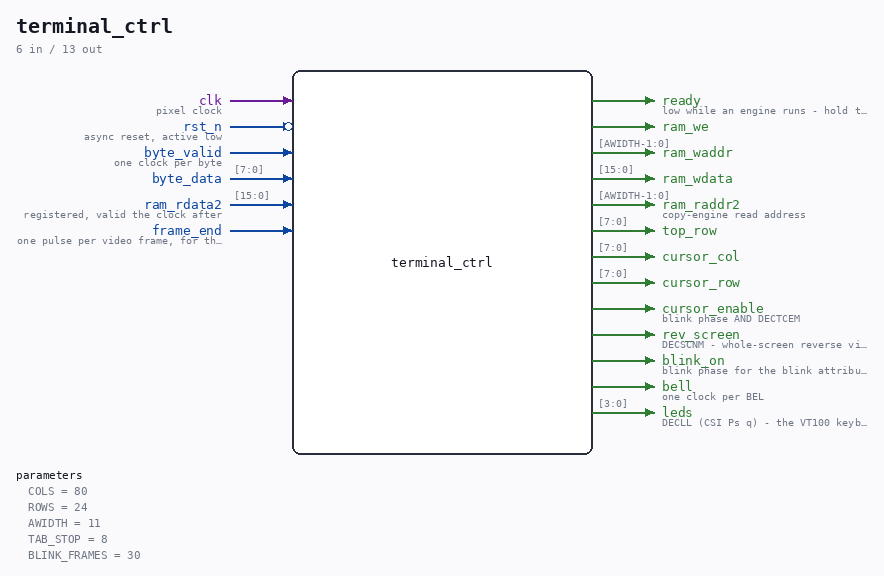
Schematic
Drawn from the Verilog: no build top uses this module, so it was elaborated from its own file with no defines and default parameters. Sub-modules are boxes (click the picture to open it full size; there every sub-module box links to its page, and every wire shows its Verilog name).

Parameters
| Parameter | Default |
|---|---|
COLS |
80 |
ROWS |
24 |
AWIDTH |
11 |
TAB_STOP |
8 |
BLINK_FRAMES |
30 |
Ports
| Direction | Width | Name | Description |
|---|---|---|---|
| input | 1 |
clk |
pixel clock |
| input | 1 |
rst_n (active low) |
async reset, active low |
| input | 1 |
byte_valid |
one clock per byte |
| input | [7:0] |
byte_data |
|
| output | 1 |
ready |
low while an engine runs - hold the source |
| output | 1 |
ram_we |
|
| output | [AWIDTH-1:0] |
ram_waddr |
|
| output | [15:0] |
ram_wdata |
|
| output | [AWIDTH-1:0] |
ram_raddr2 |
copy-engine read address |
| input | [15:0] |
ram_rdata2 |
registered, valid the clock after |
| output | [7:0] |
top_row |
|
| output | [7:0] |
cursor_col |
|
| output | [7:0] |
cursor_row |
|
| output | 1 |
cursor_enable |
blink phase AND DECTCEM |
| output | 1 |
rev_screen |
DECSCNM - whole-screen reverse video |
| output | 1 |
blink_on |
blink phase for the blink attribute |
| input | 1 |
frame_end |
one pulse per video frame, for the blink |
| output | 1 |
bell |
one clock per BEL |
| output | [3:0] |
leds |
DECLL (CSI Ps q) - the VT100 keyboard lamps L1-L4 |
Verilog source
Verilog/Terminals/rtl/terminal_ctrl.v on GitHub.
Show the Verilog of terminal_ctrl (914 lines)
//============================================================================
//! Terminal control - a VT100 (ANSI/ECMA-48 subset)
//!
//! Part of the board-independent terminal core (Verilog/Terminals/).
//! Plan: Verilog/Terminals/docs/PLAN-vt100-terminal-core.md
//!
//! Takes one byte at a time and turns it into character-RAM writes and cursor
//! movement. This is the terminal SINTRAN terminal type 6 (DEC-VT100)
//! expects.
//!
//! DECISION 30-AUG-2026 (Ronny): plain VT100, not TDV2200. The specification
//! source is RetroTerm ($ND_REPOS/RetroTerm, MIT, Ronny's own), whose
//! class hierarchy settles the relationship: TDV2200Emulator derives from the
//! same ECMA-48 core VT100Emulator is, and adds ND private CSI finals,
//! rectangles, work areas and nine character sets on top. We build the base.
//! The earlier TDV-native C0 build (FF=roll, EM=erase, DLE addressing) was
//! REMOVED with this rewrite - the C0 codes here have their ASCII meanings
//! again. If TDV2200 is ever wanted, it is a delta on this parser, not a
//! rewrite: route the ND finals (z u v ~ < { } | p q s t) and ND private
//! modes (40/66/67/68/69) out of the CSI dispatch below.
//!
//! What is implemented (verified against RetroTerm's TerminalEmulatorBase):
//!
//! C0: BEL BS HT LF VT FF CR SO SI, CAN/SUB abort a sequence,
//! ESC starts one. Everything else is dropped.
//! ESC: D (IND) E (NEL) M (RI) 7/8 (DECSC/DECRC) c (RIS)
//! = > (keypad modes, swallowed) H (HTS, swallowed - fixed 8 tabs)
//! ( ) * + <final> character-set designation: final '0' = DEC Special
//! Graphics, anything else = US ASCII. Only G0 ( '(' ) and G1 ( ')' )
//! are stored; G2/G3 designations are parsed and dropped.
//! CSI: A B C D (cursor, margin-aware) G (CHA) d (VPA)
//! H f (CUP, origin-aware) J (ED 0/1/2) K (EL 0/1/2)
//! m (SGR: 0 1 4 5 7 22 24 25 27) r (DECSTBM)
//! h l (modes - see below) q (DECLL, the four lamps)
//! Modes (CSI ? n h/l): 5 DECSCNM 6 DECOM 7 DECAWM 25 DECTCEM.
//! Unmarked mode 20 (LNM). Every other mode number is swallowed.
//!
//! Deliberately NOT implemented, and why:
//! - Reports (DA, DSR, CPR, ESC Z): they need a transmit path back to the
//! host, which this module does not have. SINTRAN does not probe - the
//! terminal type is configured (@SET-TERMINAL-TYPE n 6), not negotiated.
//! - IL/DL/ICH/DCH: VT102, not VT100.
//! - 132 columns, double-width/height, smooth scroll, tab set/clear.
//!
//! THE PARSER IS A STATE MACHINE, NOT A MATCHER. Escape sequences arrive
//! split across bytes as a matter of course (one byte per UART frame), so
//! there is never a whole sequence in a buffer to match against. The states
//! follow RetroTerm's EscapeSequenceParser.cs: GROUND -> ESC -> CSI, with
//! intermediates 0x20-0x2F collected, private markers 0x3C-0x3F flagged, a
//! final 0x40-0x7E dispatching. Rules that matter and are easy to lose:
//! - ESC inside any sequence abandons it and starts a new one.
//! - CAN (0x18) and SUB (0x1A) abandon the sequence, output nothing.
//! - An executable C0 (BS, CR, LF...) arriving INSIDE a sequence executes
//! without abandoning the sequence. Real hosts do this.
//! - A sequence with an intermediate byte we do not know is swallowed
//! whole, never printed.
//!
//! AUTOWRAP is the VT100's "last column flag": printing in column 79 sets a
//! pending-wrap flag instead of moving; the NEXT printable resolves it as
//! CR+LF (scrolling if needed) and then prints. Without this, every 80-column
//! line ends in a spurious blank line - the classic wrong-wrap bug. CUP and
//! friends clear the flag. Default ON: SINTRAN writes 80-column tables and
//! expects them to wrap.
//!
//! SCROLLING. With the scroll region covering the whole screen (the normal
//! state), scrolling moves the top-of-screen pointer `top_row` - one register
//! increment plus blanking the row that has come round. With a DECSTBM region
//! set, the ring trick cannot work (rows outside the region must not move),
//! so a copy engine moves the region row by row through the second RAM port:
//! two clocks per cell, 160 per row - a full 23-row region scroll is ~3.8k
//! clocks (~96 us at 40 MHz). `ready` is low throughout; terminal_top has a
//! FIFO in front of this module so a 115200 console cannot lose bytes to it.
//!
//! CELL LAYOUT written to the character RAM (text_screen.v reads it):
//! [7:0] character code [8] reverse [9] bold (stored, not drawn)
//! [10] underline [11] blink [12] DEC graphics charset
//! [15:13] reserved
//!
//! CLOCK DOMAIN: everything here runs on the pixel clock, the same as the
//! character RAM and the screen. Bytes cross into this domain BEFORE they
//! arrive here - see terminal_top.v.
//!
//! Rewritten 30-AUG-2026 (was the TDV-native C0 controller, 27-AUG-2026).
//============================================================================
`default_nettype none
module terminal_ctrl #(
parameter integer COLS = 80,
//! 80x24 is DEC VT100 geometry (RetroTerm EmulatorFactory.cs:197).
//! The earlier 25 was TDV 2200 geometry and left with the TDV build.
parameter integer ROWS = 24,
parameter integer AWIDTH = 11,
parameter integer TAB_STOP = 8,
//! Cursor/attribute blink period in frames. 30 frames at ~60 Hz ~ 1 Hz.
parameter integer BLINK_FRAMES = 30
) (
input wire clk, //! pixel clock
input wire rst_n, //! async reset, active low
// Byte in, already in this clock domain
input wire byte_valid, //! one clock per byte
input wire [7:0] byte_data,
output wire ready, //! low while an engine runs - hold the source
// Character RAM port A - write, plus the copy engine's read
output reg ram_we,
output reg [AWIDTH-1:0] ram_waddr,
output reg [ 15:0] ram_wdata,
output wire [AWIDTH-1:0] ram_raddr2, //! copy-engine read address
input wire [ 15:0] ram_rdata2, //! registered, valid the clock after
// Screen state, consumed by text_screen
output reg [7:0] top_row,
output reg [7:0] cursor_col,
output reg [7:0] cursor_row,
output wire cursor_enable, //! blink phase AND DECTCEM
output reg rev_screen, //! DECSCNM - whole-screen reverse video
output wire blink_on, //! blink phase for the blink attribute
input wire frame_end, //! one pulse per video frame, for the blink
output reg bell, //! one clock per BEL
output reg [3:0] leds //! DECLL (CSI Ps q) - the VT100 keyboard lamps L1-L4
);
localparam [15:0] BLANK_CELL = {8'h00, 8'h20}; //! space, no attributes
//--------------------------------------------------------------------------
// Engine states - multi-clock screen operations. `ready` is low outside RUN.
//--------------------------------------------------------------------------
localparam [2:0] ST_RUN = 3'd0;
localparam [2:0] ST_CLEAR = 3'd1; //! blank cells (r1,c1)..(r2,c2), screen coords
localparam [2:0] ST_COPY_RD = 3'd2; //! region scroll: read one cell
localparam [2:0] ST_COPY_WR = 3'd3; //! region scroll: write it one row over
localparam [2:0] ST_APPLY = 3'd4; //! walk SGR / mode / lamp parameters
reg [2:0] s_state;
//--------------------------------------------------------------------------
// Parser states - where we are inside an escape sequence
//--------------------------------------------------------------------------
localparam [1:0] P_GROUND = 2'd0;
localparam [1:0] P_ESC = 2'd1; //! ESC seen, awaiting the next byte
localparam [1:0] P_ESCINT = 2'd2; //! ESC + intermediate(s): ( ) * + #
localparam [1:0] P_CSI = 2'd3; //! inside ESC [
reg [1:0] p_state;
reg [7:0] s_par [0:3]; //! numeric parameters, saturating at 255
reg [2:0] s_npar; //! how many parameters have been started
reg s_priv; //! saw a private marker (0x3C-0x3F, e.g. '?')
reg s_ign; //! unknown intermediate - swallow to the final
reg [7:0] s_escint; //! the ESC intermediate byte itself
//--------------------------------------------------------------------------
// Terminal modes and rendition state
//--------------------------------------------------------------------------
reg s_origin; //! DECOM - cursor addressing relative to the region
reg s_autowrap; //! DECAWM - default ON, see the header
reg s_cursor_vis; //! DECTCEM
reg s_lnm; //! LNM - LF implies CR
reg [7:0] s_rtop; //! scroll region, screen rows, inclusive
reg [7:0] s_rbot;
reg s_at_rev, s_at_bold, s_at_ul, s_at_blink; //! current SGR state
reg s_shift; //! SO/SI: 0 = G0 active, 1 = G1 active
reg s_g0_gfx; //! G0 designated DEC Special Graphics (ESC ( 0)
reg s_g1_gfx; //! G1 designated DEC Special Graphics (ESC ) 0)
reg s_pending; //! the VT100 last-column flag (see header)
// DECSC/DECRC saved state
reg [7:0] s_sv_row, s_sv_col;
reg s_sv_rev, s_sv_bold, s_sv_ul, s_sv_blink;
reg s_sv_origin, s_sv_shift, s_sv_g0, s_sv_g1;
//! A printable held over while the wrap-triggered scroll runs; written the
//! moment the engine is idle again.
reg s_wr_hold;
reg [7:0] s_wr_char;
// Clear engine bounds, SCREEN coordinates, inclusive
reg [7:0] s_cl_row, s_cl_col, s_cl_erow, s_cl_ecol;
// Copy engine (region scroll)
reg [7:0] s_cp_dst; //! destination screen row this pass
reg [7:0] s_cp_col;
reg s_cp_down; //! 0 = scroll up (src = dst+1), 1 = down (src = dst-1)
// Parameter-apply engine. The four cursor moves also execute here, ONE
// CYCLE after their final byte - a timing fix, not a semantics change:
// synthesized at the 1080p pixel clock (139.7 MHz) the one-cycle path
// "byte decode -> margin mux -> 9-bit add -> clamp -> cursor_row" missed
// by 0.33 ns (first Vivado run of this file, 30-AUG-2026, worst path
// cursor_row_reg[2] -> cursor_row_reg[1]). Deferring the execute means the
// cursor registers are enabled from a REGISTERED kind, and the margins
// used are the REGISTERED ones below - the front half of that path is
// gone. Cost: one extra 7 ns cycle per cursor-move sequence.
localparam [3:0] AP_SGR = 4'd0;
localparam [3:0] AP_MODE = 4'd1;
localparam [3:0] AP_LED = 4'd2;
localparam [3:0] AP_CUU = 4'd3;
localparam [3:0] AP_CUD = 4'd4;
localparam [3:0] AP_CUF = 4'd5;
localparam [3:0] AP_CUB = 4'd6;
localparam [3:0] AP_CUP = 4'd7; //! CUP/HVP - row and column
localparam [3:0] AP_VPA = 4'd8;
localparam [3:0] AP_CHA = 4'd9;
reg [3:0] s_ap_kind;
reg [2:0] s_ap_idx;
reg s_ap_enable; //! for modes: 'h' = 1, 'l' = 0
reg s_ap_priv;
//! The deferred moves run in TWO apply cycles: first the operands are
//! latched out of the parameter array (s_par -> ap_n_q/ap_col_q is the
//! only logic in that cycle), then the move commits from the latched
//! operands. Round two of the 139.7 MHz work: after the first deferral
//! the one surviving violated endpoint (WNS -0.001 ns) was
//! s_par_reg[0][4] -> cursor_row_reg[3] - the parameter feeding the
//! CUP origin add directly. Deferring alone could not cut that cone,
//! because it starts at the parameter register, not at the byte decode;
//! latching the operand does.
reg s_ap_phase; //! 0 = latch operands, 1 = commit
reg [7:0] s_ap_n_q; //! par_or(s_par[0], 1), latched
reg [7:0] s_ap_col_q; //! par_or(s_par[1], 1), latched (CUP's column)
//! Cursor bounds, REGISTERED - one cycle behind their inputs, which is
//! exactly current at the commit cycle: neither the final byte nor the
//! operand-latch cycle moves the cursor or the region.
reg [7:0] s_floor_q; //! CUU stops here (region top if inside the region)
reg [7:0] s_ceil_q; //! CUD stops here
reg [7:0] s_ofloor_q; //! CUP/VPA origin: region top under DECOM, else 0
reg [7:0] s_oceil_q; //! CUP/VPA limit: region bottom under DECOM, else ROWS-1
assign ready = (s_state == ST_RUN) && !s_wr_hold;
//--------------------------------------------------------------------------
// Address arithmetic
//--------------------------------------------------------------------------
//! stored row for a given screen row = (top_row + screen_row) mod ROWS.
//! automatic, not the Verilog default: task and function locals are STATIC
//! unless you say otherwise, and this one is called from several places in
//! the same always block. Static locals shared between call sites are a
//! real synthesis hazard, not a style point.
function automatic [7:0] stored_row;
input [7:0] top;
input [7:0] screen;
reg [8:0] sum;
begin
sum = {1'b0, top} + {1'b0, screen};
stored_row = (sum >= ROWS) ? (sum[7:0] - ROWS[7:0]) : sum[7:0];
end
endfunction
//! address = row * COLS + col. COLS = 80 = 64 + 16, so two shifts and an add
//! - no multiplier inferred.
function automatic [AWIDTH-1:0] cell_addr;
input [7:0] row;
input [7:0] col;
begin
cell_addr = {row, 6'b0} + {row, 4'b0} + col;
end
endfunction
//! A CSI parameter with its default: 0 or absent means `dflt` (ECMA-48).
function automatic [7:0] par_or;
input [7:0] value;
input [7:0] dflt;
begin
par_or = (value == 8'd0) ? dflt : value;
end
endfunction
//! Accumulate one decimal digit into a parameter, saturating at 255 - a
//! host sending "CSI 999 A" must clamp, not wrap to a small number.
function automatic [7:0] dig_acc;
input [7:0] cur;
input [7:0] digit;
reg [11:0] wide;
begin
wide = {4'd0, cur} * 12'd10 + {8'd0, digit[3:0]};
dig_acc = (wide > 12'd255) ? 8'd255 : wide[7:0];
end
endfunction
//! The copy engine's source row: one below (scroll up) or above (down) the
//! destination, converted to a stored row here so the mapping through the
//! top_row ring is applied exactly once, in one place.
wire [7:0] s_cp_src = s_cp_down ? (s_cp_dst - 8'd1) : (s_cp_dst + 8'd1);
assign ram_raddr2 = cell_addr(stored_row(top_row, s_cp_src), s_cp_col);
//--------------------------------------------------------------------------
// Cursor / attribute blink - free-running off the frame pulse
//--------------------------------------------------------------------------
reg [7:0] s_blink_count;
reg s_blink_on;
always @(posedge clk or negedge rst_n) begin
if (!rst_n) begin
s_blink_count <= 8'd0;
s_blink_on <= 1'b1;
end else if (frame_end) begin
if (s_blink_count == BLINK_FRAMES - 1) begin
s_blink_count <= 8'd0;
s_blink_on <= ~s_blink_on;
end else begin
s_blink_count <= s_blink_count + 8'd1;
end
end
end
assign cursor_enable = s_blink_on && s_cursor_vis;
assign blink_on = s_blink_on;
//--------------------------------------------------------------------------
// The screen movers. Tasks because LF, RI, the wrap and CUP all need them
// and they are the fiddly part.
//--------------------------------------------------------------------------
//! Blank a rectangle of cells, screen coordinates, inclusive, row-major.
task automatic start_clear;
input [7:0] r1; input [7:0] c1;
input [7:0] r2; input [7:0] c2;
begin
s_cl_row <= r1;
s_cl_col <= c1;
s_cl_erow <= r2;
s_cl_ecol <= c2;
s_state <= ST_CLEAR;
end
endtask
//! Scroll the region up one line (text moves up, blank line at the bottom).
//! Full-screen region: rotate the ring and blank the row that came round.
//! Partial region: the copy engine, then blank the bottom region row.
task automatic scroll_up;
begin
if (s_rtop == 8'd0 && s_rbot == ROWS - 1) begin
top_row <= (top_row == ROWS - 1) ? 8'd0 : (top_row + 8'd1);
// top_row is updated this same edge, so next cycle's stored_row()
// already maps screen row ROWS-1 onto the vacated storage row.
start_clear(ROWS[7:0] - 8'd1, 8'd0, ROWS[7:0] - 8'd1, COLS[7:0] - 8'd1);
end else begin
s_cp_down <= 1'b0;
s_cp_dst <= s_rtop;
s_cp_col <= 8'd0;
s_state <= ST_COPY_RD;
end
end
endtask
//! Scroll the region down one line (text moves down, blank line at the top).
task automatic scroll_down;
begin
if (s_rtop == 8'd0 && s_rbot == ROWS - 1) begin
top_row <= (top_row == 8'd0) ? (ROWS[7:0] - 8'd1) : (top_row - 8'd1);
start_clear(8'd0, 8'd0, 8'd0, COLS[7:0] - 8'd1);
end else begin
s_cp_down <= 1'b1;
s_cp_dst <= s_rbot;
s_cp_col <= 8'd0;
s_state <= ST_COPY_RD;
end
end
endtask
//! Cursor down; at the region's bottom line this scrolls instead. Below the
//! region (possible with DECOM off) it stops at the screen edge - it must
//! never scroll a region the cursor is not in.
task automatic do_index;
begin
if (cursor_row == s_rbot) scroll_up;
else if (cursor_row < ROWS - 1) cursor_row <= cursor_row + 8'd1;
end
endtask
//! Cursor up; at the region's top line this scrolls down instead.
task automatic do_rev_index;
begin
if (cursor_row == s_rtop) scroll_down;
else if (cursor_row != 8'd0) cursor_row <= cursor_row - 8'd1;
end
endtask
//! Write one printable at the cursor and advance. Printing in the LAST
//! column sets the pending-wrap flag instead of moving - the VT100 rule.
task automatic put_char;
input [7:0] ch;
begin
ram_we <= 1'b1;
ram_waddr <= cell_addr(stored_row(top_row, cursor_row), cursor_col);
ram_wdata <= {3'b000, (s_shift ? s_g1_gfx : s_g0_gfx),
s_at_blink, s_at_ul, s_at_bold, s_at_rev, ch};
if (cursor_col == COLS - 1) begin
if (s_autowrap) s_pending <= 1'b1;
end else begin
cursor_col <= cursor_col + 8'd1;
end
end
endtask
//! Everything RIS resets and power-up starts from. The screen clear itself
//! is started by the caller.
task automatic reset_modes;
begin
top_row <= 8'd0;
cursor_col <= 8'd0;
cursor_row <= 8'd0;
s_rtop <= 8'd0;
s_rbot <= ROWS[7:0] - 8'd1;
s_origin <= 1'b0;
s_autowrap <= 1'b1; // see the header - deliberate, not the manual default
s_cursor_vis <= 1'b1;
s_lnm <= 1'b0;
rev_screen <= 1'b0;
s_at_rev <= 1'b0;
s_at_bold <= 1'b0;
s_at_ul <= 1'b0;
s_at_blink <= 1'b0;
s_shift <= 1'b0;
s_g0_gfx <= 1'b0;
s_g1_gfx <= 1'b0;
s_pending <= 1'b0;
leds <= 4'b0000;
p_state <= P_GROUND;
end
endtask
//--------------------------------------------------------------------------
// CSI final dispatch - one task so the byte-intake case stays readable
//--------------------------------------------------------------------------
task automatic dispatch_csi;
input [7:0] fin;
reg [7:0] t, b;
begin
// (All cursor-move arithmetic lives in ST_APPLY, off registered
// operands and registered bounds - the 139.7 MHz work. Nothing here
// touches cursor_row/cursor_col except through engine starts.)
case (fin)
// Every cursor move executes in ST_APPLY, two cycles after its
// final byte - see the AP_* localparams for why (139.7 MHz).
"A": begin s_pending <= 1'b0; s_ap_kind <= AP_CUU; s_ap_phase <= 1'b0; s_state <= ST_APPLY; end
"B": begin s_pending <= 1'b0; s_ap_kind <= AP_CUD; s_ap_phase <= 1'b0; s_state <= ST_APPLY; end
"C": begin s_pending <= 1'b0; s_ap_kind <= AP_CUF; s_ap_phase <= 1'b0; s_state <= ST_APPLY; end
"D": begin s_pending <= 1'b0; s_ap_kind <= AP_CUB; s_ap_phase <= 1'b0; s_state <= ST_APPLY; end
"G": begin s_pending <= 1'b0; s_ap_kind <= AP_CHA; s_ap_phase <= 1'b0; s_state <= ST_APPLY; end
"d": begin s_pending <= 1'b0; s_ap_kind <= AP_VPA; s_ap_phase <= 1'b0; s_state <= ST_APPLY; end
"H", "f": begin
s_pending <= 1'b0; s_ap_kind <= AP_CUP; s_ap_phase <= 1'b0; s_state <= ST_APPLY;
end
"J": begin // ED - erase in display. Does NOT move the cursor.
s_pending <= 1'b0;
case (s_par[0])
8'd1: start_clear(8'd0, 8'd0, cursor_row, cursor_col);
8'd2: start_clear(8'd0, 8'd0, ROWS[7:0] - 8'd1, COLS[7:0] - 8'd1);
default: start_clear(cursor_row, cursor_col,
ROWS[7:0] - 8'd1, COLS[7:0] - 8'd1);
endcase
end
"K": begin // EL - erase in line
s_pending <= 1'b0;
case (s_par[0])
8'd1: start_clear(cursor_row, 8'd0, cursor_row, cursor_col);
8'd2: start_clear(cursor_row, 8'd0, cursor_row, COLS[7:0] - 8'd1);
default: start_clear(cursor_row, cursor_col,
cursor_row, COLS[7:0] - 8'd1);
endcase
end
"m", "h", "l", "q": begin // SGR / SM / RM / DECLL - walk the list
s_ap_kind <= (fin == "m") ? AP_SGR : (fin == "q") ? AP_LED : AP_MODE;
s_ap_enable <= (fin == "h");
s_ap_priv <= s_priv;
s_ap_idx <= 3'd0;
// No parameters at all still means one default parameter (SGR 0
// resets, DECLL 0 clears) - ECMA-48's omitted-parameter rule.
if (s_npar == 3'd0) s_npar <= 3'd1; // s_par[0] is already 0
s_state <= ST_APPLY;
end
"r": begin // DECSTBM - set region, home the cursor (origin-aware)
t = par_or(s_par[0], 8'd1);
b = par_or(s_par[1], ROWS[7:0]);
if (t < b && b <= ROWS) begin
s_rtop <= t - 8'd1;
s_rbot <= b - 8'd1;
cursor_row <= s_origin ? (t - 8'd1) : 8'd0;
cursor_col <= 8'd0;
s_pending <= 1'b0;
end
end
default: ; // unknown final - swallowed, never printed
endcase
end
endtask
//--------------------------------------------------------------------------
// Main sequencer
//--------------------------------------------------------------------------
always @(posedge clk or negedge rst_n) begin
if (!rst_n) begin
// Power-up: blank the whole screen. On a real FPGA the character RAM
// holds whatever the tool loaded, so this is not optional.
s_state <= ST_CLEAR;
s_cl_row <= 8'd0;
s_cl_col <= 8'd0;
s_cl_erow <= ROWS[7:0] - 8'd1;
s_cl_ecol <= COLS[7:0] - 8'd1;
ram_we <= 1'b0;
ram_waddr <= {AWIDTH{1'b0}};
ram_wdata <= BLANK_CELL;
bell <= 1'b0;
s_wr_hold <= 1'b0;
s_wr_char <= 8'd0;
s_npar <= 3'd0;
s_priv <= 1'b0;
s_ign <= 1'b0;
s_escint <= 8'd0;
s_par[0] <= 8'd0; s_par[1] <= 8'd0; s_par[2] <= 8'd0; s_par[3] <= 8'd0;
s_cp_dst <= 8'd0; s_cp_col <= 8'd0; s_cp_down <= 1'b0;
s_ap_kind <= AP_SGR; s_ap_idx <= 3'd0;
s_ap_enable <= 1'b0; s_ap_priv <= 1'b0;
s_ap_phase <= 1'b0; s_ap_n_q <= 8'd1; s_ap_col_q <= 8'd1;
s_floor_q <= 8'd0; s_ceil_q <= ROWS[7:0] - 8'd1;
s_ofloor_q <= 8'd0; s_oceil_q <= ROWS[7:0] - 8'd1;
s_sv_row <= 8'd0; s_sv_col <= 8'd0;
s_sv_rev <= 1'b0; s_sv_bold <= 1'b0; s_sv_ul <= 1'b0; s_sv_blink <= 1'b0;
s_sv_origin <= 1'b0; s_sv_shift <= 1'b0; s_sv_g0 <= 1'b0; s_sv_g1 <= 1'b0;
reset_modes;
end else begin
// Defaults - overridden below where something actually happens.
ram_we <= 1'b0;
bell <= 1'b0;
// Cursor bounds for the deferred moves - see the AP_* note above.
s_floor_q <= (cursor_row >= s_rtop) ? s_rtop : 8'd0;
s_ceil_q <= (cursor_row <= s_rbot) ? s_rbot : (ROWS[7:0] - 8'd1);
s_ofloor_q <= s_origin ? s_rtop : 8'd0;
s_oceil_q <= s_origin ? s_rbot : (ROWS[7:0] - 8'd1);
case (s_state)
//--------------------------------------------------------------------
ST_CLEAR: begin
ram_we <= 1'b1;
ram_waddr <= cell_addr(stored_row(top_row, s_cl_row), s_cl_col);
ram_wdata <= BLANK_CELL;
if (s_cl_row == s_cl_erow && s_cl_col == s_cl_ecol) begin
s_state <= ST_RUN;
end else if (s_cl_col == COLS - 1) begin
s_cl_col <= 8'd0;
s_cl_row <= s_cl_row + 8'd1;
end else begin
s_cl_col <= s_cl_col + 8'd1;
end
end
//--------------------------------------------------------------------
// Region scroll: read src cell this clock, write it to dst the next.
// Two clocks per cell; see the header for the arithmetic.
//--------------------------------------------------------------------
ST_COPY_RD: begin
// ram_raddr2 is combinational from s_cp_dst/s_cp_col; the RAM
// registers the read on this edge, so rdata2 is valid in COPY_WR.
s_state <= ST_COPY_WR;
end
ST_COPY_WR: begin
ram_we <= 1'b1;
ram_waddr <= cell_addr(stored_row(top_row, s_cp_dst), s_cp_col);
ram_wdata <= ram_rdata2;
if (s_cp_col != COLS - 1) begin
s_cp_col <= s_cp_col + 8'd1;
s_state <= ST_COPY_RD;
end else begin
s_cp_col <= 8'd0;
if (!s_cp_down) begin
// Scrolling up: rows walk rtop..rbot-1, then blank rbot.
if (s_cp_dst == s_rbot - 1) begin
start_clear(s_rbot, 8'd0, s_rbot, COLS[7:0] - 8'd1);
end else begin
s_cp_dst <= s_cp_dst + 8'd1;
s_state <= ST_COPY_RD;
end
end else begin
// Scrolling down: rows walk rbot..rtop+1, then blank rtop.
if (s_cp_dst == s_rtop + 1) begin
start_clear(s_rtop, 8'd0, s_rtop, COLS[7:0] - 8'd1);
end else begin
s_cp_dst <= s_cp_dst - 8'd1;
s_state <= ST_COPY_RD;
end
end
end
end
//--------------------------------------------------------------------
// Walk the parameter list of SGR / SM / RM / DECLL, one per clock -
// and execute the deferred cursor moves (see the AP_* note). The
// moves clamp margin-aware: a cursor inside the DECSTBM region is
// confined to it, one outside to the screen (RetroTerm
// MoveCursor*WithinMargins) - via the registered bounds.
//--------------------------------------------------------------------
ST_APPLY: begin : apply
reg [8:0] ap_sum;
if (s_ap_kind >= AP_CUU) begin
// A deferred cursor move. Phase 0 latches the operands - the
// ONLY logic between s_par and a register that cycle - and
// phase 1 commits from registers alone.
if (!s_ap_phase) begin
s_ap_n_q <= par_or(s_par[0], 8'd1);
s_ap_col_q <= par_or(s_par[1], 8'd1);
s_ap_phase <= 1'b1;
end else begin
s_state <= ST_RUN;
case (s_ap_kind)
AP_CUU: cursor_row <=
({1'b0, cursor_row} > {1'b0, s_floor_q} + {1'b0, s_ap_n_q})
? (cursor_row - s_ap_n_q) : s_floor_q;
AP_CUD: begin
ap_sum = {1'b0, cursor_row} + {1'b0, s_ap_n_q};
cursor_row <= (ap_sum < {1'b0, s_ceil_q}) ? ap_sum[7:0] : s_ceil_q;
end
AP_CUF: begin
ap_sum = {1'b0, cursor_col} + {1'b0, s_ap_n_q};
cursor_col <= (ap_sum < COLS - 1) ? ap_sum[7:0] : (COLS[7:0] - 8'd1);
end
AP_CUB: cursor_col <=
({1'b0, cursor_col} > {1'b0, s_ap_n_q})
? (cursor_col - s_ap_n_q) : 8'd0;
AP_CHA: cursor_col <=
(s_ap_n_q <= COLS) ? (s_ap_n_q - 8'd1) : (COLS[7:0] - 8'd1);
AP_VPA: begin
ap_sum = {1'b0, s_ofloor_q} + {1'b0, s_ap_n_q} - 9'd1;
cursor_row <= (ap_sum < {1'b0, s_oceil_q}) ? ap_sum[7:0] : s_oceil_q;
end
AP_CUP: begin
ap_sum = {1'b0, s_ofloor_q} + {1'b0, s_ap_n_q} - 9'd1;
cursor_row <= (ap_sum < {1'b0, s_oceil_q}) ? ap_sum[7:0] : s_oceil_q;
cursor_col <= (s_ap_col_q <= COLS) ? (s_ap_col_q - 8'd1)
: (COLS[7:0] - 8'd1);
end
default: ;
endcase
end
end else if (s_ap_idx >= s_npar) begin
s_state <= ST_RUN;
end else begin
s_ap_idx <= s_ap_idx + 3'd1;
case (s_ap_kind)
AP_SGR: begin
case (s_par[s_ap_idx[1:0]])
8'd0: begin
s_at_rev <= 1'b0; s_at_bold <= 1'b0;
s_at_ul <= 1'b0; s_at_blink <= 1'b0;
end
8'd1: s_at_bold <= 1'b1;
8'd4: s_at_ul <= 1'b1;
8'd5: s_at_blink <= 1'b1;
8'd7: s_at_rev <= 1'b1;
8'd22: s_at_bold <= 1'b0;
8'd24: s_at_ul <= 1'b0;
8'd25: s_at_blink <= 1'b0;
8'd27: s_at_rev <= 1'b0;
default: ; // 2 (dim), colours, the rest: swallowed
endcase
end
AP_MODE: begin
if (s_ap_priv) begin
case (s_par[s_ap_idx[1:0]])
8'd5: rev_screen <= s_ap_enable; // DECSCNM
8'd6: begin // DECOM - homes cursor
s_origin <= s_ap_enable;
cursor_row <= s_ap_enable ? s_rtop : 8'd0;
cursor_col <= 8'd0;
s_pending <= 1'b0;
end
8'd7: begin // DECAWM
s_autowrap <= s_ap_enable;
if (!s_ap_enable) s_pending <= 1'b0;
end
8'd25: s_cursor_vis <= s_ap_enable; // DECTCEM
default: ; // ?1 ?3 ?4 ?8 ... swallowed
endcase
end else begin
case (s_par[s_ap_idx[1:0]])
8'd20: s_lnm <= s_ap_enable; // LNM
default: ;
endcase
end
end
AP_LED: begin
case (s_par[s_ap_idx[1:0]])
8'd0: leds <= 4'b0000;
8'd1: leds[0] <= 1'b1;
8'd2: leds[1] <= 1'b1;
8'd3: leds[2] <= 1'b1;
8'd4: leds[3] <= 1'b1;
default: ;
endcase
end
default: ;
endcase
end
end
//--------------------------------------------------------------------
ST_RUN: begin
if (s_wr_hold) begin
// The printable that triggered a wrap, now that the scroll it
// caused has finished. Column is already 0.
s_wr_hold <= 1'b0;
put_char(s_wr_char);
end else if (byte_valid) begin
//----------------------------------------------------------------
// C0 controls first. Executable ones act WITHOUT abandoning a
// sequence in progress; CAN/SUB abandon it; ESC restarts it.
//----------------------------------------------------------------
if (byte_data < 8'h20) begin
case (byte_data)
8'h07: bell <= 1'b1; // BEL
8'h08: begin // BS
s_pending <= 1'b0;
if (cursor_col != 0) cursor_col <= cursor_col - 8'd1;
end
8'h09: begin // HT
// Next multiple of TAB_STOP, stopping at the right margin.
// (The old form jumped from column 71 straight to 79 - the
// comparison ran on the CURRENT column, not the next stop.)
s_pending <= 1'b0;
if (((cursor_col / TAB_STOP) + 8'd1) * TAB_STOP >= COLS)
cursor_col <= COLS[7:0] - 8'd1;
else
cursor_col <= ((cursor_col / TAB_STOP) + 8'd1) * TAB_STOP;
end
8'h0A, 8'h0B, 8'h0C: begin // LF VT FF
s_pending <= 1'b0;
if (s_lnm) cursor_col <= 8'd0;
do_index;
end
8'h0D: begin // CR
s_pending <= 1'b0;
cursor_col <= 8'd0;
end
8'h0E: s_shift <= 1'b1; // SO -> G1
8'h0F: s_shift <= 1'b0; // SI -> G0
8'h18, 8'h1A: p_state <= P_GROUND; // CAN SUB
8'h1B: begin // ESC
p_state <= P_ESC;
s_npar <= 3'd0;
s_priv <= 1'b0;
s_ign <= 1'b0;
s_par[0] <= 8'd0; s_par[1] <= 8'd0;
s_par[2] <= 8'd0; s_par[3] <= 8'd0;
end
default: ; // NUL, ENQ, the TDV lamp codes... all dropped
endcase
end else begin
case (p_state)
//------------------------------------------------------------
P_GROUND: begin
if (byte_data < 8'h7F) begin
if (s_pending && s_autowrap) begin
// Resolve the last-column flag: CR + LF now, print after
// the scroll (if any) has run.
s_pending <= 1'b0;
cursor_col <= 8'd0;
s_wr_hold <= 1'b1;
s_wr_char <= byte_data;
do_index;
end else begin
put_char(byte_data);
end
end
// 0x7F DEL and 0x80-0xFF: dropped. The ND-120 is a 7-bit
// machine; a high bit here is line noise, not a character.
end
//------------------------------------------------------------
P_ESC: begin
p_state <= P_GROUND; // every arm below that stays is explicit
case (byte_data)
"[": begin
p_state <= P_CSI;
end
8'h20, "#", "(", ")", "*", "+", "%": begin
s_escint <= byte_data;
p_state <= P_ESCINT;
end
"D": begin s_pending <= 1'b0; do_index; end // IND
"E": begin // NEL
s_pending <= 1'b0;
cursor_col <= 8'd0;
do_index;
end
"M": begin s_pending <= 1'b0; do_rev_index; end // RI
"7": begin // DECSC
s_sv_row <= cursor_row;
s_sv_col <= cursor_col;
s_sv_rev <= s_at_rev;
s_sv_bold <= s_at_bold;
s_sv_ul <= s_at_ul;
s_sv_blink <= s_at_blink;
s_sv_origin <= s_origin;
s_sv_shift <= s_shift;
s_sv_g0 <= s_g0_gfx;
s_sv_g1 <= s_g1_gfx;
end
"8": begin // DECRC
cursor_row <= s_sv_row;
cursor_col <= s_sv_col;
s_at_rev <= s_sv_rev;
s_at_bold <= s_sv_bold;
s_at_ul <= s_sv_ul;
s_at_blink <= s_sv_blink;
s_origin <= s_sv_origin;
s_shift <= s_sv_shift;
s_g0_gfx <= s_sv_g0;
s_g1_gfx <= s_sv_g1;
s_pending <= 1'b0;
end
"c": begin // RIS
reset_modes;
start_clear(8'd0, 8'd0, ROWS[7:0] - 8'd1, COLS[7:0] - 8'd1);
end
// '=' '>' keypad modes, 'H' HTS, 'Z' DECID, 'N' 'O' SS2/3,
// 'n' 'o' LS2/3 and anything unknown: swallowed.
default: ;
endcase
end
//------------------------------------------------------------
// ESC + intermediate. Character-set designation is the one
// that matters: final '0' = DEC Special Graphics (the VT100
// line-drawing set the SINTRAN full-screen tools use for
// boxes - PED's init sends ESC ) 0). Everything else, incl.
// ESC # line sizes, is parsed and dropped.
//------------------------------------------------------------
P_ESCINT: begin
if (byte_data >= 8'h20 && byte_data <= 8'h2F) begin
s_escint <= byte_data; // keep the LAST intermediate
end else begin
p_state <= P_GROUND;
case (s_escint)
"(": s_g0_gfx <= (byte_data == "0");
")": s_g1_gfx <= (byte_data == "0");
default: ; // * + (G2/G3), # (line size), % : dropped
endcase
end
end
//------------------------------------------------------------
P_CSI: begin
if (byte_data >= "0" && byte_data <= "9") begin
if (s_npar == 3'd0) begin
s_npar <= 3'd1;
s_par[0] <= dig_acc(s_par[0], byte_data);
end else if (s_npar <= 3'd4) begin
s_par[s_npar[1:0] - 2'd1]
<= dig_acc(s_par[s_npar[1:0] - 2'd1], byte_data);
end
end else if (byte_data == ";") begin
if (s_npar == 3'd0) s_npar <= 3'd2; // leading ';' = omitted first
else if (s_npar < 3'd4) s_npar <= s_npar + 3'd1;
else s_ign <= 1'b1; // more than 4 parameters - swallow
end else if (byte_data >= 8'h3C && byte_data <= 8'h3F) begin
s_priv <= 1'b1; // '<' '=' '>' '?'
end else if (byte_data >= 8'h20 && byte_data <= 8'h2F) begin
s_ign <= 1'b1; // intermediate we know nothing about
end else if (byte_data >= 8'h40 && byte_data <= 8'h7E) begin
p_state <= P_GROUND;
if (!s_ign) dispatch_csi(byte_data);
end else begin
p_state <= P_GROUND; // 0x7F or garbage - abandon
end
end
default: p_state <= P_GROUND;
endcase
end
end
end
//--------------------------------------------------------------------
default: s_state <= ST_RUN;
endcase
end
end
endmodule
`default_nettype wire