key_tdv2200
Source: Verilog/Terminals/rtl/key_tdv2200.v
Where it sits (Nexys): nd120_nexys4ddr_top > key_tdv2200
- instance path: KEYEXP
Used in: nd120_console_mega65 (MEGA65 R6, MEGA65 R3), nd120_console_mister (MiSTer), nd120_nexys4ddr_top (Nexys)
Contains: no other modules.
Module hierarchy - All modules
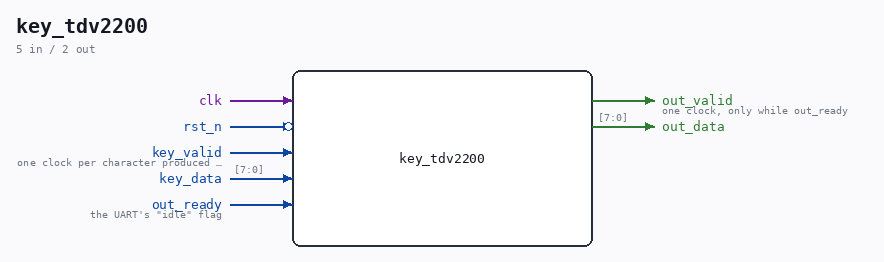
Schematic
Drawn from the Verilog: the yosys netlist of the Nexys 4 DDR build, instance KEYEXP. Sub-modules are boxes (click the picture to open it full size; there every sub-module box links to its page, and every wire shows its Verilog name).

Ports
| Direction | Width | Name | Description |
|---|---|---|---|
| input | 1 |
clk |
|
| input | 1 |
rst_n (active low) |
|
| input | 1 |
key_valid |
one clock per character produced (from ps2_decoder_tdv.ascii_valid) |
| input | [7:0] |
key_data |
|
| output | 1 |
out_valid |
one clock, only while out_ready |
| output | [7:0] |
out_data |
|
| input | 1 |
out_ready |
the UART's "idle" flag |
Verilog source
Verilog/Terminals/rtl/key_tdv2200.v on GitHub.
Show the Verilog of key_tdv2200 (209 lines)
//============================================================================
//! TDV2200 key-sequence expander - markers in, wire bytes out
//!
//! Part of the board-independent terminal core (Verilog/Terminals/).
//! Sibling of key_vt100.v. Ordinary bytes (including the TDV's bare C0
//! cursor/Home/Delete codes - see ps2_ascii_table_tdv.v) pass through
//! unchanged; a SEQUENCE MARKER (bit 7 set) becomes a wire byte sequence.
//! TWO marker families, distinguished by range (see ps2_ascii_table_tdv.v's
//! header for exactly how each marker value is chosen):
//!
//!   0x80-0xC3   ESC [ <2-digit n> _   the F-key/registry family (shift =
//!               n+1), always exactly 4 bytes after ESC, zero-padded.
//!   0xC4-0xDC   Alt+key application/editing shortcuts - each marker has
//!               its OWN fixed byte sequence (4 to 5 bytes after ESC; the
//!               PUSH-key family runs to 5, including an EMBEDDED ESC as
//!               plain data mid-sequence, harmless - the FIFO just moves
//!               bytes, it never re-parses them).
//!
//! Same FIFO/handshake reasoning as key_vt100.v: the UART needs ~870 us per
//! byte at 115200-8N1 and this expander hands it up to 6 at once now (ESC +
//! up to 5), which is why the queue grew from 4 lookahead registers to 5.
//!
//! Written 31-AUG-2026.
//============================================================================

`default_nettype none

module key_tdv2200 (
    input wire clk,
    input wire rst_n,

    // From the keyboard decoder - strobes, no backpressure
    input wire       key_valid,   //! one clock per character produced (from ps2_decoder_tdv.ascii_valid)
    input wire [7:0] key_data,

    // To the console UART TX
    output reg        out_valid,  //! one clock, only while out_ready
    output reg  [7:0] out_data,
    input  wire       out_ready   //! the UART's "idle" flag
);

  localparam [7:0] ESC = 8'h1B;

  //! The ESC[nn_ family's marker is 8'h80|n; n runs up to 86 in the
  //! registry (NEWPARA) and Insert alone already uses 82 (marker 0xD2) -
  //! NOT capped at 67. Everything from 0xE0 up is the Alt+key family
  //! instead (ps2_ascii_table_tdv.v's ALTM_* localparams), chosen with
  //! headroom past the highest n-based marker in use. key_data[7] alone
  //! (used by key_vt100.v's sibling logic) is not enough here because
  //! there are now two DIFFERENT marker shapes sharing the bit7 flag.
  localparam [7:0] ALT_BASE = 8'hE0;

  //--------------------------------------------------------------------------
  // The FIFO - 16 bytes, pointers one bit wider than the index so full and
  // empty are distinct (same construction as byte_fifo.v / key_vt100.v).
  //--------------------------------------------------------------------------
  reg [7:0] s_mem[0:15];
  reg [4:0] s_wptr, s_rptr;

  wire s_empty = (s_wptr == s_rptr);
  wire s_full  = (s_wptr[4] != s_rptr[4]) && (s_wptr[3:0] == s_rptr[3:0]);

  //--------------------------------------------------------------------------
  // Push side - expands a marker over up to 5 clocks: ESC now, up to 5 more
  // bytes lined up in s_q0..s_q4 for the next PU_SEQ cycles, s_len says how
  // many of them are real (4 for the ESC[nn_ family, 4 or 5 for Alt+key).
  //--------------------------------------------------------------------------
  localparam PU_IDLE = 1'b0;
  localparam PU_SEQ  = 1'b1;

  reg       s_push;
  reg [7:0] s_q0, s_q1, s_q2, s_q3, s_q4;
  reg [2:0] s_idx;
  reg [2:0] s_len;

  //! ESC[nn_ family: n is 0..67 by construction (bits[6:0] of the marker
  //! when it is below ALT_BASE); always two ASCII decimal digits,
  //! zero-padded.
  wire [6:0] s_n    = key_data[6:0];
  wire [7:0] s_tens = "0" + (s_n / 7'd10);
  wire [7:0] s_ones = "0" + (s_n % 7'd10);

  //--------------------------------------------------------------------------
  // Pop side - one UART handshake at a time (identical contract/timing to
  // key_vt100.v - see that file's header for the full reasoning).
  //--------------------------------------------------------------------------
  localparam [1:0] PO_IDLE = 2'd0;
  localparam [1:0] PO_TAKE = 2'd1;

  reg [1:0] s_pop;
  reg       s_po_seen;

  always @(posedge clk or negedge rst_n) begin
    if (!rst_n) begin
      s_wptr    <= 5'd0;
      s_rptr    <= 5'd0;
      s_push    <= PU_IDLE;
      s_q0 <= 8'd0; s_q1 <= 8'd0; s_q2 <= 8'd0; s_q3 <= 8'd0; s_q4 <= 8'd0;
      s_idx     <= 3'd0;
      s_len     <= 3'd0;
      s_pop     <= PO_IDLE;
      out_valid <= 1'b0;
      out_data  <= 8'd0;
    end else begin
      out_valid <= 1'b0;

      // ---- push ----
      case (s_push)
        PU_IDLE: begin
          if (key_valid && !s_full) begin
            if (!key_data[7]) begin
              s_mem[s_wptr[3:0]] <= key_data;
              s_wptr <= s_wptr + 5'd1;
            end else if (key_data < ALT_BASE) begin
              // ESC[nn_ family - see the header.
              s_mem[s_wptr[3:0]] <= ESC;
              s_wptr <= s_wptr + 5'd1;
              s_push <= PU_SEQ;
              s_idx  <= 3'd0;
              s_len  <= 3'd4;
              s_q0   <= "[";
              s_q1   <= s_tens;
              s_q2   <= s_ones;
              s_q3   <= "_";
            end else begin
              // Alt+key family - each marker's own fixed sequence.
              s_mem[s_wptr[3:0]] <= ESC;
              s_wptr <= s_wptr + 5'd1;
              // Default to staying idle (ESC alone, nothing queued) so an
              // unrecognised marker can never leave s_len at 0 while
              // s_push sits in PU_SEQ - "s_idx == s_len-1" would wrap
              // 3'd0-1 to 3'd7 and PU_SEQ would never see it, pushing
              // garbage until the FIFO fills. Every real case below
              // overrides both.
              s_push <= PU_IDLE;
              s_idx  <= 3'd0;
              case (key_data)
                8'hE0: begin s_push<=PU_SEQ; s_len<=3'd4; s_q0<="["; s_q1<="4"; s_q2<="6"; s_q3<="_"; end            // Alt+H HELP -> HJELP ESC[46_
                8'hE1: begin s_push<=PU_SEQ; s_len<=3'd4; s_q0<="["; s_q1<="2"; s_q2<="9"; s_q3<="~"; end            // Alt+D DO (user-specified)
                8'hE2: begin s_push<=PU_SEQ; s_len<=3'd4; s_q0<="["; s_q1<="4"; s_q2<="2"; s_q3<="_"; end            // Alt+U FUNC -> FUNK ESC[42_
                8'hE3: begin s_push<=PU_SEQ; s_len<=3'd4; s_q0<="["; s_q1<="4"; s_q2<="8"; s_q3<="_"; end            // Alt+X EXIT -> SLUTT ESC[48_
                8'hE4: begin s_push<=PU_SEQ; s_len<=3'd4; s_q0<="["; s_q1<="3"; s_q2<="0"; s_q3<="_"; end            // Alt+C CANCEL -> ANGRE ESC[30_
                8'hE5: begin s_push<=PU_SEQ; s_len<=3'd4; s_q0<="["; s_q1<="2"; s_q2<="6"; s_q3<="~"; end            // Alt+M COMMAND (user-specified)
                8'hE6: begin s_push<=PU_SEQ; s_len<=3'd5; s_q0<="["; s_q1<="1"; s_q2<=";"; s_q3<="2"; s_q4<="R"; end // Alt+F FIND (user-specified)
                8'hE7: begin s_push<=PU_SEQ; s_len<=3'd5; s_q0<="["; s_q1<="4"; s_q2<=";"; s_q3<="2"; s_q4<="~"; end // Alt+S SELECT (user-specified)
                8'hE8: begin s_push<=PU_SEQ; s_len<=3'd4; s_q0<="["; s_q1<="1"; s_q2<="2"; s_q3<="_"; end            // Alt+K COPY -> KOPI ESC[12_
                8'hE9: begin s_push<=PU_SEQ; s_len<=3'd4; s_q0<="["; s_q1<="1"; s_q2<="4"; s_q3<="_"; end            // Alt+V MOVE -> FLYTT ESC[14_
                8'hEA: begin s_push<=PU_SEQ; s_len<=3'd4; s_q0<="["; s_q1<="2"; s_q2<="4"; s_q3<="_"; end            // Alt+J JUST ESC[24_
                8'hEB: begin s_push<=PU_SEQ; s_len<=3'd4; s_q0<="["; s_q1<="0"; s_q2<="0"; s_q3<="_"; end            // Alt+A MARK -> MERK ESC[00_
                8'hEC: begin s_push<=PU_SEQ; s_len<=3'd4; s_q0<="["; s_q1<="0"; s_q2<="2"; s_q3<="_"; end            // Alt+L FIELD -> FELT ESC[02_
                8'hED: begin s_push<=PU_SEQ; s_len<=3'd4; s_q0<="["; s_q1<="0"; s_q2<="4"; s_q3<="_"; end            // Alt+P PARA -> AVSH ESC[04_
                8'hEE: begin s_push<=PU_SEQ; s_len<=3'd4; s_q0<="["; s_q1<="0"; s_q2<="6"; s_q3<="_"; end            // Alt+E SENT -> SETN ESC[06_
                8'hEF: begin s_push<=PU_SEQ; s_len<=3'd4; s_q0<="["; s_q1<="0"; s_q2<="8"; s_q3<="_"; end            // Alt+W WORD -> ORD ESC[08_
                8'hF0: begin s_push<=PU_SEQ; s_len<=3'd4; s_q0<="["; s_q1<="8"; s_q2<="2"; s_q3<="_"; end            // Alt+I INSERT HERE -> INNS/EXPS ESC[82_ (approximate)
                // PUSH1-8 (Alt+1..Alt+8): "ESC P N<digit> ESC \" - user-specified,
                // unconfirmed (registry: PUSH keys have no fixed sequence at all).
                8'hF1: begin s_push<=PU_SEQ; s_len<=3'd5; s_q0<="P"; s_q1<="N"; s_q2<="1"; s_q3<=ESC; s_q4<=8'h5C; end
                8'hF2: begin s_push<=PU_SEQ; s_len<=3'd5; s_q0<="P"; s_q1<="N"; s_q2<="2"; s_q3<=ESC; s_q4<=8'h5C; end
                8'hF3: begin s_push<=PU_SEQ; s_len<=3'd5; s_q0<="P"; s_q1<="N"; s_q2<="3"; s_q3<=ESC; s_q4<=8'h5C; end
                8'hF4: begin s_push<=PU_SEQ; s_len<=3'd5; s_q0<="P"; s_q1<="N"; s_q2<="4"; s_q3<=ESC; s_q4<=8'h5C; end
                8'hF5: begin s_push<=PU_SEQ; s_len<=3'd5; s_q0<="P"; s_q1<="N"; s_q2<="5"; s_q3<=ESC; s_q4<=8'h5C; end
                8'hF6: begin s_push<=PU_SEQ; s_len<=3'd5; s_q0<="P"; s_q1<="N"; s_q2<="6"; s_q3<=ESC; s_q4<=8'h5C; end
                8'hF7: begin s_push<=PU_SEQ; s_len<=3'd5; s_q0<="P"; s_q1<="N"; s_q2<="7"; s_q3<=ESC; s_q4<=8'h5C; end
                8'hF8: begin s_push<=PU_SEQ; s_len<=3'd5; s_q0<="P"; s_q1<="N"; s_q2<="8"; s_q3<=ESC; s_q4<=8'h5C; end
                default: ;  // unrecognised marker: stays PU_IDLE, ESC alone sent (defensive only - never reached from ps2_ascii_table_tdv.v)
              endcase
            end
          end
        end
        PU_SEQ: begin
          if (!s_full) begin
            s_mem[s_wptr[3:0]] <= (s_idx == 3'd0) ? s_q0
                                : (s_idx == 3'd1) ? s_q1
                                : (s_idx == 3'd2) ? s_q2
                                : (s_idx == 3'd3) ? s_q3 : s_q4;
            s_wptr <= s_wptr + 5'd1;
            if (s_idx == s_len - 3'd1) s_push <= PU_IDLE;
            else s_idx <= s_idx + 3'd1;
          end
        end
        default: s_push <= PU_IDLE;
      endcase

      // ---- pop ----
      case (s_pop)
        PO_IDLE: begin
          s_po_seen <= 1'b0;
          if (!s_empty && out_ready) begin
            out_valid <= 1'b1;
            out_data  <= s_mem[s_rptr[3:0]];
            s_pop     <= PO_TAKE;
          end
        end
        PO_TAKE: begin
          if (!s_po_seen) begin
            s_po_seen <= 1'b1;
          end else begin
            if (!out_ready) s_rptr <= s_rptr + 5'd1;
            s_pop <= PO_IDLE;
          end
        end
        default: s_pop <= PO_IDLE;
      endcase
    end
  end

endmodule

`default_nettype wire