nd_storage_hps
Source: Verilog/fpga/mister/rtl/nd_storage_hps.v
Where it sits (MiSTer): emu > nd_storage_mister_devices > nd_storage_hps
- instance path: STORAGE.u_hps
Used in: nd_storage_mister_devices (MiSTer)
Contains: no other modules.
Module hierarchy - All modules
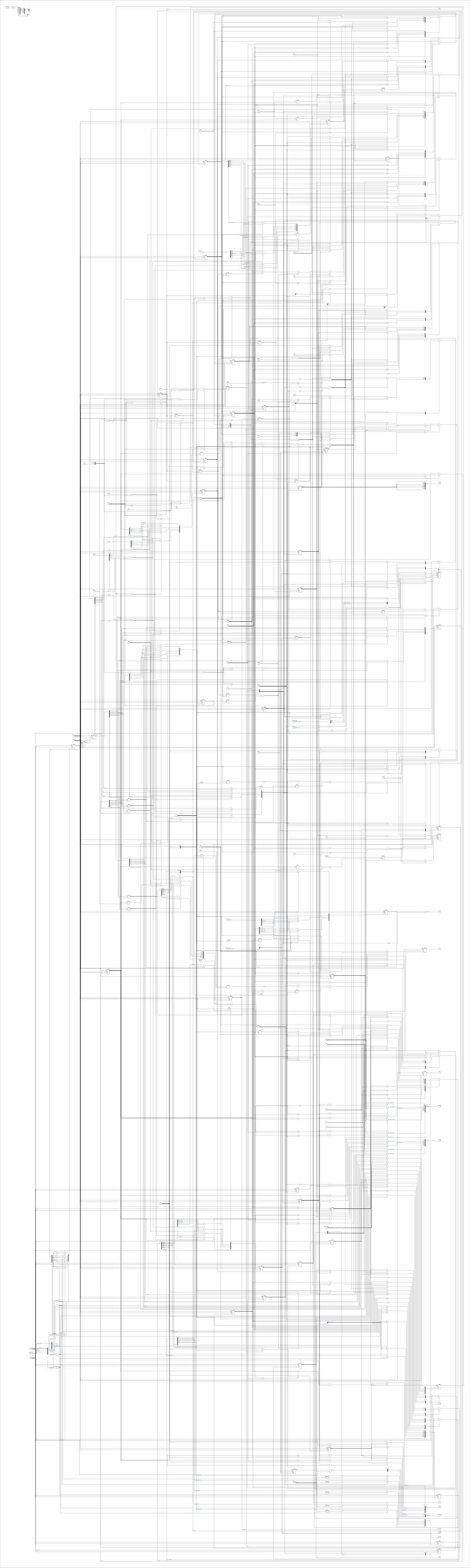
Schematic
Drawn from the Verilog: the yosys netlist of the MiSTer build, instance STORAGE.u_hps. Sub-modules are boxes (click the picture to open it full size; there every sub-module box links to its page, and every wire shows its Verilog name).
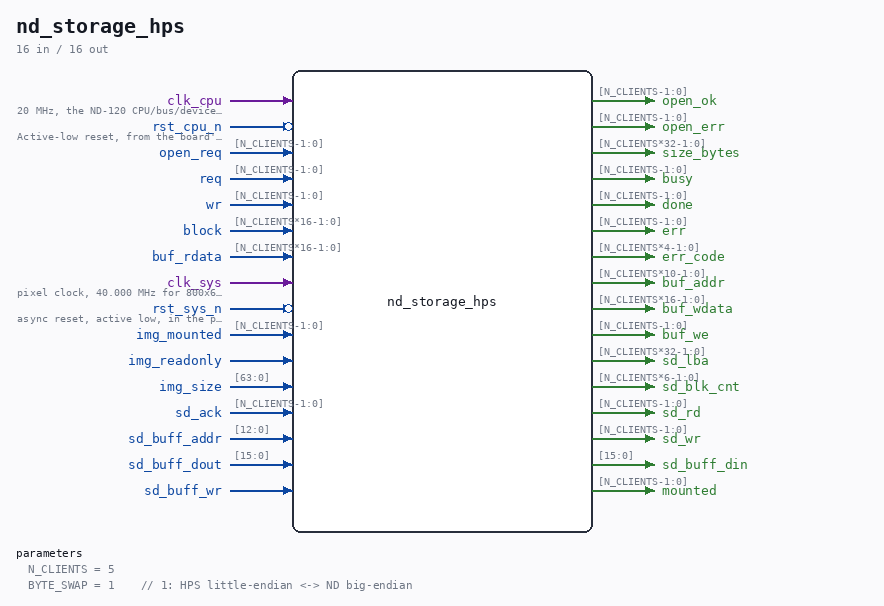
Parameters
| Parameter | Default |
|---|---|
N_CLIENTS |
5 |
BYTE_SWAP |
1 // 1: HPS little-endian <-> ND big-endian |
Ports
| Direction | Width | Name | Description |
|---|---|---|---|
| input | 1 |
clk_cpu |
20 MHz, the ND-120 CPU/bus/device domain (from pll_cpu.outclk_0) |
| input | 1 |
rst_cpu_n (active low) |
Active-low reset, from the board's power-on reset (same net as ND120_CORE.sys_rst_n) |
| input | [N_CLIENTS-1:0] |
open_req |
|
| output | [N_CLIENTS-1:0] |
open_ok |
|
| output | [N_CLIENTS-1:0] |
open_err |
|
| output | [N_CLIENTS*32-1:0] |
size_bytes |
|
| input | [N_CLIENTS-1:0] |
req |
|
| input | [N_CLIENTS-1:0] |
wr |
|
| input | [N_CLIENTS*16-1:0] |
block |
|
| output | [N_CLIENTS-1:0] |
busy |
|
| output | [N_CLIENTS-1:0] |
done |
|
| output | [N_CLIENTS-1:0] |
err |
|
| output | [N_CLIENTS*4-1:0] |
err_code |
|
| output | [N_CLIENTS*10-1:0] |
buf_addr |
|
| output | [N_CLIENTS*16-1:0] |
buf_wdata |
|
| output | [N_CLIENTS-1:0] |
buf_we |
|
| input | [N_CLIENTS*16-1:0] |
buf_rdata |
|
| input | 1 |
clk_sys |
pixel clock, 40.000 MHz for 800x600@60 (same net as nd120_console_mister.clk) |
| input | 1 |
rst_sys_n (active low) |
async reset, active low, in the pixel domain (same net as nd120_console_mister.rst_n) |
| input | [N_CLIENTS-1:0] |
img_mounted |
|
| input | 1 |
img_readonly |
|
| input | [63:0] |
img_size |
|
| output | [N_CLIENTS*32-1:0] |
sd_lba |
|
| output | [N_CLIENTS*6-1:0] |
sd_blk_cnt |
|
| output | [N_CLIENTS-1:0] |
sd_rd |
|
| output | [N_CLIENTS-1:0] |
sd_wr |
|
| input | [N_CLIENTS-1:0] |
sd_ack |
|
| input | [12:0] |
sd_buff_addr |
|
| input | [15:0] |
sd_buff_dout |
|
| output | [15:0] |
sd_buff_din |
|
| input | 1 |
sd_buff_wr |
|
| output | [N_CLIENTS-1:0] |
mounted |
Verilog source
Verilog/fpga/mister/rtl/nd_storage_hps.v on GitHub.
Show the Verilog of nd_storage_hps (549 lines)
`include "nd_storage_status.vh"
/****************************************************************************
** nd_storage_hps - the ND-120 storage client bus served by the MiSTer HPS  **
**                                                                         **
** WHAT THIS IS                                                            **
**                                                                         **
** The MiSTer replacement for nd_storage (Verilog/SD-FAT/circuit/          **
** nd_storage.v). It presents the SAME flattened client port - spec         **
** Verilog/docs/nd-storage-interface-spec.md section 4: one request moves  **
** ONE 2048-byte block (1024 ND words) by file-relative 16-bit block       **
** number, and the backend masters the client's own buffer through         **
** buf_addr / buf_wdata / buf_we (reads) and buf_rdata (writes) - so the   **
** controller-facing adapters (nd_storage_floppy_adapter,                  **
** nd_storage_disc_adapter, nd_storage_tape_adapter) are reused unchanged. **
** On the other side there is no SD card, no SPI, no FAT: the images are   **
** FILES the user mounts from the MiSTer OSD, and the HPS (the ARM side)   **
** serves them through hps_io's block interface. One client = one OSD      **
** mount slot ("S<n>" line in CONF_STR) = one file.                        **
**                                                                         **
** THE HPS BLOCK INTERFACE, AS IT REALLY BEHAVES (read from the official   **
** docs, Main_MiSTer/user_io.cpp and sys/hps_io.sv on 01-SEP-2026; the     **
** rules below are what the design is built on, not guesses):             **
**   - The ARM POLLS. It never sees sd_rd change; it reads a status word,  **
**     picks ONE slot with a request pending (rotating round-robin),       **
**     samples that slot's sd_lba in the same transaction, and later runs  **
**     ONE data transaction with sd_ack[slot] high for its whole length.   **
**     So: hold sd_rd/sd_wr until sd_ack RISES, then drop it (the official **
**     sys/sd_card.sv does exactly this); the FALLING edge of sd_ack means **
**     "block done". sd_lba and sd_blk_cnt must be stable from request to  **
**     ack.                                                                **
**   - sd_blk_cnt = 3 with BLKSZ = 2 (512-byte blocks) makes one 2048-byte **
**     transaction, one ack, sd_buff_addr running 0..1023 words in WIDE    **
**     (16-bit) mode. Exactly one client block.                            **
**   - Data arrives at the HPS SPI rate, many clk_sys cycles per word:     **
**     sd_buff_wr pulses one cycle per word, sd_buff_addr increments two   **
**     cycles after it. For WRITES the core must present sd_buff_din =     **
**     buffer[sd_buff_addr] from address 0 the moment ack rises; the ARM   **
**     reads it on its own strobe and bumps the address.                   **
**   - The buffer bus (sd_buff_addr/dout/wr) is BROADCAST to every slot.   **
**     This module only ever has ONE transaction in flight, so it        **
**     qualifies by "the slot I asked for" rather than by a per-slot ack.  **
**   - A read on an UNMOUNTED slot is still acked and returns zeros. The   **
**     only way to know there is no image is the mount pulse: img_mounted  **
**     [n] pulses a few cycles, img_size / img_readonly are valid during   **
**     it (the size is sent first), and an UNMOUNT is the same pulse with  **
**     img_size == 0. So a request on an unmounted slot never reaches the  **
**     HPS here: it completes at once with err + NDS_ERR_NOTOPEN, per the  **
**     rule in nd_storage_status.vh (never done-without-error on a fault,  **
**     never done-never).                                                  **
**   - Writes go to the file immediately (O_SYNC on the ARM). A write past **
**     the end of the file is trimmed and the image cannot grow, so a      **
**     write whose block does not lie entirely inside the file is refused  **
**     here with NDS_ERR_RANGE. Read-only is only REPORTED by the HPS      **
**     (img_readonly); enforcing it is our job: NDS_ERR_WRPROT.            **
**                                                                         **
** CLOCKS. The client port is the CPU domain (clk_cpu, 20 MHz on this      **
** board); hps_io is clk_sys (40 MHz, and it must be >= 20 MHz per the     **
** MiSTer maintainer). They are two PLL outputs and are treated as         **
** asynchronous. Each block goes through a staging buffer of this module's **
** own - rbuf for reads (written on clk_sys by the HPS stream, read on     **
** clk_cpu into the client), wbuf for writes (filled on clk_cpu from the   **
** client, read on clk_sys by the HPS) - and one 4-phase go/done handshake **
** carries the request across. Two simple-dual-port 1024x16 RAMs rather   **
** than one true-dual-port RAM: one write port each is what every tool     **
** infers without argument. The mount records cross the other way on a    **
** per-slot toggle: the clk_sys side latches mounted/size/readonly on the  **
** img_mounted pulse and flips the toggle; the clk_cpu side copies the     **
** (long since stable) record when it sees the toggle change.              **
**                                                                         **
** BYTE ORDER. ND image words are big-endian bytes: word w = {byte 2w,     **
** byte 2w+1} (nd_storage_disc_adapter.v, and the nd_storage engine packs  **
** them that way, so one image file works in Verilator, on the Tang/Nexys  **
** card and here). hps_io in WIDE mode hands over the file as 16-bit       **
** little-endian words, {byte 2w+1, byte 2w}. BYTE_SWAP = 1 swaps once in  **
** each direction. It is a parameter because the HPS word order is taken   **
** from reading the framework, not from a measurement on this board; the   **
** Phase-4 byte-order check on real hardware is the proof, and if it says  **
** otherwise this is the one line to flip.                                 **
**                                                                         **
** Port shapes: everything per-slot is FLATTENED (slot n in bits           **
** [n*W +: W]) because this is plain Verilog; nd120.sv unpacks into the    **
** SystemVerilog arrays hps_io wants. sd_buff_din is ONE value: only one   **
** transaction is ever in flight, so every hps_io slot can be fed the same **
** word.                                                                   **
**                                                                         **
** Ronny Hansen, 01-SEP-2026                                                **
*****************************************************************************/

module nd_storage_hps #(
    parameter integer N_CLIENTS = 5,   // = hps_io VDNUM; slot n = client n
    parameter integer BYTE_SWAP = 1    // 1: HPS little-endian <-> ND big-endian
) (
    // ---- client ports (clk_cpu domain, flattened; spec section 4) ----
    input  wire                    clk_cpu,  //! 20 MHz, the ND-120 CPU/bus/device domain (from pll_cpu.outclk_0)
    input  wire                    rst_cpu_n,  //! Active-low reset, from the board's power-on reset (same net as ND120_CORE.sys_rst_n)
    input  wire [N_CLIENTS-1:0]    open_req,
    output wire [N_CLIENTS-1:0]    open_ok,
    output wire [N_CLIENTS-1:0]    open_err,
    output wire [N_CLIENTS*32-1:0] size_bytes,
    input  wire [N_CLIENTS-1:0]    req,
    input  wire [N_CLIENTS-1:0]    wr,
    input  wire [N_CLIENTS*16-1:0] block,
    output wire [N_CLIENTS-1:0]    busy,
    output reg  [N_CLIENTS-1:0]    done,
    output reg  [N_CLIENTS-1:0]    err,
    output wire [N_CLIENTS*4-1:0]  err_code,
    output wire [N_CLIENTS*10-1:0] buf_addr,
    output wire [N_CLIENTS*16-1:0] buf_wdata,
    output wire [N_CLIENTS-1:0]    buf_we,
    input  wire [N_CLIENTS*16-1:0] buf_rdata,

    // ---- hps_io block interface (clk_sys domain) ----
    input  wire                    clk_sys,  //! pixel clock, 40.000 MHz for 800x600@60 (same net as nd120_console_mister.clk)
    input  wire                    rst_sys_n,  //! async reset, active low, in the pixel domain (same net as nd120_console_mister.rst_n)
    input  wire [N_CLIENTS-1:0]    img_mounted,
    input  wire                    img_readonly,
    input  wire [63:0]             img_size,
    output wire [N_CLIENTS*32-1:0] sd_lba,
    output wire [N_CLIENTS*6-1:0]  sd_blk_cnt,
    output reg  [N_CLIENTS-1:0]    sd_rd,
    output reg  [N_CLIENTS-1:0]    sd_wr,
    input  wire [N_CLIENTS-1:0]    sd_ack,
    input  wire [12:0]             sd_buff_addr,
    input  wire [15:0]             sd_buff_dout,
    output wire [15:0]             sd_buff_din,
    input  wire                    sd_buff_wr,

    // ---- diagnostics (clk_cpu domain): which slots hold a file ----
    output wire [N_CLIENTS-1:0]    mounted
);

  localparam integer N = N_CLIENTS;

  // one client block = 4 HPS blocks of 512 bytes, sent as ONE transaction
  localparam [5:0] BLK_CNT_M1 = 6'd3;

  function [15:0] swap16(input [15:0] w);
    swap16 = (BYTE_SWAP != 0) ? {w[7:0], w[15:8]} : w;
  endfunction

  // =======================================================================
  // clk_sys side: mount records + the HPS transaction
  // =======================================================================

  // ---- mount records, latched on the rising edge of img_mounted[n] ------
  // hps_io holds img_mounted for the rest of its SPI transaction (several
  // clk_sys cycles), so it is edge-detected. img_size was loaded by the
  // PREVIOUS transaction and is stable here; img_readonly rides in the
  // same word as the mount bit.
  reg [N-1:0]  m_mounted;
  reg [N-1:0]  m_ro;
  reg [N*32-1:0] m_size;
  reg [N-1:0]  m_tgl;          // flips once per mount/unmount event
  reg [N-1:0]  img_mounted_d;

  integer n;
  always @(posedge clk_sys or negedge rst_sys_n) begin
    if (!rst_sys_n) begin
      m_mounted     <= {N{1'b0}};
      m_ro          <= {N{1'b0}};
      m_size        <= {(N*32){1'b0}};
      m_tgl         <= {N{1'b0}};
      img_mounted_d <= {N{1'b0}};
    end else begin
      img_mounted_d <= img_mounted;
      for (n = 0; n < N; n = n + 1) begin
        if (img_mounted[n] && !img_mounted_d[n]) begin
          m_mounted[n]         <= |img_size;          // size 0 = unmount
          m_ro[n]              <= img_readonly;
          m_size[n*32 +: 32]   <= img_size[31:0];
          m_tgl[n]             <= ~m_tgl[n];
        end
      end
    end
  end

  // ---- request fields, written by the clk_cpu side, stable while t_go ---
  reg        t_go;             // clk_cpu: request handed to the HPS side
  reg        t_wr;
  reg [31:0] t_lba;
  reg [N-1:0] t_sel;           // one-hot slot

  // go -> clk_sys, done -> clk_cpu, 4-phase
  reg [1:0] go_s;              // clk_sys copy of t_go
  reg       h_done;            // clk_sys: transaction finished
  reg [1:0] hd_s;              // clk_cpu copy of h_done

  // hps_io wants a per-slot array; every slot carries the same request,
  // only the selected slot's sd_rd/sd_wr bit is raised.
  genvar gs;
  generate
    for (gs = 0; gs < N; gs = gs + 1) begin : g_lba
      assign sd_lba[gs*32 +: 32]   = t_lba;
      assign sd_blk_cnt[gs*6 +: 6] = BLK_CNT_M1;
    end
  endgenerate

  // ---- the two staging buffers ------------------------------------------
  reg [15:0] rbuf[0:1023];     // HPS -> client: written on clk_sys
  reg [15:0] wbuf[0:1023];     // client -> HPS: written on clk_cpu
  reg [15:0] wbuf_q;           // clk_sys registered read of wbuf
  reg [15:0] rbuf_q;           // clk_cpu registered read of rbuf

  wire ack_sel = |(sd_ack & t_sel);

  // read direction: every word the HPS strobes lands in rbuf. Only the
  // low 10 address bits matter (1024 words); hps_io's counter saturates and
  // never wraps, so a longer transaction than asked for cannot alias.
  always @(posedge clk_sys) begin
    if (ack_sel && sd_buff_wr && !t_wr) rbuf[sd_buff_addr[9:0]] <= swap16(sd_buff_dout);
    wbuf_q <= wbuf[sd_buff_addr[9:0]];
  end
  // write direction: the ARM reads sd_buff_din on its own strobe, many
  // clk_sys cycles apart, so the one-cycle registered read above is ready
  // long before each strobe - including the first, at address 0.
  assign sd_buff_din = swap16(wbuf_q);

  // ---- HPS transaction FSM ----------------------------------------------
  localparam [1:0] H_IDLE = 2'd0,   // wait for go
                   H_REQ  = 2'd1,   // sd_rd/sd_wr raised, wait ack rising
                   H_XFER = 2'd2,   // ack high: the stream runs
                   H_DONE = 2'd3;   // tell the client side; wait go low

  reg [1:0] h_state;
  reg       ack_sel_d;

  always @(posedge clk_sys or negedge rst_sys_n) begin
    if (!rst_sys_n) begin
      go_s      <= 2'b00;
      h_state   <= H_IDLE;
      h_done    <= 1'b0;
      sd_rd     <= {N{1'b0}};
      sd_wr     <= {N{1'b0}};
      ack_sel_d <= 1'b0;
    end else begin
      go_s      <= {go_s[0], t_go};
      ack_sel_d <= ack_sel;

      case (h_state)
        H_IDLE: begin
          if (go_s[1]) begin
            // t_wr / t_lba / t_sel have been stable since before t_go rose
            if (t_wr) sd_wr <= t_sel;
            else      sd_rd <= t_sel;
            h_state <= H_REQ;
          end
        end

        H_REQ: begin
          // the request is held until the ARM has picked it up (ack rises),
          // then dropped so the next poll does not run it a second time
          if (ack_sel) begin
            sd_rd   <= {N{1'b0}};
            sd_wr   <= {N{1'b0}};
            h_state <= H_XFER;
          end
        end

        H_XFER: begin
          // the data moves in the always block above; the falling edge of
          // ack is the end of the transaction
          if (!ack_sel && ack_sel_d) begin
            h_done  <= 1'b1;
            h_state <= H_DONE;
          end
        end

        H_DONE: begin
          if (!go_s[1]) begin
            h_done  <= 1'b0;
            h_state <= H_IDLE;
          end
        end
      endcase
    end
  end

  // =======================================================================
  // clk_cpu side: mount copy, arbiter, client streaming
  // =======================================================================

  // ---- mount records copied over on the toggle ---------------------------
  reg [N-1:0]   tgl_s1, tgl_s2, tgl_seen;
  reg [N-1:0]   c_mounted;
  reg [N-1:0]   c_ro;
  reg [N*32-1:0] c_size;
  reg [N-1:0]   c_open_seen;    // an open_req was issued (for open_err)

  always @(posedge clk_cpu or negedge rst_cpu_n) begin
    if (!rst_cpu_n) begin
      tgl_s1      <= {N{1'b0}};
      tgl_s2      <= {N{1'b0}};
      tgl_seen    <= {N{1'b0}};
      c_mounted   <= {N{1'b0}};
      c_ro        <= {N{1'b0}};
      c_size      <= {(N*32){1'b0}};
      c_open_seen <= {N{1'b0}};
    end else begin
      tgl_s1 <= m_tgl;
      tgl_s2 <= tgl_s1;
      for (n = 0; n < N; n = n + 1) begin
        if (tgl_s2[n] != tgl_seen[n]) begin
          // the record was written >= 2 clk_sys cycles before the toggle
          // reached here and only changes on the next mount event, so a
          // plain copy across the domains is safe
          tgl_seen[n]        <= tgl_s2[n];
          c_mounted[n]       <= m_mounted[n];
          c_ro[n]            <= m_ro[n];
          c_size[n*32 +: 32] <= m_size[n*32 +: 32];
        end
        if (open_req[n]) c_open_seen[n] <= 1'b1;
      end
    end
  end

  // open semantics (spec: open_req pulse -> open_ok / open_err LEVELS).
  // There is nothing to "open": the file is whatever the OSD mounted. So
  // open_ok simply reports the mount, and open_err reports "you asked and
  // there is no file", which clears itself the moment one is mounted.
  assign open_ok    = c_mounted;
  assign open_err   = c_open_seen & ~c_mounted;
  assign size_bytes = c_size;
  assign mounted    = c_mounted;

  // ---- per-client request latch + round-robin arbiter --------------------
  reg [N-1:0]    pend;
  reg [N-1:0]    pend_wr;
  reg [N*16-1:0] pend_blk;
  reg [N*4-1:0]  code_q;         // err_code per client, valid with done

  assign err_code = code_q;

  localparam integer SW = (N <= 2) ? 1 : (N <= 4) ? 2 : (N <= 8) ? 3 : 4;
  reg [SW-1:0] rr;               // next slot to look at first
  reg [SW-1:0] g;                // granted client
  reg          g_act;            // a grant is being processed

  // the pick: first pending client at or after rr, wrapping
  reg [SW-1:0] pick;
  reg          pick_ok;
  integer k, m;
  always @(*) begin
    pick    = {SW{1'b0}};
    pick_ok = 1'b0;
    m       = 0;
    for (k = N - 1; k >= 0; k = k - 1) begin
      m = k + {{(32-SW){1'b0}}, rr};
      if (m >= N) m = m - N;
      if (pend[m]) begin
        pick    = m[SW-1:0];
        pick_ok = 1'b1;
      end
    end
  end

  assign busy = pend;

  // ---- client-side FSM ---------------------------------------------------
  localparam [2:0] C_IDLE   = 3'd0,  // pick a pending client, check it
                   C_PULL   = 3'd1,  // write: client buffer -> wbuf
                   C_GO     = 3'd2,  // hand to the HPS side, wait h_done
                   C_STREAM = 3'd3,  // read: rbuf -> client buffer
                   C_DONE   = 3'd4;  // pulse done (+err)

  reg [2:0]  c_state;
  reg        g_wr;
  reg [15:0] g_blk;
  reg [10:0] idx;                // word walk, 0..1024
  reg        g_err;
  reg [3:0]  g_code;

  // the granted client's block-end check, 32-bit bytes
  wire [31:0] g_size    = c_size[g*32 +: 32];
  wire [31:0] blk_start = {5'd0, g_blk, 11'd0};        // block * 2048
  wire [31:0] blk_end   = blk_start + 32'd2048;

  // buffer mastering, one client at a time (all others parked at 0 so the
  // per-controller OR in the aggregators stays clean)
  reg [9:0]  o_addr;
  reg        o_we;
  reg [15:0] o_wdata;            // registered with o_we: same-cycle pair
  wire [15:0] g_rdata = buf_rdata[g*16 +: 16];

  genvar gc;
  generate
    for (gc = 0; gc < N; gc = gc + 1) begin : g_bus
      assign buf_addr [gc*10 +: 10] = (g_act && (g == gc)) ? o_addr : 10'd0;
      assign buf_wdata[gc*16 +: 16] = (g_act && (g == gc)) ? o_wdata : 16'd0;
      assign buf_we   [gc]          = (g_act && (g == gc)) ? o_we    : 1'b0;
    end
  endgenerate

  // rbuf registered read for the STREAM walk: address idx this cycle, word
  // out next cycle, written to the client at address idx-1
  //
  // wbuf write for the PULL walk. o_addr <= idx is registered, so the
  // client SEES address idx one cycle later, and its buffer read is itself
  // registered (every adapter: nd_storage_floppy_adapter's c_buf_rdata <=
  // s_blkbuf[c_buf_addr]; the disc adapter passes the controller's
  // registered dbuf_rdata straight through), so the word for address idx
  // is on buf_rdata TWO cycles after idx was set. Hence wbuf[idx-2].
  always @(posedge clk_cpu) begin
    rbuf_q <= rbuf[idx[9:0]];
    if ((c_state == C_PULL) && (idx >= 11'd2)) wbuf[idx[9:0] - 10'd2] <= g_rdata;
  end

  always @(posedge clk_cpu or negedge rst_cpu_n) begin
    if (!rst_cpu_n) begin
      pend     <= {N{1'b0}};
      pend_wr  <= {N{1'b0}};
      pend_blk <= {(N*16){1'b0}};
      code_q   <= {(N*4){1'b0}};
      done     <= {N{1'b0}};
      err      <= {N{1'b0}};
      rr       <= {SW{1'b0}};
      g        <= {SW{1'b0}};
      g_act    <= 1'b0;
      g_wr     <= 1'b0;
      g_blk    <= 16'd0;
      idx      <= 11'd0;
      g_err    <= 1'b0;
      g_code   <= `NDS_ERR_NONE;
      o_addr   <= 10'd0;
      o_we     <= 1'b0;
      o_wdata  <= 16'd0;
      t_go     <= 1'b0;
      t_wr     <= 1'b0;
      t_lba    <= 32'd0;
      t_sel    <= {N{1'b0}};
      hd_s     <= 2'b00;
      c_state  <= C_IDLE;
    end else begin
      done <= {N{1'b0}};
      err  <= {N{1'b0}};
      o_we <= 1'b0;
      hd_s <= {hd_s[0], h_done};

      // latch requests (spec: a req while busy may be ignored - it is)
      for (n = 0; n < N; n = n + 1) begin
        if (req[n] && !pend[n]) begin
          pend[n]              <= 1'b1;
          pend_wr[n]           <= wr[n];
          pend_blk[n*16 +: 16] <= block[n*16 +: 16];
        end
      end

      case (c_state)
        C_IDLE: begin
          if (pick_ok) begin
            g      <= pick;
            g_act  <= 1'b1;
            g_wr   <= pend_wr[pick];
            g_blk  <= pend_blk[pick*16 +: 16];
            idx    <= 11'd0;
            g_err  <= 1'b0;
            g_code <= `NDS_ERR_NONE;
            // advance the scan past the winner: no starvation
            rr     <= ({{(32-SW){1'b0}}, pick} == N - 1) ? {SW{1'b0}} : pick + 1'b1;
            c_state <= C_GO;   // provisional; the checks below override
            // the three refusals, each with its reason
            if (!c_mounted[pick]) begin
              g_err <= 1'b1; g_code <= `NDS_ERR_NOTOPEN; c_state <= C_DONE;
            end else if (pend_wr[pick] && c_ro[pick]) begin
              g_err <= 1'b1; g_code <= `NDS_ERR_WRPROT;  c_state <= C_DONE;
            end else if (pend_wr[pick]) begin
              c_state <= C_PULL;  // range check follows in C_PULL's first cycle
            end
          end
        end

        // ---- write: walk the client buffer into wbuf, 1 word/cycle ------
        // (the range check sits here so g_* are registered when it runs)
        C_PULL: begin
          if ((idx == 11'd0) && (blk_end > g_size)) begin
            // a write must lie entirely inside the file: the HPS trims a
            // write past EOF and the image cannot grow through the core
            g_err <= 1'b1; g_code <= `NDS_ERR_RANGE; c_state <= C_DONE;
          end else begin
            if (idx < 11'd1024) o_addr <= idx[9:0];
            idx    <= idx + 11'd1;
            if (idx == 11'd1025) begin
              // the word for address 1023 landed this cycle (see the wbuf
              // write above); now hand the block to the HPS side
              t_wr    <= 1'b1;
              t_lba   <= {14'd0, g_blk, 2'b00};   // block * 4 HPS blocks
              t_sel   <= {{(N-1){1'b0}}, 1'b1} << g;
              t_go    <= 1'b1;
              c_state <= C_GO;
            end
          end
        end

        // ---- reads arrive here straight from C_IDLE ----------------------
        C_GO: begin
          if (!t_go && !g_wr) begin
            if (blk_start >= g_size) begin
              // the block starts past the end of the file
              g_err <= 1'b1; g_code <= `NDS_ERR_RANGE; c_state <= C_DONE;
            end else begin
              t_wr  <= 1'b0;
              t_lba <= {14'd0, g_blk, 2'b00};
              t_sel <= {{(N-1){1'b0}}, 1'b1} << g;
              t_go  <= 1'b1;
            end
          end else if (hd_s[1]) begin
            // the HPS side is finished: release the handshake
            t_go <= 1'b0;
            idx  <= 11'd0;
            if (g_wr) c_state <= C_DONE;
            else      c_state <= C_STREAM;
          end
        end

        // ---- read: walk rbuf into the client buffer, 1 word/cycle --------
        C_STREAM: begin
          // rbuf_q holds word idx-1 this cycle (registered read above);
          // address, data and strobe are registered TOGETHER so the client
          // sees them in the same cycle (the strobe alone registered, with
          // the data taken live, delivered word k+1 at address k - caught by
          // nd_storage_hps_tb test 3)
          idx <= idx + 11'd1;
          if (idx != 11'd0) begin
            o_addr  <= idx[9:0] - 10'd1;
            o_wdata <= rbuf_q;
            o_we    <= 1'b1;
          end
          if (idx == 11'd1024) c_state <= C_DONE;
        end

        C_DONE: begin
          // wait for the HPS side to have dropped h_done before the next
          // request can raise go again (4-phase discipline)
          if (!hd_s[1]) begin
            done[g]            <= 1'b1;
            err[g]             <= g_err;
            code_q[g*4 +: 4]   <= g_err ? g_code : `NDS_ERR_NONE;
            pend[g]            <= 1'b0;
            g_act              <= 1'b0;
            o_addr             <= 10'd0;
            c_state            <= C_IDLE;
          end
        end

        default: c_state <= C_IDLE;
      endcase
    end
  end

endmodule