sd_fat_test_top
Source: Verilog/fpga/tang-nano-20k/sd-fat-test/src/sd_fat_test_top.v
Hierarchy: not instantiated by any of the 9 build tops (elaborated by yosys).
Module hierarchy - All modules
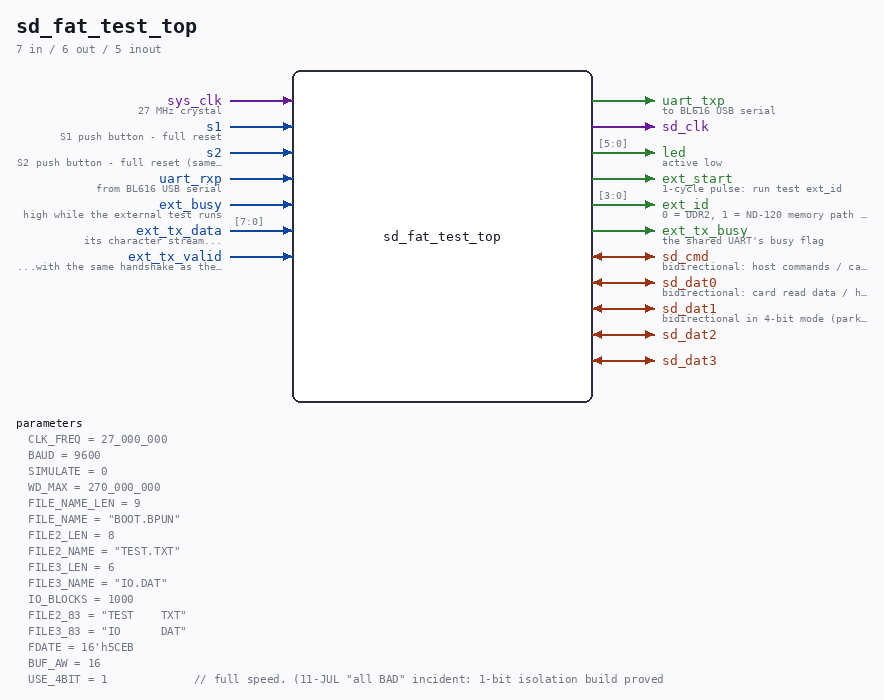
Schematic
Schematic not generated: netlistsvg failed: RangeError: Maximum call stack size exceeded.
Description
Tang Nano 20K SD + FAT test (Milestone 1 of the SD-BPUN device plan) Interactive UART menu (BL616 USB serial, 9600 8N1) over the reusable SD/FAT library in Verilog/SD-FAT/: SD: OK (persistent card status) 1=LIST 2=DUMP BOOT.BPUN 3=COPY TO TEST.TXT H=HELP

1 re-init the card, mount FAT16/FAT32, list the root directory: size (or
Parameters
| Parameter | Default |
|---|---|
CLK_FREQ |
27_000_000 |
BAUD |
9600 |
SIMULATE |
0 |
WD_MAX |
270_000_000 |
FILE_NAME_LEN |
9 |
FILE_NAME |
"BOOT.BPUN" |
FILE2_LEN |
8 |
FILE2_NAME |
"TEST.TXT" |
FILE3_LEN |
6 |
FILE3_NAME |
"IO.DAT" |
IO_BLOCKS |
1000 |
FILE2_83 |
"TEST TXT" |
FILE3_83 |
"IO DAT" |
FDATE |
16'h5CEB |
BUF_AW |
16 |
USE_4BIT |
1 // full speed. (11-JUL "all BAD" incident: 1-bit isolation build proved card+logic healthy; suspect was the snooped RCA |
Ports
| Direction | Width | Name | Description |
|---|---|---|---|
| input | 1 |
sys_clk |
27 MHz crystal |
| input | 1 |
s1 |
S1 push button - full reset |
| input | 1 |
s2 |
S2 push button - full reset (same, for convenience) |
| input | 1 |
uart_rxp |
from BL616 USB serial |
| output | 1 |
uart_txp |
to BL616 USB serial |
| output | 1 |
sd_clk |
|
| inout | 1 |
sd_cmd |
bidirectional: host commands / card responses |
| inout | 1 |
sd_dat0 |
bidirectional: card read data / host write data |
| inout | 1 |
sd_dat1 |
bidirectional in 4-bit mode (parked high otherwise) |
| inout | 1 |
sd_dat2 |
|
| inout | 1 |
sd_dat3 |
|
| output | [5:0] |
led |
active low |
| output | 1 |
ext_start |
1-cycle pulse: run test ext_id |
| output | [3:0] |
ext_id |
0 = DDR2, 1 = ND-120 memory path (BRAM) |
| input | 1 |
ext_busy |
high while the external test runs |
| input | [7:0] |
ext_tx_data |
its character stream... |
| input | 1 |
ext_tx_valid |
...with the same handshake as the others |
| output | 1 |
ext_tx_busy |
the shared UART's busy flag |
Verilog source
Verilog/fpga/tang-nano-20k/sd-fat-test/src/sd_fat_test_top.v on GitHub.
Show the Verilog of sd_fat_test_top (2727 lines)
/****************************************************************************
** Tang Nano 20K SD + FAT test (Milestone 1 of the SD-BPUN device plan) **
** **
** Interactive UART menu (BL616 USB serial, 9600 8N1) over the reusable **
** SD/FAT library in Verilog/SD-FAT/: **
** **
** SD: OK (persistent card status) **
** 1=LIST 2=DUMP BOOT.BPUN 3=COPY TO TEST.TXT H=HELP **
** # **
** **
** 1 re-init the card, mount FAT16/FAT32, list the root directory: **
** size (or <DIR>), date and name of every file and subdirectory **
** 2342 10-JAN-2025 BOOT.BPUN **
** <DIR> 11-JUL-2026 HDD **
** then a disk-info line: card capacity (from the CMD9 CSD), volume **
** size (total sectors) and free space (one FAT #0 scan counting **
** free entries; a SCANNING line is printed first - a 32 GB card **
** takes seconds): **
** CARD 30436 MB VOL 30425 MB FREE 30298 MB **
** 2 find BOOT.BPUN, buffer it (64 KB BRAM) and hex/octal-dump it **
** 3 COPY: read BOOT.BPUN into the buffer, then make TEST.TXT an exact **
** copy. If TEST.TXT's allocation is big enough its data sectors are **
** rewritten in place and only the size field is patched; if it is **
** TOO SMALL (or empty) it is REPLACED: sd_fat_rewrite frees the old **
** cluster chain, allocates a fresh contiguous chain and patches the **
** directory entry, then the data is written. TEST.TXT must already **
** exist on the card (any size). **
** 4 WRBLK1: write a counter pattern (1024 big-endian 16-bit words, **
** word[w] = w) into 1-kiloword block 1 of BOOT.BPUN. ND-120 block **
** framing: 1 block = 1024 words = 2048 bytes = 4 SD sectors; block **
** N of a file lives at file_first_sector + 4*N. Refuses when the **
** file is smaller than (N+1)*2048 bytes (a shorter file's cluster **
** chain ends inside the block - writing there would corrupt the **
** NEXT file). Validate with 2 (DUMP): block 1 shows the pattern, **
** blocks 0 and 2 are untouched. **
** 8 BLOCK: dump 1-kiloword block N of the target file WITHOUT **
** buffering the file. The reader runs with no_stream=1 (directory **
** match only), the 4 sectors of the block are read one at a time **
** through the sd_writer engine's READ path and dumped. Cost and **
** memory are the same for a 7 KB file and a 75 MB one - which is the **
** point: command 2 cannot look at anything past its 64 KB buffer. **
** The block number is typed on the console in decimal. **
** 9 SECTOR: dump one ABSOLUTE SD sector, number typed in decimal, with **
** the FAT not consulted at all. This is what separates "the **
** directory entry points at the wrong place" from "the card really **
** holds zeros there" - the two look identical through command 2. **
** R RANGE: read a run of consecutive blocks (start block and count **
** typed on the console) the same streaming way, keeping only a **
** 16-bit checksum of every word and a block count - the data never **
** reaches the console, because a 1000-block hex dump at 9600 baud **
** would take about six hours. One progress line per 64 blocks, then **
** a summary: blocks, sectors, checksum, 27 MHz cycles of card **
** traffic, PASS or FAIL. A failed card read stops the run and names **
** the exact sector and block - that is what this command is for: **
** every earlier check read a SINGLE block, and SINTRAN segment **
** handling is the first thing that reads many in a row. **
** N set the target file name at runtime (root directory only, 8.3 **
** name, length-exact - that is all sd_file_reader can match) **
** H detailed help; any other key reprints the menu **
** S1 / S2 (either button) full reset **
** **
** DEFAULT BUILD IS READ-ONLY (src/sd_fat_test_config.vh): 3, 4, 6 are **
** compiled out and the sd_writer engine's rd_mode is tied to a constant **
** 1. A write-capable bitstream must never be pointed at a card that is **
** being diagnosed. **
** **
** Robustness: every wait state has a watchdog - no card, no file, **
** unmountable filesystem, stuck reads and failed writes all print an **
** ERROR line and fall back to the menu; the menu SD: line shows **
** NOT CHECKED / NO CARD / ERROR / OK. **
** **
** SD pins per the Sipeed Tang Nano 20K schematic (verified against **
** sipeed/TangNano-20K-example, nestang and snestang constraint files): **
** CLK=83 CMD=82 DAT0=84 DAT1=85 DAT2=80 DAT3=81. CMD and DAT0-3 are **
** bidirectional per the SD specification; the ONLY tristate drivers sit **
** here at the top-level pads (repo rule: no 'z' inside the FPGA fabric). **
** **
** LEDs (active low): [0] alive [1] FS mounted [2] file found **
** [3] command done [4] truncated [5] error **
** **
** Single 27 MHz clock domain - no PLL, no derived clocks (the SD **
** library and sd_writer divide their bus clocks with enable-style **
** dividers). Reader CLK_DIV=1 (init 137 kHz - inside the spec's **
** 100-400 kHz identification band - data 3.375 MHz); writer CLKDIV=1 **
** (13.5 MHz bit clock, inside the mandatory 25 MHz default-speed limit). **
** **
** Speed tests: menu 6 writes IO.DAT in CMD25 multi-block bursts (ACMD23 **
** pre-erase + up to 128 sectors per burst + CMD12), menu 7 reads it back **
** in CMD18 bursts through the same MIT engine - the file reader only **
** mounts the filesystem and locates the file. With USE_4BIT=1 (default, **
** speed-plan rung c) every writer-engine operation switches the card to **
** the 4-bit DAT bus via CMD55+ACMD6 and moves data on DAT3..DAT0; the **
** reader keeps its proven 1-bit path for mount/locate. **
** **
** Design plan: Verilog/docs/sd-bpun-device-plan.md (section 9). **
** **
** Last reviewed: 11-JUL-2026 **
** Ronny Hansen **
*****************************************************************************/
`include "sd_fat_test_config.vh"
`include "sd_fat_features.vh"
module sd_fat_test_top #(
parameter CLK_FREQ = 27_000_000, // crystal, used directly
parameter BAUD = 9600,
parameter SIMULATE = 0, // 1: shorter SD init (sim only)
parameter [31:0] WD_MAX = 270_000_000, // watchdog: 10 s at 27 MHz
parameter FILE_NAME_LEN = 9,
parameter [52*8-1:0] FILE_NAME = "BOOT.BPUN",
parameter FILE2_LEN = 8,
parameter [52*8-1:0] FILE2_NAME = "TEST.TXT", // COPY target (pre-created)
parameter FILE3_LEN = 6,
parameter [52*8-1:0] FILE3_NAME = "IO.DAT", // speed-test file (pre-created)
parameter IO_BLOCKS = 1000, // speed test: 1KW blocks
parameter [87:0] FILE2_83 = "TEST TXT", // 8.3 form for creation
parameter [87:0] FILE3_83 = "IO DAT",
parameter [15:0] FDATE = 16'h5CEB, // 11-JUL-2026 (create stamp)
parameter BUF_AW = 16, // 2^16 = 64 KB buffer
// USE_4BIT - SD bus width for ALL bulk data through the sd_writer
// engine (speed tests, CHECK/COPY/WRBLK1 FAT + payload traffic):
// 1 = DAT0..DAT3, four data wires: ~4x throughput (sim: 5.9 MB/s
// write / 6.4 MB/s read). THE production / full-speed setting.
// Each operation switches the card via CMD55+ACMD6 first, so
// the reader's card re-inits between commands are harmless.
// 0 = DAT0 only (sim: ~1.6 MB/s). For diagnosis, or boards where
// only DAT0 is wired. Commands/CRC-status/busy are on their
// single lines in BOTH modes; the FAT mount/scan path
// (sd_file_reader) always runs 1-bit regardless.
// Full story: README.md "USE_4BIT" + Verilog/docs/sd-cmd18-block-gap-research.md.
parameter USE_4BIT = 1 // full speed. (11-JUL "all BAD" incident: 1-bit isolation build proved card+logic healthy; suspect was the snooped RCA, now taken from the reader's card_rca export)
) (
input sys_clk, // 27 MHz crystal
input s1, // S1 push button - full reset
input s2, // S2 push button - full reset (same, for convenience)
input uart_rxp, // from BL616 USB serial
output uart_txp, // to BL616 USB serial
// microSD slot, SD-native mode; the reader runs 1-bit, the writer
// engine switches to 4-bit per operation when USE_4BIT=1 (rung c)
output sd_clk,
inout sd_cmd, // bidirectional: host commands / card responses
inout sd_dat0, // bidirectional: card read data / host write data
inout sd_dat1, // bidirectional in 4-bit mode (parked high otherwise)
inout sd_dat2,
inout sd_dat3,
output [5:0] led // active low
`ifdef SDFAT_EXT_TEST
// External test commands (Nexys 4 DDR memory tests). Gated: builds that
// do not define SDFAT_EXT_TEST are byte-identical to before. The external
// module runs a self-contained test and prints through this design's UART.
,
output reg ext_start, // 1-cycle pulse: run test ext_id
output reg [3:0] ext_id, // 0 = DDR2, 1 = ND-120 memory path (BRAM)
input wire ext_busy, // high while the external test runs
input wire [7:0] ext_tx_data, // its character stream...
input wire ext_tx_valid, // ...with the same handshake as the others
output wire ext_tx_busy // the shared UART's busy flag
`endif
);
localparam DELAY_FRAMES = CLK_FREQ / BAUD;
wire clk = sys_clk; // single 27 MHz domain, no PLL
/*******************************************************************************
** Reset: power-on counter, reloaded by S1 = full restart **
*******************************************************************************/
reg s1_r1, s1_r2, s1_r3, s2_r1, s2_r2, s2_r3;
always @(posedge clk) begin
s1_r1 <= s1;
s1_r2 <= s1_r1;
s1_r3 <= s1_r2;
s2_r1 <= s2;
s2_r2 <= s2_r1;
s2_r3 <= s2_r2;
end
wire btn_press = (s1_r2 & ~s1_r3) | (s2_r2 & ~s2_r3);
reg [10:0] rst_cnt = 0;
wire sys_rst_n = rst_cnt[10];
always @(posedge clk) begin
if (btn_press) rst_cnt <= 0;
else if (!rst_cnt[10]) rst_cnt <= rst_cnt + 1;
end
// The SD reader is held in reset between commands; each menu command
// releases it for a full init+mount+scan run (= the future tape rewind).
// COPY resets it a second time (rdrst_cnt) to re-scan for TEST.TXT, and
// parks it (phase_write) while the sd_writer owns the card.
reg cmd_running;
reg [4:0] rdrst_cnt;
reg phase_write;
wire sd_rst_n = sys_rst_n & cmd_running & (rdrst_cnt == 0) & ~phase_write;
/*******************************************************************************
** Command mode and runtime target file name **
*******************************************************************************/
localparam M_DUMP = 4'd0;
localparam M_LIST = 4'd1;
localparam M_COPY = 4'd2;
localparam M_BLK = 4'd3; // write the test pattern into 1KW block 1
localparam M_CHK = 4'd4; // validate every root file's cluster chain
localparam M_IOW = 4'd5; // write speed test (rewrites IO.DAT)
localparam M_IOR = 4'd6; // read speed test (streams IO.DAT)
localparam M_BDMP = 4'd7; // dump 1KW block N of the file, nothing buffered
localparam M_SDMP = 4'd8; // dump one absolute SD sector, FAT bypassed
localparam M_RDMP = 4'd9; // read a RANGE of blocks, checksum only
localparam [31:0] IO_BYTES = IO_BLOCKS * 32'd2048;
localparam [12:0] IO_SECT = IO_BLOCKS * 13'd4;
// KB/s numerator: KB * clock frequency (40-bit: 2000 * 27e6 overflows 32)
localparam [39:0] SPEED_NUM = 40'd2 * IO_BLOCKS * CLK_FREQ;
localparam [8:0] BLK_NO = 9'd1; // the block the menu command updates
reg [3:0] mode;
reg copy_phase; // COPY: 0 = read BOOT.BPUN, 1 = locate TEST.TXT
reg list_done; // LIST: listing captured - the reader's automatic
// restart after the free scan must not append again
wire mode_list = (mode == M_LIST);
wire [52*8-1:0] tgt_boot, tgt_test, tgt_io;
generate
genvar tk;
for (tk = 0; tk < 52; tk = tk + 1) begin : g_target_names
assign tgt_boot[8*tk+:8] =
(tk < FILE_NAME_LEN) ? FILE_NAME[8*(FILE_NAME_LEN-1-tk)+:8] : 8'h00;
assign tgt_test[8*tk+:8] =
(tk < FILE2_LEN) ? FILE2_NAME[8*(FILE2_LEN-1-tk)+:8] : 8'h00;
assign tgt_io[8*tk+:8] =
(tk < FILE3_LEN) ? FILE3_NAME[8*(FILE3_LEN-1-tk)+:8] : 8'h00;
end
endgenerate
// ---- runtime target file name (menu key N) ------------------------------
// Typed on the console; empty (rt_len = 0, the state after reset) means the
// compile-time FILE_NAME parameter is used, so nothing changes for an
// operator who never presses N. sd_file_reader matches ROOT-DIRECTORY
// entries only and compares the name LENGTH-EXACTLY (case-insensitively),
// which is why the help text spells that out.
reg [52*8-1:0] rt_name;
reg [7:0] rt_len;
wire rt_use = (rt_len != 8'd0);
wire copy2 = (mode == M_COPY) && copy_phase;
wire io_mode = (mode == M_IOW) || (mode == M_IOR);
// block dump (8), sector dump (9) and the range read (R): nothing is
// buffered, so all three are "streaming" modes as far as the buffer, the
// engine direction and the error texts are concerned
wire dump_mode = (mode == M_BDMP) || (mode == M_SDMP) || (mode == M_RDMP);
wire [52*8-1:0] target_name = io_mode ? tgt_io : copy2 ? tgt_test
: rt_use ? rt_name : tgt_boot;
// the absolute-sector dump never looks at a file: target_len 0 = scan only
wire scan_only = mode_list || (mode == M_CHK) || (mode == M_SDMP);
wire [7:0] target_len = scan_only ? 8'd0
: io_mode ? FILE3_LEN[7:0]
: copy2 ? FILE2_LEN[7:0]
: rt_use ? rt_len : FILE_NAME_LEN[7:0];
// BLOCK: stop at the directory match. Reading a 75 MB file into a 64 KB
// buffer only to look at 2 KB of it is what this command exists to avoid,
// and no_stream also ends the reader's run at a clean card boundary.
wire no_stream = (mode == M_BDMP) || (mode == M_RDMP);
/*******************************************************************************
** SD card + FAT filesystem library (Verilog/SD-FAT/, board-independent) **
*******************************************************************************/
wire rd_sdclk;
wire rd_cmd_o, rd_cmd_oe;
wire [3:0] card_stat;
wire [1:0] card_type;
wire [1:0] fs_type;
wire file_found;
wire f_outen;
wire [7:0] f_outbyte;
wire scan_done;
wire [31:0] file_size;
wire dir_valid;
wire [52*8-1:0] dir_name;
wire [7:0] dir_len;
wire [31:0] dir_size;
wire [15:0] dir_date;
wire [31:0] dir_cluster;
wire dir_isdir;
wire [31:0] file_first_sector;
wire [7:0] fs_cs;
wire [31:0] fs_fat0, fs_spf, fs_dbase, fs_total, fs_rootclus;
wire [7:0] fs_nfat;
wire [31:0] fnd_dir_sec;
wire [3:0] fnd_dir_idx;
wire [31:0] fnd_cluster;
wire [31:0] rd_cap_mb; // card capacity from the CMD9 CSD (0 = unknown)
wire [15:0] rd_rca; // CMD3-published RCA
sd_file_reader #(
.CLK_DIV (3'd1), // 27 MHz: init 137 kHz (spec 100-400 kHz), data 3.375 MHz
.SIMULATE(SIMULATE)
) u_sd (
.rstn (sd_rst_n),
.clk (clk),
.sdclk (rd_sdclk),
.sdcmd_i (sd_cmd),
.sdcmd_o (rd_cmd_o),
.sdcmd_oe (rd_cmd_oe),
.sddat0 (sd_dat0),
.card_stat (card_stat),
.card_type (card_type),
.filesystem_type(fs_type),
.file_found (file_found),
.outen (f_outen),
.outbyte (f_outbyte),
.scan_done (scan_done),
.found_file_size(file_size),
.target_name (target_name),
.no_stream (no_stream),
.target_len (target_len),
.dir_entry_valid(dir_valid),
.dir_entry_name (dir_name),
.dir_entry_len (dir_len),
.dir_entry_size (dir_size),
.dir_entry_date (dir_date),
.dir_entry_cluster(dir_cluster),
.dir_entry_is_dir(dir_isdir),
.found_file_first_sector(file_first_sector),
.fs_cluster_size(fs_cs),
.fs_fat0_sector(fs_fat0),
.fs_sectors_per_fat(fs_spf),
.fs_num_fats(fs_nfat),
.fs_data_base_sector(fs_dbase),
.fs_total_sectors(fs_total),
.fs_root_cluster(fs_rootclus),
.found_dir_entry_sector(fnd_dir_sec),
.found_dir_entry_index(fnd_dir_idx),
.found_file_cluster(fnd_cluster),
.card_capacity_mb(rd_cap_mb),
.card_rca (rd_rca)
);
// card init done = sector-read FSM reached its CMD17 idle state (8) or beyond
wire card_ready = (card_stat >= 4'd8);
/*******************************************************************************
** RCA hold: the burst writer needs the CMD3-assigned RCA for CMD55 (the **
** ACMD23/ACMD6 prefixes), but the reader that owns it is parked - reset - **
** while the writer runs (phase_write). Track the reader's exported RCA **
** while it is live and hold the last good value through the parking. **
** (This replaces the old CMD-line response snoop: with CMD9's 136-bit R2 **
** now following CMD3, a bit pattern inside the CSD could have retriggered **
** the snoop and corrupted the captured RCA.) **
*******************************************************************************/
reg [15:0] card_rca;
always @(posedge clk) begin
if (!sys_rst_n) card_rca <= 16'h0000;
else if (card_ready) card_rca <= rd_rca;
end
/*******************************************************************************
** SD sector writer (project code, MIT) - owns the card during COPY writes **
*******************************************************************************/
reg wr_start;
reg [31:0] tgt_sector;
reg [12:0] nsec, seccnt;
reg [8:0] wr_burst; // burst length for the next engine start (menus 6/7)
reg [BUF_AW:0] copy_len;
wire wr_sdclk, wr_cmd_o, wr_cmd_oe, wr_dat0_o, wr_dat0_oe;
wire wr_dat1_o, wr_dat1_oe, wr_dat2_o, wr_dat2_oe, wr_dat3_o, wr_dat3_oe;
wire s_use4 = (USE_4BIT != 0);
wire wr_busy, wr_done, wr_err, wr_block_next;
wire [8:0] wr_rd_addr;
wire [7:0] wr_data_in;
// menus 6/7 burst in chunks of up to 128 sectors (IO.DAT is contiguous)
wire [12:0] sec_left = nsec - seccnt;
wire [8:0] burst_now = (sec_left > 13'd128) ? 9'd128 : sec_left[8:0];
// engine control is muxed: the FAT surgeon owns it while fx_busy,
// the data-sector loop otherwise
wire fx_busy, fx_done, fx_err;
wire [1:0] fx_err_kind; // surgeon verdict: 0 no-space, 1 read, 2 write, 3 corrupt
reg fx_start, fx_realloc, fx_create;
wire [31:0] fx_new_first;
wire fx_eng_start, fx_eng_rd;
wire [31:0] fx_eng_sector;
wire eng_rx_we;
wire [8:0] eng_rx_addr;
wire [7:0] eng_rx_data;
wire [7:0] fx_tx_data;
// free-space scanner (LIST info line) - shares the engine like the checker
reg fsn_start;
wire fsn_busy, fsn_done, fsn_err, fsn_tick;
wire fsn_eng_start, fsn_eng_rd;
wire [31:0] fsn_eng_sector;
wire [31:0] fsn_free_clusters, fsn_free_mb;
// geometry/target latches (captured while the reader still holds them)
reg cp_is32;
reg [7:0] cp_cs, cp_nfat;
reg [31:0] cp_fat0, cp_spf, cp_dbase, cp_total;
reg [31:0] cp_rootclus;
reg [31:0] cp_dir_sec;
reg [3:0] cp_dir_idx;
reg [31:0] cp_old_cluster;
reg [31:0] cp_cap; // card capacity in MB, held for the LIST info line
`ifdef SDFAT_WRITE
sd_writer #(
.CLKDIV(8'd1) // 27 MHz / 2 = 13.5 MHz bit clock (25 MHz default-speed limit)
) u_wr (
.clk (clk),
.rst_n (sys_rst_n),
.sd_clk_o (wr_sdclk),
.sd_cmd_i (sd_cmd),
.sd_cmd_o (wr_cmd_o),
.sd_cmd_oe (wr_cmd_oe),
.sd_dat0_i (sd_dat0),
.sd_dat0_o (wr_dat0_o),
.sd_dat0_oe(wr_dat0_oe),
.sd_dat1_i (sd_dat1),
.sd_dat1_o (wr_dat1_o),
.sd_dat1_oe(wr_dat1_oe),
.sd_dat2_i (sd_dat2),
.sd_dat2_o (wr_dat2_o),
.sd_dat2_oe(wr_dat2_oe),
.sd_dat3_i (sd_dat3),
.sd_dat3_o (wr_dat3_o),
.sd_dat3_oe(wr_dat3_oe),
.use_4bit (s_use4),
// this design's reader re-initialises the card between commands, so a
// negotiated width never survives: renegotiate every operation
.width_hold(1'b0),
.start (fx_busy ? fx_eng_start : ck_busy ? ck_eng_start
: fsn_busy ? fsn_eng_start : wr_start),
`ifdef SDFAT_TEST_READONLY
// READ-ONLY BUILD: a constant, so the engine's CMD24/CMD25 write paths
// have no reachable driver and synthesis prunes them. This is the last
// line of defence behind the missing menu keys - see
// src/sd_fat_test_config.vh for why the tool defaults this way.
.rd_mode (1'b1),
`else
.rd_mode (fx_busy ? fx_eng_rd : ck_busy ? ck_eng_rd
: fsn_busy ? fsn_eng_rd
: ((mode == M_IOR) || dump_mode)),
`endif
.sector (fx_busy ? fx_eng_sector : ck_busy ? ck_eng_sector
: fsn_busy ? fsn_eng_sector
: tgt_sector + {19'b0, seccnt}),
.busy (wr_busy),
.done (wr_done),
.err (wr_err),
.burst_len ((fx_busy || ck_busy || fsn_busy) ? 9'd1 : wr_burst),
.rca (card_rca),
.block_next(wr_block_next),
.rd_addr (wr_rd_addr),
.rd_data (fx_busy ? fx_tx_data : wr_data_in),
.rx_we (eng_rx_we),
.rx_addr (eng_rx_addr),
.rx_data (eng_rx_data)
);
`else
// write engine stripped: commands depending on it answer NOT IMPLEMENTED
assign wr_sdclk = 1'b0;
assign wr_cmd_o = 1'b1;
assign wr_cmd_oe = 1'b0;
assign wr_dat0_o = 1'b1;
assign wr_dat0_oe = 1'b0;
assign wr_dat1_o = 1'b1;
assign wr_dat1_oe = 1'b0;
assign wr_dat2_o = 1'b1;
assign wr_dat2_oe = 1'b0;
assign wr_dat3_o = 1'b1;
assign wr_dat3_oe = 1'b0;
assign wr_busy = 1'b0;
assign wr_done = 1'b0;
assign wr_err = 1'b1;
assign wr_block_next = 1'b0;
assign wr_rd_addr = 9'd0;
assign eng_rx_we = 1'b0;
assign eng_rx_addr = 9'd0;
assign eng_rx_data = 8'h00;
`endif
// ---- CHECK: root entry table captured during the scan -------------------
reg [127:0] vt_name [0:15];
reg [31:0] vt_cluster[0:15];
reg [31:0] vt_size [0:15];
reg [15:0] vt_isdir;
reg [4:0] vt_n;
always @(posedge clk) begin
if (!sd_rst_n) begin
vt_n <= 0;
end else if (mode == M_CHK && dir_valid && dir_len != 0 && !vt_n[4]) begin
vt_name[vt_n[3:0]] <= dir_name[127:0];
vt_cluster[vt_n[3:0]] <= dir_cluster;
vt_size[vt_n[3:0]] <= dir_size;
vt_isdir[vt_n[3:0]] <= dir_isdir;
vt_n <= vt_n + 5'd1;
end
end
reg ck_start;
wire ck_busy, ck_done, ck_err;
wire [3:0] ck_t_idx;
wire ck_eng_start, ck_eng_rd;
wire [31:0] ck_eng_sector;
wire ck_we;
wire [7:0] ck_byte;
reg [4:0] vt_n_r; // latched entry count for the checker run
`ifdef SDFAT_CHECK
sd_fat_check u_ck (
.clk (clk),
.rst_n (sys_rst_n),
.start (ck_start),
.busy (ck_busy),
.done (ck_done),
.err (ck_err),
.fs_is_fat32 (cp_is32),
.cluster_size (cp_cs),
.fat0_sector (cp_fat0),
.data_base_sector(cp_dbase),
.total_sectors (cp_total),
.n_entries (vt_n_r),
.t_idx (ck_t_idx),
.t_name (vt_name[ck_t_idx]),
.t_cluster (vt_cluster[ck_t_idx]),
.t_size (vt_size[ck_t_idx]),
.t_isdir (vt_isdir[ck_t_idx]),
.eng_start (ck_eng_start),
.eng_rd (ck_eng_rd),
.eng_sector (ck_eng_sector),
.eng_done (wr_done),
.eng_err (wr_err),
.eng_rx_we (eng_rx_we),
.eng_rx_addr (eng_rx_addr),
.eng_rx_data (eng_rx_data),
.ck_we (ck_we),
.ck_byte (ck_byte)
);
`else
assign ck_busy = 1'b0;
assign ck_done = 1'b0;
assign ck_err = 1'b1;
assign ck_t_idx = 4'd0;
assign ck_eng_start = 1'b0;
assign ck_eng_rd = 1'b0;
assign ck_eng_sector = 32'd0;
assign ck_we = 1'b0;
assign ck_byte = 8'h00;
`endif
`ifdef SDFAT_FREESCAN
sd_fat_freescan u_fsn (
.clk (clk),
.rst_n (sys_rst_n),
.start (fsn_start),
.busy (fsn_busy),
.done (fsn_done),
.err (fsn_err),
.sec_tick (fsn_tick),
.fs_is_fat32 (cp_is32),
.cluster_size (cp_cs),
.fat0_sector (cp_fat0),
.sectors_per_fat (cp_spf),
.data_base_sector(cp_dbase),
.total_sectors (cp_total),
.eng_start (fsn_eng_start),
.eng_rd (fsn_eng_rd),
.eng_sector (fsn_eng_sector),
.eng_done (wr_done),
.eng_err (wr_err),
.eng_rx_we (eng_rx_we),
.eng_rx_addr (eng_rx_addr),
.eng_rx_data (eng_rx_data),
.free_clusters (fsn_free_clusters),
.free_mb (fsn_free_mb)
);
`else
// stripped: LIST prints the CARD/VOL sizes and reports FREE N/A
assign fsn_busy = 1'b0;
assign fsn_done = 1'b0;
assign fsn_err = 1'b1;
assign fsn_tick = 1'b0;
assign fsn_eng_start = 1'b0;
assign fsn_eng_rd = 1'b0;
assign fsn_eng_sector = 32'd0;
assign fsn_free_clusters = 32'd0;
assign fsn_free_mb = 32'd0;
`endif
`ifdef SDFAT_REWRITE
sd_fat_rewrite u_fx (
.clk (clk),
.rst_n (sys_rst_n),
.start (fx_start),
.realloc (fx_realloc),
.busy (fx_busy),
.done (fx_done),
.err (fx_err),
.err_kind (fx_err_kind),
.fs_is_fat32 (cp_is32),
.cluster_size (cp_cs),
.fat0_sector (cp_fat0),
.sectors_per_fat (cp_spf),
.num_fats (cp_nfat),
.data_base_sector (cp_dbase),
.total_sectors (cp_total),
.root_start (cp_fat0 + cp_spf * {24'b0, cp_nfat}),
.root_secs ((cp_dbase + {24'b0, cp_cs} * 32'd2) -
(cp_fat0 + cp_spf * {24'b0, cp_nfat})),
.root_cluster (cp_rootclus),
.create (fx_create),
.name83 ((mode == M_IOW) ? FILE3_83 : FILE2_83),
.fdate (FDATE),
.dir_sector (cp_dir_sec),
.dir_index (cp_dir_idx),
.old_first_cluster(cp_old_cluster),
.new_size ((mode == M_IOW) ? IO_BYTES : {{(31-BUF_AW){1'b0}}, copy_len}),
.new_first_cluster(fx_new_first),
.eng_start (fx_eng_start),
.eng_rd (fx_eng_rd),
.eng_sector (fx_eng_sector),
.eng_busy (wr_busy),
.eng_done (wr_done),
.eng_err (wr_err),
.eng_rx_we (eng_rx_we),
.eng_rx_addr (eng_rx_addr),
.eng_rx_data (eng_rx_data),
.eng_tx_addr (wr_rd_addr),
.eng_tx_data (fx_tx_data)
);
`else
assign fx_busy = 1'b0;
assign fx_done = 1'b0;
assign fx_err = 1'b1;
assign fx_err_kind = 2'd0;
assign fx_new_first = 32'd0;
assign fx_eng_start = 1'b0;
assign fx_eng_rd = 1'b0;
assign fx_eng_sector = 32'd0;
assign fx_tx_data = 8'h00;
`endif
/*******************************************************************************
** SD pin muxes - the ONLY tristate drivers, at the pads (repo rule). **
** **
** EVERY pad must use the single-ternary form oe ? val : 1'bz - it is the **
** only tristate idiom yosys maps to a real IOBUF. The previous DAT1-3 **
** expression (park-driven-1 with 1'bz in the INNER ternary branch) was **
** silently collapsed to an always-driving OBUF: the FPGA fought the card **
** on DAT1-3 through every 4-bit read data phase and all 4-bit reads failed **
** on silicon while simulating perfectly (z-semantics in sim, none in the **
** netlist). Proven from the synthesis netlist 12-JUL-2026: sd_dat1-3 came **
** out as direction "output"/OBUF, sd_cmd/sd_dat0 (this form) as inout. **
** The pads idle released; the slot's external 10K pull-ups (R53-R57) hold **
** the lines high, incl. DAT3 at CMD0 (SD-native mode select). The pad oe **
** wires below also feed the simulation contention monitors. **
*******************************************************************************/
assign sd_clk = phase_write ? wr_sdclk : rd_sdclk;
wire cmd_oe = phase_write ? wr_cmd_oe : rd_cmd_oe;
wire cmd_o = phase_write ? wr_cmd_o : rd_cmd_o;
wire s_dat0_pad_oe = phase_write & wr_dat0_oe;
wire s_dat1_pad_oe = phase_write & wr_dat1_oe;
wire s_dat2_pad_oe = phase_write & wr_dat2_oe;
wire s_dat3_pad_oe = phase_write & wr_dat3_oe;
assign sd_cmd = cmd_oe ? cmd_o : 1'bz;
assign sd_dat0 = s_dat0_pad_oe ? wr_dat0_o : 1'bz;
assign sd_dat1 = s_dat1_pad_oe ? wr_dat1_o : 1'bz;
assign sd_dat2 = s_dat2_pad_oe ? wr_dat2_o : 1'bz;
assign sd_dat3 = s_dat3_pad_oe ? wr_dat3_o : 1'bz;
/*******************************************************************************
** LIST mode: pack " size DD-MMM-YYYY NAME" lines into the buffer **
*******************************************************************************/
function [31:0] pow10(input [3:0] i);
case (i)
4'd0: pow10 = 32'd1;
4'd1: pow10 = 32'd10;
4'd2: pow10 = 32'd100;
4'd3: pow10 = 32'd1000;
4'd4: pow10 = 32'd10000;
4'd5: pow10 = 32'd100000;
4'd6: pow10 = 32'd1000000;
4'd7: pow10 = 32'd10000000;
4'd8: pow10 = 32'd100000000;
default: pow10 = 32'd1000000000;
endcase
endfunction
function [7:0] hexd(input [3:0] n);
hexd = (n < 4'd10) ? (8'h30 + {4'b0, n}) : (8'h37 + {4'b0, n});
endfunction
function [23:0] month3(input [3:0] m);
case (m)
4'd1: month3 = "JAN";
4'd2: month3 = "FEB";
4'd3: month3 = "MAR";
4'd4: month3 = "APR";
4'd5: month3 = "MAY";
4'd6: month3 = "JUN";
4'd7: month3 = "JUL";
4'd8: month3 = "AUG";
4'd9: month3 = "SEP";
4'd10: month3 = "OCT";
4'd11: month3 = "NOV";
4'd12: month3 = "DEC";
default: month3 = "???";
endcase
endfunction
localparam S_DIRPAD = " <DIR>"; // 10 chars, right-aligned like the sizes
localparam PK_IDLE = 4'd0;
localparam PK_DEC = 4'd1; // decimal emit engine (size / day / year)
localparam PK_DIRSTR = 4'd2;
localparam PK_SPA = 4'd3; // two spaces after the size column
localparam PK_DASH1 = 4'd4;
localparam PK_MON = 4'd5;
localparam PK_DASH2 = 4'd6;
localparam PK_SPB = 4'd7; // two spaces after the date column
localparam PK_WR = 4'd8; // the name
localparam PK_CR = 4'd9;
localparam PK_LF = 4'd10;
localparam PK_CL = 4'd11; // 8 hex digits of the first cluster
localparam PK_SPC = 4'd12; // two spaces after the cluster column
localparam PK_SPD = 4'd13; // two spaces after the absolute-sector column
reg [3:0] pk_state, pk_ret;
reg [52*8-1:0] pk_name;
reg [7:0] pk_len, pk_i;
reg [15:0] pk_date;
reg [31:0] pk_cluster;
reg [31:0] pk_abs; // first absolute sector of this entry
reg pk_we;
reg [7:0] pk_byte;
reg [31:0] pk_dval; // decimal engine value
reg [3:0] pk_dpow; // current power-of-ten index
reg [3:0] pk_ddig; // current digit
reg pk_dpad; // 1 = zero-pad (day/year), 0 = space-pad (size)
reg pk_dstart; // a nonzero digit has been emitted
wire pk_print_num = pk_dpad || pk_dstart || (pk_ddig != 0) || (pk_dpow == 0);
always @(posedge clk) begin
if (!sd_rst_n) begin
pk_state <= PK_IDLE;
pk_ret <= PK_IDLE;
pk_name <= 0;
pk_len <= 0;
pk_i <= 0;
pk_date <= 0;
pk_we <= 1'b0;
pk_byte <= 8'h00;
pk_dval <= 0;
pk_dpow <= 0;
pk_ddig <= 0;
pk_dpad <= 1'b0;
pk_dstart <= 1'b0;
end else begin
pk_we <= 1'b0;
case (pk_state)
PK_IDLE:
if (mode_list && !list_done && dir_valid && dir_len != 0) begin
pk_name <= dir_name;
pk_len <= dir_len;
pk_date <= dir_date;
pk_cluster <= dir_cluster;
// first ABSOLUTE sector of the entry, straight from the geometry
// the reader publishes: data_base_sector is already biased so that
// cluster c starts at base + cluster_size*c. Printed so the
// operator can feed it to command 9 (or compare it against what
// the ND-120 storage stack thinks the file's address is) without
// doing the arithmetic by hand. Clusters 0/1 do not exist (an
// empty file records cluster 0), so those print 0.
pk_abs <= (dir_cluster < 32'd2) ? 32'd0
: (fs_dbase + {24'b0, fs_cs} * dir_cluster);
pk_i <= 0;
if (dir_isdir) begin
pk_state <= PK_DIRSTR;
end else begin
pk_dval <= dir_size;
pk_dpow <= 4'd9;
pk_ddig <= 0;
pk_dpad <= 1'b0;
pk_dstart <= 1'b0;
pk_ret <= PK_SPA;
pk_state <= PK_DEC;
end
end
PK_DEC: // one decimal number, MSD first, one char per emit cycle
if (pk_dval >= pow10(pk_dpow)) begin
pk_dval <= pk_dval - pow10(pk_dpow);
pk_ddig <= pk_ddig + 4'd1;
end else begin
pk_byte <= pk_print_num ? (8'h30 + {4'b0, pk_ddig}) : 8'h20;
pk_we <= 1'b1;
pk_dstart <= pk_dstart | (pk_ddig != 0);
pk_ddig <= 0;
if (pk_dpow == 0) pk_state <= pk_ret;
else pk_dpow <= pk_dpow - 4'd1;
end
PK_DIRSTR: begin
pk_byte <= S_DIRPAD[8*(9-pk_i)+:8];
pk_we <= 1'b1;
if (pk_i == 8'd9) begin
pk_i <= 0;
pk_state <= PK_SPA;
end else pk_i <= pk_i + 8'd1;
end
PK_SPA: begin
pk_byte <= 8'h20;
pk_we <= 1'b1;
if (pk_i == 8'd1) begin
// load the day (2 digits, zero-padded)
pk_i <= 0;
pk_dval <= {27'b0, pk_date[4:0]};
pk_dpow <= 4'd1;
pk_ddig <= 0;
pk_dpad <= 1'b1;
pk_ret <= PK_DASH1;
pk_state <= PK_DEC;
end else pk_i <= pk_i + 8'd1;
end
PK_DASH1: begin
pk_byte <= "-";
pk_we <= 1'b1;
pk_i <= 0;
pk_state <= PK_MON;
end
PK_MON: begin
pk_byte <= month3(pk_date[8:5]) >> (8 * (2 - pk_i));
pk_we <= 1'b1;
if (pk_i == 8'd2) begin
pk_i <= 0;
pk_state <= PK_DASH2;
end else pk_i <= pk_i + 8'd1;
end
PK_DASH2: begin
pk_byte <= "-";
pk_we <= 1'b1;
// load the year (4 digits, zero-padded; FAT epoch 1980)
pk_dval <= 32'd1980 + {25'b0, pk_date[15:9]};
pk_dpow <= 4'd3;
pk_ddig <= 0;
pk_dpad <= 1'b1;
pk_ret <= PK_SPB;
pk_state <= PK_DEC;
end
PK_SPB: begin
pk_byte <= 8'h20;
pk_we <= 1'b1;
if (pk_i == 8'd1) begin
pk_i <= 0;
pk_state <= PK_CL;
end else pk_i <= pk_i + 8'd1;
end
PK_CL: begin // first cluster, 8 hex digits
pk_byte <= hexd(pk_cluster[31-4*pk_i[2:0]-:4]);
pk_we <= 1'b1;
if (pk_i == 8'd7) begin
pk_i <= 0;
pk_state <= PK_SPC;
end else pk_i <= pk_i + 8'd1;
end
PK_SPC: begin
pk_byte <= 8'h20;
pk_we <= 1'b1;
if (pk_i == 8'd1) begin
// load the first absolute sector (10 digits, space-padded)
pk_i <= 0;
pk_dval <= pk_abs;
pk_dpow <= 4'd9;
pk_ddig <= 0;
pk_dpad <= 1'b0;
pk_dstart <= 1'b0;
pk_ret <= PK_SPD;
pk_state <= PK_DEC;
end else pk_i <= pk_i + 8'd1;
end
PK_SPD: begin
pk_byte <= 8'h20;
pk_we <= 1'b1;
if (pk_i == 8'd1) begin
pk_i <= 0;
pk_state <= PK_WR;
end else pk_i <= pk_i + 8'd1;
end
PK_WR:
if (pk_i < pk_len) begin
pk_byte <= pk_name[8*pk_i+:8];
pk_we <= 1'b1;
pk_i <= pk_i + 8'd1;
end else pk_state <= PK_CR;
PK_CR: begin
pk_byte <= 8'h0D;
pk_we <= 1'b1;
pk_state <= PK_LF;
end
PK_LF: begin
pk_byte <= 8'h0A;
pk_we <= 1'b1;
pk_state <= PK_IDLE;
end
default: pk_state <= PK_IDLE;
endcase
end
end
/*******************************************************************************
** LIST disk-info line: "CARD c MB VOL v MB FREE f MB" appended to the **
** buffer after the file listing. CARD = CMD9 CSD capacity (latched in **
** cp_cap), VOL = total sectors / 2048, FREE = the free-space scanner's **
** result (or N/A when the scan is stripped/failed). Decimal, no padding. **
*******************************************************************************/
localparam S_IL_CARD = "CARD "; // 5 chars
localparam S_IL_VOL = " MB VOL "; // 9 chars
localparam S_IL_FREE = " MB FREE "; // 10 chars
localparam S_IL_SPC1 = " MB SPC "; // 9 chars, follows a numeric FREE
localparam S_IL_SPC2 = " SPC "; // 5 chars, follows "N/A"
localparam S_IL_DBAS = " DBASE "; // 7 chars
localparam S_IL_TAIL = "\015\012"; // 2 chars
localparam S_IL_NA = "N/A"; // 3 chars
function [7:0] ilchr(input [8*10-1:0] s, input [3:0] len, input [3:0] i);
ilchr = (i < len) ? s[8*(len-1-i)+:8] : 8'h00;
endfunction
// MB values stay below 10^7 (10 TB) for every CSD we decode, so this
// decimal engine is 24-bit / 8 digits (the 32-bit pow10 would waste LUTs)
function [23:0] pow10i(input [2:0] i);
case (i)
3'd0: pow10i = 24'd1;
3'd1: pow10i = 24'd10;
3'd2: pow10i = 24'd100;
3'd3: pow10i = 24'd1000;
3'd4: pow10i = 24'd10000;
3'd5: pow10i = 24'd100000;
3'd6: pow10i = 24'd1000000;
default: pow10i = 24'd10000000;
endcase
endfunction
localparam IL_IDLE = 2'd0;
localparam IL_STR = 2'd1; // current segment's characters
localparam IL_DEC = 2'd2; // one decimal number, leading zeros skipped
// Segment order (a segment is a label, optionally followed by a decimal
// number). SPC and DBASE are the two numbers an operator needs to turn a
// LIST first-cluster column into an absolute sector by hand:
// first sector = DBASE + SPC * first cluster
// which is exactly what the listing's own sector column computes.
// 0 "CARD " capacity -> 1
// 1 " MB VOL " volume MB -> 2
// 2 " MB FREE " free MB -> 3 (or, with no scanner, -> 6)
// 3 " MB SPC " sectors/clus -> 5
// 4 " SPC " sectors/clus -> 5 (the same after an "N/A" free)
// 5 " DBASE " data base sec -> 7
// 6 "N/A" no number -> 4
// 7 CR LF no number -> end
reg [1:0] il_state;
reg [2:0] il_seg;
reg [3:0] il_si;
reg il_we;
reg [7:0] il_byte;
reg [23:0] il_dval;
reg [2:0] il_dpow;
reg [3:0] il_ddig;
reg il_dstart;
reg il_go; // pulsed by the menu FSM
reg il_have_free; // 0: the FREE column prints N/A
wire il_busy = (il_state != IL_IDLE);
reg [7:0] il_ch;
always @(*) begin
case (il_seg)
3'd0: il_ch = ilchr({40'b0, S_IL_CARD}, 4'd5, il_si);
3'd1: il_ch = ilchr({8'b0, S_IL_VOL}, 4'd9, il_si);
3'd2: il_ch = ilchr(S_IL_FREE, 4'd10, il_si);
3'd3: il_ch = ilchr({8'b0, S_IL_SPC1}, 4'd9, il_si);
3'd4: il_ch = ilchr({40'b0, S_IL_SPC2}, 4'd5, il_si);
3'd5: il_ch = ilchr({24'b0, S_IL_DBAS}, 4'd7, il_si);
3'd6: il_ch = ilchr({56'b0, S_IL_NA}, 4'd3, il_si);
default: il_ch = ilchr({64'b0, S_IL_TAIL}, 4'd2, il_si);
endcase
end
// segment that follows a printed number
function [2:0] il_nxt(input [2:0] s);
case (s)
3'd0: il_nxt = 3'd1;
3'd1: il_nxt = 3'd2;
3'd2: il_nxt = 3'd3;
3'd3: il_nxt = 3'd5;
3'd4: il_nxt = 3'd5;
default: il_nxt = 3'd7;
endcase
endfunction
always @(posedge clk) begin
if (!sys_rst_n) begin
il_state <= IL_IDLE;
il_seg <= 0;
il_si <= 0;
il_we <= 1'b0;
il_byte <= 8'h00;
il_dval <= 0;
il_dpow <= 0;
il_ddig <= 0;
il_dstart <= 1'b0;
end else begin
il_we <= 1'b0;
case (il_state)
IL_IDLE:
if (il_go) begin
il_seg <= 0;
il_si <= 0;
il_state <= IL_STR;
end
IL_STR:
if (il_ch == 8'h00) begin
il_dpow <= 3'd7;
il_ddig <= 0;
il_dstart <= 1'b0;
case (il_seg)
3'd0: begin
il_dval <= cp_cap[23:0]; // CARD capacity in MB
il_state <= IL_DEC;
end
3'd1: begin
il_dval <= {3'd0, cp_total[31:11]}; // sectors * 512 / 1 MB
il_state <= IL_DEC;
end
3'd2:
if (il_have_free) begin
il_dval <= fsn_free_mb[23:0];
il_state <= IL_DEC;
end else begin
il_seg <= 3'd6; // "N/A", then straight to SPC
il_si <= 0;
end
3'd3, 3'd4: begin
il_dval <= {16'd0, cp_cs}; // sectors per cluster
il_state <= IL_DEC;
end
3'd5: begin
il_dval <= cp_dbase[23:0]; // biased data base sector
il_state <= IL_DEC;
end
3'd6: begin // "N/A" carries no number
il_seg <= 3'd4;
il_si <= 0;
end
default: il_state <= IL_IDLE; // segment 7 = CR LF: line done
endcase
end else begin
il_we <= 1'b1;
il_byte <= il_ch;
il_si <= il_si + 4'd1;
end
IL_DEC: // MSD first; leading zeros skipped entirely (no padding)
if (il_dval >= pow10i(il_dpow)) begin
il_dval <= il_dval - pow10i(il_dpow);
il_ddig <= il_ddig + 4'd1;
end else begin
if (il_dstart || il_ddig != 0 || il_dpow == 0) begin
il_we <= 1'b1;
il_byte <= 8'h30 + {4'b0, il_ddig};
end
il_dstart <= il_dstart | (il_ddig != 0);
il_ddig <= 0;
if (il_dpow == 0) begin
il_seg <= il_nxt(il_seg); // next segment header / tail
il_si <= 0;
il_state <= IL_STR;
end else il_dpow <= il_dpow - 3'd1;
end
default: il_state <= IL_IDLE;
endcase
end
end
/*******************************************************************************
** IO speed report: KB/s = SPEED_NUM / io_cycles (40/32-bit restoring **
** divider), formatted as "WRITE NNNNN KB/S" into the text buffer **
*******************************************************************************/
`ifdef SDFAT_SPEED
localparam SP_IDLE = 3'd0;
localparam SP_DIV = 3'd1;
localparam SP_LBL = 3'd2;
localparam SP_DIG = 3'd3;
localparam SP_TAIL = 3'd4;
reg [2:0] spf_state;
reg spf_we;
reg [7:0] spf_byte;
reg spf_rd_r;
reg [3:0] spf_i;
reg [39:0] div_q;
reg [40:0] div_r;
reg [5:0] div_i;
reg [31:0] div_d;
reg [16:0] sp_val;
reg [3:0] sp_pow, sp_dig;
wire spf_busy = (spf_state != SP_IDLE);
wire [40:0] div_shift = {div_r[39:0], SPEED_NUM[6'd39-div_i]};
wire div_ge = (div_shift >= {9'b0, div_d});
wire [39:0] div_qn = {div_q[38:0], div_ge};
function [7:0] spstr(input rd, input tail, input [3:0] i);
begin
if (tail) begin
case (i) // " KB/S" CR LF
4'd0: spstr = " ";
4'd1: spstr = "K";
4'd2: spstr = "B";
4'd3: spstr = "/";
4'd4: spstr = "S";
4'd5: spstr = 8'h0D;
4'd6: spstr = 8'h0A;
default: spstr = 8'h00;
endcase
end else if (rd) begin
case (i)
4'd0: spstr = "R";
4'd1: spstr = "E";
4'd2: spstr = "A";
4'd3: spstr = "D";
4'd4: spstr = " ";
default: spstr = 8'h00;
endcase
end else begin
case (i)
4'd0: spstr = "W";
4'd1: spstr = "R";
4'd2: spstr = "I";
4'd3: spstr = "T";
4'd4: spstr = "E";
4'd5: spstr = " ";
default: spstr = 8'h00;
endcase
end
end
endfunction
always @(posedge clk) begin
if (!sys_rst_n) begin
spf_state <= SP_IDLE;
spf_we <= 1'b0;
spf_byte <= 0;
spf_rd_r <= 1'b0;
spf_i <= 0;
div_q <= 0;
div_r <= 0;
div_i <= 0;
div_d <= 1;
sp_val <= 0;
sp_pow <= 0;
sp_dig <= 0;
end else begin
spf_we <= 1'b0;
case (spf_state)
SP_IDLE:
if (spf_go) begin
spf_rd_r <= spf_read;
div_d <= (io_cycles == 0) ? 32'd1 : io_cycles;
div_q <= 0;
div_r <= 0;
div_i <= 0;
spf_state <= SP_DIV;
end
SP_DIV: begin
div_r <= div_ge ? (div_shift - {9'b0, div_d}) : div_shift;
div_q <= div_qn;
if (div_i == 6'd39) begin
sp_val <= (div_qn > 40'd99999) ? 17'd99999 : div_qn[16:0];
spf_i <= 0;
spf_state <= SP_LBL;
end else div_i <= div_i + 6'd1;
end
SP_LBL:
if (spstr(spf_rd_r, 1'b0, spf_i) == 8'h00) begin
sp_pow <= 4'd4;
sp_dig <= 0;
spf_state <= SP_DIG;
end else begin
spf_we <= 1'b1;
spf_byte <= spstr(spf_rd_r, 1'b0, spf_i);
spf_i <= spf_i + 4'd1;
end
SP_DIG: // 5 decimal digits, zero padded
if ({15'b0, sp_val} >= pow10(sp_pow)) begin
sp_val <= sp_val - pow10(sp_pow); // sp_pow <= 4: fits in 17 bits
sp_dig <= sp_dig + 4'd1;
end else begin
spf_we <= 1'b1;
spf_byte <= 8'h30 + {4'b0, sp_dig};
sp_dig <= 0;
if (sp_pow == 0) begin
spf_i <= 0;
spf_state <= SP_TAIL;
end else sp_pow <= sp_pow - 4'd1;
end
SP_TAIL:
if (spstr(1'b0, 1'b1, spf_i) == 8'h00) begin
spf_state <= SP_IDLE;
end else begin
spf_we <= 1'b1;
spf_byte <= spstr(1'b0, 1'b1, spf_i);
spf_i <= spf_i + 4'd1;
end
default: spf_state <= SP_IDLE;
endcase
end
end
`else
wire spf_busy = 1'b0;
wire spf_we = 1'b0;
wire [7:0] spf_byte = 8'h00;
`endif
/*******************************************************************************
** 64 KB byte buffer (BRAM): file bytes (DUMP/COPY) or list lines (LIST) in, **
** hex_dumper / buf_text_printer / sd_writer out **
*******************************************************************************/
// SDFAT_BUF_BLOCKRAM: Vivado maps this array to DISTRIBUTED RAM by default
// (measured 20-AUG-2026 on xc7a100t: 24,576 RAMD64E cells against 19,000
// sites, so place_design fails outright) even though the write and the read
// are both clocked. The attribute forces block RAM. It is gated so that
// builds which do not define it - Tang Nano 20K (Gowin) and Basys3 - compile
// byte-identically to before.
`ifdef SDFAT_BUF_BLOCKRAM
(* ram_style = "block" *)
`endif
reg [7:0] file_buf[0:(1 << BUF_AW)-1];
reg [BUF_AW:0] wptr;
reg trunc;
// COPY phase 1 (locating TEST.TXT) must not disturb the buffered file
wire wr_gate = (mode == M_COPY) && copy_phase;
wire [7:0] wr_byte = (mode == M_CHK) ? ck_byte
: io_mode ? spf_byte
: mode_list ? (il_we ? il_byte : pk_byte) : f_outbyte;
wire wr_req = !wr_gate && ((mode == M_CHK) ? ck_we
: io_mode ? spf_we
: mode_list ? (pk_we | il_we) : f_outen);
wire buf_we = wr_req && !wptr[BUF_AW];
// BLOCK (8) / SECTOR (9): sectors land in the buffer straight off the
// engine's read port as they arrive, at most 4 sectors (2048 bytes) per
// command whatever the file size - the buffer is only a landing pad here,
// never a copy of the file. seccnt is the sector index inside the block.
wire rx_buf_we = phase_write && dump_mode && eng_rx_we;
wire [BUF_AW-1:0] rx_buf_addr = {{(BUF_AW-11){1'b0}}, seccnt[1:0], eng_rx_addr};
// ONE write port, explicitly muxed. Written as two if/else branches with
// two different address expressions - which is what this was - Vivado
// counts them as two separate write ports, needs a third for the read, and
// gives up on block RAM ("Infeasible attribute ram_style", measured
// 20-AUG-2026: 6144 RAM64M primitives instead of 16 RAMB36, which no longer
// fits any part here). The priority is unchanged: rx_buf_we wins.
wire [BUF_AW-1:0] buf_waddr = rx_buf_we ? rx_buf_addr : wptr[BUF_AW-1:0];
wire [7:0] buf_wdata = rx_buf_we ? eng_rx_data : wr_byte;
wire buf_wen = rx_buf_we | buf_we;
always @(posedge clk) begin
if (buf_wen) file_buf[buf_waddr] <= buf_wdata;
end
// the buffer pointer clears with the reader reset EXCEPT while the
// reader is merely parked (phase_write): the CHECK report and the COPY
// write phase need the buffer to stay alive through that
always @(posedge clk) begin
if (!sys_rst_n || (!sd_rst_n && !phase_write)) begin
wptr <= 0;
trunc <= 0;
end else begin
if (buf_we) wptr <= wptr + 1;
if (wr_req && wptr[BUF_AW]) trunc <= 1;
end
end
wire [BUF_AW:0] widx = {seccnt[BUF_AW-9:0], 9'b0} + {8'b0, wr_rd_addr};
// speed-test pattern: distinct per sector and offset, cheap to generate
wire [7:0] io_pat = seccnt[7:0] ^ wr_rd_addr[7:0] ^ {seccnt[12:9], 4'hA};
wire [BUF_AW-1:0] dump_addr, text_addr;
reg [7:0] buf_rdata;
wire tp_busy;
// the text printer wins even while the reader is parked (phase_write):
// the CHECK/SPEED/LIST reports print with the card still parked so the
// reader is not restarted just to be reset mid-command at the menu
// in the BLOCK/SECTOR dumps the reader stays parked (phase_write) while
// hex_dumper prints, so the dumper - not the write-data path - owns the
// read port there
wire [BUF_AW-1:0] rd_addr = tp_busy ? text_addr
: (phase_write && !dump_mode) ? widx[BUF_AW-1:0]
: dump_addr;
always @(posedge clk) buf_rdata <= file_buf[rd_addr];
// COPY: buffer bytes, zero-filled past the file end (real tapes had zero
// trailers). WRBLK1: counter pattern - 1024 big-endian 16-bit words,
// word[w] = w, so every sector of the block is distinct and a misplaced
// write cannot pass the dump check.
wire [10:0] blk_off = widx[10:0]; // byte offset inside the block
wire [9:0] blk_word = blk_off[10:1]; // word index 0..1023
wire [7:0] blk_pat = blk_off[0] ? blk_word[7:0] : {6'b0, blk_word[9:8]};
assign wr_data_in = (mode == M_BLK) ? blk_pat
: (mode == M_IOW) ? io_pat
: (widx < copy_len) ? buf_rdata : 8'h00;
/*******************************************************************************
** UART: rx = menu keys, tx shared by the three printers **
*******************************************************************************/
wire [7:0] rx_data;
wire rx_valid;
uart_rx #(
.DELAY_FRAMES(DELAY_FRAMES)
) u_rx (
.clk(clk),
.rst_n(sys_rst_n),
.rxd(uart_rxp),
.rx_data(rx_data),
.rx_valid(rx_valid)
);
reg sp_start;
reg [5:0] sp_msg;
wire sp_busy;
wire [7:0] sp_tx_data;
wire sp_tx_valid;
status_printer u_sp (
.clk(clk),
.rst_n(sys_rst_n),
.start(sp_start),
.msg(sp_msg),
.busy(sp_busy),
.tx_data(sp_tx_data),
.tx_valid(sp_tx_valid),
.tx_busy(tx_busy)
);
reg hd_start;
wire hd_busy;
wire [7:0] hd_tx_data;
wire hd_tx_valid;
// BLOCK/SECTOR dump exactly the sectors just read (nsec * 512 bytes);
// every other command dumps what the buffer collected
wire [BUF_AW:0] hd_length = dump_mode ? {{(BUF_AW-11){1'b0}}, nsec[2:0], 9'b0}
: wptr;
hex_dumper #(
.ADDR_W(BUF_AW)
) u_dump (
.clk(clk),
.rst_n(sys_rst_n),
.start(hd_start),
.length(hd_length),
.busy(hd_busy),
.mem_addr(dump_addr),
.mem_data(buf_rdata),
.tx_data(hd_tx_data),
.tx_valid(hd_tx_valid),
.tx_busy(tx_busy)
);
reg tp_start;
wire [7:0] tp_tx_data;
wire tp_tx_valid;
buf_text_printer #(
.ADDR_W(BUF_AW)
) u_text (
.clk(clk),
.rst_n(sys_rst_n),
.start(tp_start),
.length(wptr),
.busy(tp_busy),
.mem_addr(text_addr),
.mem_data(buf_rdata),
.tx_data(tp_tx_data),
.tx_valid(tp_tx_valid),
.tx_busy(tx_busy)
);
// the FSM serializes the printers; the pulse selects whose byte is latched
// menu-key echo (owner request 12-JUL-2026): every ACCEPTED key is
// echoed back as <key> CR LF before its command output starts, so a
// captured console log has copy-pasteable command boundaries
reg ec_valid;
reg [7:0] ec_byte;
`ifdef SDFAT_EXT_TEST
// the external test owns the console while it runs - nothing else prints
// during a memory test, so top priority is safe and keeps its lines intact
wire [7:0] tx_data = ext_tx_valid ? ext_tx_data
: hd_tx_valid ? hd_tx_data : tp_tx_valid ? tp_tx_data
: ec_valid ? ec_byte : sp_tx_data;
wire tx_valid = ext_tx_valid | hd_tx_valid | tp_tx_valid | ec_valid | sp_tx_valid;
assign ext_tx_busy = tx_busy;
`else
wire [7:0] tx_data = hd_tx_valid ? hd_tx_data : tp_tx_valid ? tp_tx_data
: ec_valid ? ec_byte : sp_tx_data;
wire tx_valid = hd_tx_valid | tp_tx_valid | ec_valid | sp_tx_valid;
`endif
wire tx_busy;
uart_tx #(
.DELAY_FRAMES(DELAY_FRAMES)
) u_tx (
.clk(clk),
.rst_n(sys_rst_n),
.tx_data(tx_data),
.tx_valid(tx_valid),
.tx_busy(tx_busy),
.txd(uart_txp)
);
/*******************************************************************************
** Menu FSM **
*******************************************************************************/
// status_printer message codes (must match status_printer.v)
localparam MSG_BANNER = 6'd0;
localparam MSG_FS_UNKNOWN = 6'd6;
localparam MSG_FILE_FOUND = 6'd7;
localparam MSG_FILE_NOTFND = 6'd8;
localparam MSG_ERR_CARD_TO = 6'd9;
localparam MSG_ERR_SCAN_TO = 6'd10;
localparam MSG_ERR_TRUNC = 6'd11;
localparam MSG_MENU = 6'd12;
localparam MSG_NOTIMPL = 6'd13;
localparam MSG_SD_STATUS0 = 6'd14; // + sd_status
localparam MSG_COPYING = 6'd18;
localparam MSG_COPY_DONE = 6'd19;
localparam MSG_ERR_NOTGT = 6'd20;
localparam MSG_ERR_SMALL = 6'd21;
localparam MSG_ERR_WRITE = 6'd22;
localparam MSG_BLK_WRITING = 6'd23;
localparam MSG_BLK_DONE = 6'd24;
localparam MSG_ERR_RANGE = 6'd25;
localparam MSG_HELP1 = 6'd26; // ..MSG_HELP7 = 32, printed in sequence
localparam MSG_HELP7 = 6'd32;
localparam MSG_ERR_IOSZ = 6'd33;
localparam MSG_IOW_RUN = 6'd34;
localparam MSG_IOR_RUN = 6'd35;
localparam MSG_SCANNING = 6'd36;
localparam MSG_ERR_READ = 6'd37;
localparam MSG_ERR_FATRD = 6'd38;
localparam MSG_ERR_FATCOR = 6'd39;
localparam MSG_MENU2 = 6'd40;
localparam MSG_ASK_BLK = 6'd41;
localparam MSG_ASK_SEC = 6'd42;
localparam MSG_ASK_NAME = 6'd43;
localparam MSG_ERR_NUM = 6'd44;
localparam MSG_AT_SEC = 6'd45;
localparam MSG_NAME_SET = 6'd46;
localparam MSG_HELP8 = 6'd47; // ..MSG_HELP13 = 52
localparam MSG_HELP13 = 6'd52;
localparam MSG_ASK_STA = 6'd53;
localparam MSG_ASK_CNT = 6'd54;
localparam MSG_R_RUN = 6'd55;
localparam MSG_R_AT = 6'd56;
localparam MSG_R_BLOCKS = 6'd57;
localparam MSG_R_SECS = 6'd58;
localparam MSG_R_CHK = 6'd59;
localparam MSG_R_CYC = 6'd60;
localparam MSG_R_PASS = 6'd61;
localparam MSG_R_FAIL = 6'd62;
localparam ST_BANNER = 6'd0;
localparam ST_MENU = 6'd1; // print the SD status line, then
localparam ST_MENU2 = 6'd15; // the menu itself, then
localparam ST_MENU3 = 6'd31; // its second line (64-char message limit)
localparam ST_KEY = 6'd2;
localparam ST_CARD = 6'd3;
localparam ST_FS = 6'd4;
localparam ST_FILE = 6'd5;
localparam ST_STREAM = 6'd6;
localparam ST_DUMP = 6'd7;
localparam ST_DUMP_W = 6'd8;
localparam ST_LSCAN = 6'd9;
localparam ST_LPRINT = 6'd10;
localparam ST_LPRINT_W = 6'd11;
localparam ST_CMD_END = 6'd12;
localparam ST_PRINT = 6'd13; // pulse sp_start, then
localparam ST_PRINT_W = 6'd14; // wait for the message to finish
localparam ST_C_FIND = 6'd16; // COPY: wait for the TEST.TXT scan
localparam ST_C_WRITE = 6'd17; // COPY/WRBLK1/BLOCK/SECTOR: kick a sector
localparam ST_C_NEXT = 6'd18; // and wait for that sector to finish
localparam ST_HELP = 6'd19; // print MSG_HELP1..12 in sequence
localparam ST_C_FIX = 6'd20; // COPY: kick sd_fat_rewrite
localparam ST_C_FIX_W = 6'd21; // COPY: wait for it, then write the data
localparam ST_CHK = 6'd22; // CHECK: park the reader, kick the checker
localparam ST_CHK_W = 6'd23; // CHECK: wait, then print the report
localparam ST_SPEED = 6'd24; // IO speed: kick the KB/s formatter
localparam ST_SPEED_W = 6'd25; // IO speed: wait, then print the line
localparam ST_FREE = 6'd26; // LIST: park the reader, kick the free scan
localparam ST_FREE_W = 6'd27; // LIST: wait for the FAT scan
localparam ST_INFO = 6'd28; // LIST: kick the disk-info line formatter
localparam ST_INFO_W = 6'd29; // LIST: wait, then print the whole buffer
localparam ST_ECHO = 6'd30; // echo the accepted menu key (+ CR-LF)
localparam ST_NUM = 6'd32; // BLOCK/SECTOR: read a decimal number in
localparam ST_NAME = 6'd33; // N: read a file name in
localparam ST_HEXOUT = 6'd34; // print 8 hex digits + CR LF (hx_val)
localparam ST_SWAIT = 6'd35; // SECTOR: let the reader's run end cleanly
localparam ST_R_NEXT = 6'd36; // RANGE: one block done - advance or report
localparam ST_R_SUM = 6'd37; // RANGE: print the summary, field by field
localparam ST_R_ERR = 6'd38; // RANGE: a read failed - print the sector
localparam ST_R_ERR2 = 6'd39; // RANGE: ...and the block, then summarise
`ifdef SDFAT_EXT_TEST
localparam ST_EXT_W = 6'd40; // external test running - wait for ext_busy
reg ext_kicked;
`endif
// persistent SD status shown in the menu (survives between commands)
localparam SD_NOTCHK = 2'd0;
localparam SD_NOCARD = 2'd1;
localparam SD_ERROR = 2'd2;
localparam SD_OK = 2'd3;
reg [5:0] state;
reg [5:0] next_after_print;
reg [7:0] echo_ch; // the accepted key being echoed
reg [5:0] echo_next; // state after the echo finishes
reg [1:0] ec_i; // echo byte index: key, CR, LF
reg ec_crlf; // 0 = echo the key alone (console number entry)
reg ec_gap; // one-cycle gap for tx_busy to assert
// ---- console number entry (BLOCK / SECTOR) and name entry (N) ----------
reg [31:0] num_val; // decimal accumulator
reg num_dig; // at least one digit seen (an empty entry is an error)
reg [23:0] blk_no; // 1KW block index inside the file
reg [31:0] sec_no; // absolute SD sector number
reg [31:0] hx_val; // value printed by ST_HEXOUT
reg [3:0] hx_i; // 0..7 digits, 8 = CR, 9 = LF
reg [5:0] hx_next; // state after the hex value has been printed
// num_val * 10, built from shifts (no multiplier for a console keypress).
// The guard below stops the accumulator at 10 digits: 4294967295 is the
// largest sector number a 32-bit SD address can carry (2 TB), so anything
// beyond that is a typo, not an address.
wire [31:0] num_x10 = {num_val[28:0], 3'b0} + {num_val[30:0], 1'b0};
wire num_fits = (num_val < 32'd400_000_000);
// ---- multi-block range read (menu R) ------------------------------------
// Segment handling in SINTRAN is the first thing that reads MANY
// consecutive blocks in one go, and everything validated before this
// command only ever read ONE block. So this reads a run of blocks the
// same way command 8 reads one - sector by sector, nothing buffered - and
// keeps only a running checksum and a block count. The console never sees
// the data: a 1000-block hex dump at 9600 baud would take about six hours.
reg [23:0] rng_start; // first block of the run
reg [23:0] rng_cnt; // number of blocks requested
reg [23:0] rng_blk; // blocks completed so far
reg [15:0] rng_sum; // sum of every 16-bit big-endian word read
reg [7:0] rng_hi; // high byte of the word being assembled
reg num_second; // number entry: 0 = start block, 1 = block count
reg [2:0] r_i; // summary field index
// sum of the two block indices: (start + count) * 2048 is the number of
// bytes the file must have. 25-bit sum shifted by 11 = 36 bits, so the
// arithmetic is done in 40 - in 32 it would wrap and pass a bad range.
wire [39:0] rng_need = ({15'b0, rng_start} + {15'b0, rng_cnt}) << 11;
// bytes a file must contain for block blk_no to lie entirely inside it:
// (blk_no + 1) * 2048, computed in 40 bits because a 24-bit block index
// times 2048 is 35 bits - the same expression in 32 bits would wrap and
// let an out-of-range block through
wire [39:0] blk_need = ({16'b0, blk_no} + 40'd1) << 11;
reg io_run; // IO speed test: cycle counter enable
reg [31:0] io_cycles;
reg spf_go, spf_read;
reg [1:0] sd_status;
reg [31:0] wd; // watchdog for the waiting states
reg err_flag, done_flag;
assign led = ~{err_flag, // led[5] error (last command)
trunc, // led[4] truncated
done_flag, // led[3] last command completed
file_found, // led[2] file found
fs_type[1], // led[1] FS mounted
sys_rst_n}; // led[0] alive
always @(posedge clk) begin
if (!sys_rst_n) begin
state <= ST_BANNER;
next_after_print <= ST_BANNER;
cmd_running <= 1'b0;
`ifdef SDFAT_EXT_TEST
ext_start <= 1'b0;
ext_id <= 4'd0;
ext_kicked <= 1'b0;
`endif
rdrst_cnt <= 0;
phase_write <= 1'b0;
mode <= M_DUMP;
copy_phase <= 1'b0;
copy_len <= 0;
tgt_sector <= 0;
nsec <= 0;
seccnt <= 0;
wr_burst <= 9'd1;
wr_start <= 1'b0;
fx_start <= 1'b0;
ck_start <= 1'b0;
fsn_start <= 1'b0;
il_go <= 1'b0;
il_have_free <= 1'b0;
list_done <= 1'b0;
cp_cap <= 0;
vt_n_r <= 0;
spf_go <= 1'b0;
spf_read <= 1'b0;
io_run <= 1'b0;
io_cycles <= 0;
fx_realloc <= 1'b0;
cp_is32 <= 1'b0;
cp_cs <= 0;
cp_nfat <= 0;
cp_fat0 <= 0;
cp_spf <= 0;
cp_dbase <= 0;
cp_total <= 0;
cp_rootclus <= 0;
cp_dir_sec <= 0;
cp_dir_idx <= 0;
cp_old_cluster <= 0;
sp_start <= 1'b0;
sp_msg <= MSG_BANNER;
hd_start <= 1'b0;
tp_start <= 1'b0;
wd <= 0;
err_flag <= 1'b0;
done_flag <= 1'b0;
sd_status <= SD_NOTCHK;
echo_ch <= 8'h00;
echo_next <= ST_MENU;
ec_i <= 2'd0;
ec_crlf <= 1'b1;
ec_gap <= 1'b0;
ec_valid <= 1'b0;
ec_byte <= 8'h00;
num_val <= 0;
num_dig <= 1'b0;
blk_no <= 0;
sec_no <= 0;
hx_val <= 0;
hx_i <= 0;
hx_next <= ST_MENU;
rt_name <= 0;
rt_len <= 0;
rng_start <= 0;
rng_cnt <= 0;
rng_blk <= 0;
rng_sum <= 0;
rng_hi <= 0;
num_second <= 1'b0;
r_i <= 0;
end else begin
sp_start <= 1'b0;
hd_start <= 1'b0;
tp_start <= 1'b0;
wr_start <= 1'b0;
fx_start <= 1'b0;
ck_start <= 1'b0;
fsn_start <= 1'b0;
il_go <= 1'b0;
spf_go <= 1'b0;
ec_valid <= 1'b0;
if (rdrst_cnt != 0) rdrst_cnt <= rdrst_cnt - 5'd1;
if (io_run) io_cycles <= io_cycles + 1;
// RANGE: fold every 16-bit word into the checksum as its bytes arrive
// off the engine. ND-120 words are big-endian on the card, so the even
// byte offset is the high half. Kept in this process (not in the
// buffer's) so rng_sum has exactly one driver.
//
// ROTATE-then-add, not a plain sum: the checksum has to notice a block
// read from the WRONG PLACE, and a plain 16-bit sum cannot. Blocks are
// 1024 words, so shifting a run by whole blocks shifts it by a
// multiple of 1024 words, and for any position-linear content the
// difference that makes to a plain sum is a multiple of 2^20 - always
// zero in 16 bits. Rotating the accumulator by one bit per word
// destroys that cancellation for one wire and one adder.
if ((mode == M_RDMP) && phase_write && eng_rx_we) begin
if (!eng_rx_addr[0]) rng_hi <= eng_rx_data;
else rng_sum <= {rng_sum[14:0], rng_sum[15]} + {rng_hi, eng_rx_data};
end
case (state)
ST_BANNER: begin
sp_msg <= MSG_BANNER;
next_after_print <= ST_MENU;
state <= ST_PRINT;
end
ST_MENU: begin
cmd_running <= 1'b0;
phase_write <= 1'b0;
copy_phase <= 1'b0;
sp_msg <= MSG_SD_STATUS0 + {4'b0000, sd_status};
next_after_print <= ST_MENU2;
state <= ST_PRINT;
end
ST_MENU2: begin
sp_msg <= MSG_MENU;
next_after_print <= ST_MENU3;
state <= ST_PRINT;
end
// the menu does not fit in one 64-character status message, so its
// tail (and the "# " prompt) is a second one
ST_MENU3: begin
sp_msg <= MSG_MENU2;
next_after_print <= ST_KEY;
state <= ST_PRINT;
end
ST_KEY:
if (rx_valid) begin
echo_ch <= rx_data; // echoed as <key> CR LF for accepted keys
ec_i <= 2'd0;
ec_crlf <= 1'b1;
ec_gap <= 1'b0;
err_flag <= 1'b0;
done_flag <= 1'b0;
wd <= 0;
copy_phase <= 1'b0;
fx_create <= 1'b0;
list_done <= 1'b0;
case (rx_data)
"1": begin
mode <= M_LIST;
cmd_running <= 1'b1;
echo_next <= ST_CARD;
state <= ST_ECHO;
end
"2": begin
mode <= M_DUMP;
cmd_running <= 1'b1;
echo_next <= ST_CARD;
state <= ST_ECHO;
end
"3": begin
`ifdef SDFAT_REWRITE
mode <= M_COPY;
cmd_running <= 1'b1;
echo_next <= ST_CARD;
state <= ST_ECHO;
`else
sp_msg <= MSG_NOTIMPL;
next_after_print <= ST_MENU;
echo_next <= ST_PRINT;
state <= ST_ECHO;
`endif
end
"4": begin
`ifdef SDFAT_TEST_READONLY
// the read-only build contains no block-write path at all
sp_msg <= MSG_NOTIMPL;
next_after_print <= ST_MENU;
echo_next <= ST_PRINT;
state <= ST_ECHO;
`else
`ifdef SDFAT_WRITE
mode <= M_BLK;
cmd_running <= 1'b1;
echo_next <= ST_CARD;
state <= ST_ECHO;
`else
sp_msg <= MSG_NOTIMPL;
next_after_print <= ST_MENU;
echo_next <= ST_PRINT;
state <= ST_ECHO;
`endif
`endif
end
"5": begin
`ifdef SDFAT_CHECK
mode <= M_CHK;
cmd_running <= 1'b1;
echo_next <= ST_CARD;
state <= ST_ECHO;
`else
sp_msg <= MSG_NOTIMPL;
next_after_print <= ST_MENU;
echo_next <= ST_PRINT;
state <= ST_ECHO;
`endif
end
"6": begin
`ifdef SDFAT_SPEED
mode <= M_IOW;
cmd_running <= 1'b1;
echo_next <= ST_CARD;
state <= ST_ECHO;
`else
sp_msg <= MSG_NOTIMPL;
next_after_print <= ST_MENU;
echo_next <= ST_PRINT;
state <= ST_ECHO;
`endif
end
"7": begin
`ifdef SDFAT_SPEED
mode <= M_IOR;
cmd_running <= 1'b1;
echo_next <= ST_CARD;
state <= ST_ECHO;
`else
sp_msg <= MSG_NOTIMPL;
next_after_print <= ST_MENU;
echo_next <= ST_PRINT;
state <= ST_ECHO;
`endif
end
// ---- streaming diagnostics: both ask for a number first ------
// Both read their sectors through the sd_writer engine's READ
// path, so they need that engine compiled in (SDFAT_WRITE names
// the module, not the direction - the read-only build keeps it
// and ties its rd_mode to 1).
"8": begin
`ifdef SDFAT_WRITE
mode <= M_BDMP;
num_val <= 0;
num_dig <= 1'b0;
sp_msg <= MSG_ASK_BLK;
next_after_print <= ST_NUM;
echo_next <= ST_PRINT;
state <= ST_ECHO;
`else
sp_msg <= MSG_NOTIMPL;
next_after_print <= ST_MENU;
echo_next <= ST_PRINT;
state <= ST_ECHO;
`endif
end
"9": begin
`ifdef SDFAT_WRITE
mode <= M_SDMP;
num_val <= 0;
num_dig <= 1'b0;
sp_msg <= MSG_ASK_SEC;
next_after_print <= ST_NUM;
echo_next <= ST_PRINT;
state <= ST_ECHO;
`else
sp_msg <= MSG_NOTIMPL;
next_after_print <= ST_MENU;
echo_next <= ST_PRINT;
state <= ST_ECHO;
`endif
end
"R", "r": begin
`ifdef SDFAT_WRITE
mode <= M_RDMP;
num_val <= 0;
num_dig <= 1'b0;
num_second <= 1'b0; // start block first, then the count
sp_msg <= MSG_ASK_STA;
next_after_print <= ST_NUM;
echo_next <= ST_PRINT;
state <= ST_ECHO;
`else
sp_msg <= MSG_NOTIMPL;
next_after_print <= ST_MENU;
echo_next <= ST_PRINT;
state <= ST_ECHO;
`endif
end
"N", "n": begin
rt_len <= 0; // typing a name replaces the old one
rt_name <= 0;
sp_msg <= MSG_ASK_NAME;
next_after_print <= ST_NAME;
echo_next <= ST_PRINT;
state <= ST_ECHO;
end
"H", "h", "?": begin
sp_msg <= MSG_HELP1;
next_after_print <= ST_HELP;
echo_next <= ST_PRINT;
state <= ST_ECHO;
end
`ifdef SDFAT_EXT_TEST
// ---- external memory tests (Nexys 4 DDR) --------------------
// The external module owns the console until it clears ext_busy;
// the card is not touched, so no reader phase is entered here.
"M", "m": begin
ext_id <= 4'd0; // DDR2
cmd_running <= 1'b1;
echo_next <= ST_EXT_W;
state <= ST_ECHO;
end
"B", "b": begin
ext_id <= 4'd1; // ND-120 memory path (BRAM)
cmd_running <= 1'b1;
echo_next <= ST_EXT_W;
state <= ST_ECHO;
end
`endif
default: state <= ST_MENU; // anything else: reprint the menu
endcase
end
// ---- echo the accepted key + CR-LF, then run the command --------
// ec_crlf = 0 echoes the character alone (console number/name entry,
// where the line ends only when the operator presses CR); entering
// with ec_i = 1 and ec_crlf = 1 emits just the CR LF.
ST_ECHO:
if (ec_gap) ec_gap <= 1'b0; // let tx_busy assert before polling
else if (ec_i == (ec_crlf ? 2'd3 : 2'd1)) state <= echo_next;
else if (!tx_busy) begin
ec_valid <= 1'b1;
ec_byte <= (ec_i == 2'd0) ? echo_ch : (ec_i == 2'd1) ? 8'h0D : 8'h0A;
ec_i <= ec_i + 2'd1;
ec_gap <= 1'b1;
end
// ---- decimal number entry (commands 8 and 9) --------------------
ST_NUM:
if (rx_valid) begin
if (rx_data >= "0" && rx_data <= "9") begin
if (num_fits) num_val <= num_x10 + {28'b0, rx_data[3:0]};
num_dig <= 1'b1;
echo_ch <= rx_data;
ec_i <= 2'd0;
ec_crlf <= 1'b0; // echo the digit, stay on the same line
ec_gap <= 1'b0;
echo_next <= ST_NUM;
state <= ST_ECHO;
end else if (rx_data == 8'h0D || rx_data == 8'h0A) begin
ec_i <= 2'd1; // CR LF only, then act on the number
ec_crlf <= 1'b1;
ec_gap <= 1'b0;
if (!num_dig) begin
sp_msg <= MSG_ERR_NUM;
err_flag <= 1'b1;
next_after_print <= ST_MENU;
echo_next <= ST_PRINT;
end else if ((mode == M_RDMP) && !num_second) begin
// RANGE takes two numbers: this was the start block, now ask
// for the count (the CR LF goes out first, then the prompt)
rng_start <= num_val[23:0];
num_val <= 0;
num_dig <= 1'b0;
num_second <= 1'b1;
sp_msg <= MSG_ASK_CNT;
next_after_print <= ST_NUM;
echo_next <= ST_PRINT;
end else begin
blk_no <= num_val[23:0];
sec_no <= num_val;
rng_cnt <= num_val[23:0];
cmd_running <= 1'b1; // release the reader: init + mount
wd <= 0;
echo_next <= ST_CARD;
end
state <= ST_ECHO;
end else begin
// any other key aborts the entry - safer than guessing
sp_msg <= MSG_ERR_NUM;
err_flag <= 1'b1;
next_after_print <= ST_MENU;
echo_ch <= rx_data;
ec_i <= 2'd0;
ec_crlf <= 1'b1;
ec_gap <= 1'b0;
echo_next <= ST_PRINT;
state <= ST_ECHO;
end
end
// ---- file name entry (command N) --------------------------------
// Lower case is folded to upper case for the console echo only; the
// reader compares case-insensitively either way. The length limit is
// 12 = 8 + '.' + 3, the longest 8.3 name there is.
ST_NAME:
if (rx_valid) begin
if (rx_data == 8'h0D || rx_data == 8'h0A) begin
sp_msg <= (rt_len == 0) ? MSG_ERR_NUM : MSG_NAME_SET;
err_flag <= (rt_len == 0);
next_after_print <= ST_MENU;
ec_i <= 2'd1; // CR LF only
ec_crlf <= 1'b1;
ec_gap <= 1'b0;
echo_next <= ST_PRINT;
state <= ST_ECHO;
end else if (rx_data > 8'h20 && rt_len < 8'd12) begin
rt_name[8*rt_len+:8] <= (rx_data >= "a" && rx_data <= "z")
? (rx_data - 8'd32) : rx_data;
rt_len <= rt_len + 8'd1;
echo_ch <= (rx_data >= "a" && rx_data <= "z")
? (rx_data - 8'd32) : rx_data;
ec_i <= 2'd0;
ec_crlf <= 1'b0;
ec_gap <= 1'b0;
echo_next <= ST_NAME;
state <= ST_ECHO;
end
end
// ---- print hx_val as 8 hex digits + CR LF ------------------------
ST_HEXOUT:
if (ec_gap) ec_gap <= 1'b0;
else if (hx_i == 4'd10) state <= hx_next;
else if (!tx_busy) begin
ec_valid <= 1'b1;
ec_byte <= (hx_i < 4'd8) ? hexd(hx_val[31-4*hx_i[2:0]-:4])
: (hx_i == 4'd8) ? 8'h0D : 8'h0A;
hx_i <= hx_i + 4'd1;
ec_gap <= 1'b1;
end
ST_CARD:
if (card_ready) begin
// card_type 1/2/3 maps directly onto MSG_CARD_SDV1/SDV2/SDHC
sp_msg <= {4'b0000, card_type};
// the absolute-sector dump deliberately skips the FS: line - it
// must work on a card whose filesystem does not mount at all
next_after_print <= (mode == M_SDMP) ? ST_SWAIT : ST_FS;
state <= ST_PRINT;
end else if (wd == WD_MAX) begin
sp_msg <= MSG_ERR_CARD_TO;
err_flag <= 1'b1;
sd_status <= SD_NOCARD;
next_after_print <= ST_MENU;
state <= ST_PRINT;
end else wd <= wd + 1;
ST_FS:
if (fs_type[1]) begin
// fs_type 2/3 maps onto MSG_FS_FAT16/FAT32 (= fs_type + 2)
sp_msg <= 6'd2 + {4'b0000, fs_type};
sd_status <= SD_OK;
next_after_print <= scan_only ? ST_LSCAN : ST_FILE;
state <= ST_PRINT;
end else if (scan_done) begin
sp_msg <= MSG_FS_UNKNOWN;
err_flag <= 1'b1;
sd_status <= SD_ERROR;
next_after_print <= ST_MENU;
state <= ST_PRINT;
end else if (wd == WD_MAX) begin
sp_msg <= MSG_ERR_SCAN_TO;
err_flag <= 1'b1;
sd_status <= SD_ERROR;
next_after_print <= ST_MENU;
state <= ST_PRINT;
end else wd <= wd + 1;
// ---- DUMP / COPY phase 0: read BOOT.BPUN into the buffer -------
ST_FILE:
if (file_found) begin
if (mode == M_IOR && file_size != IO_BYTES) begin
sp_msg <= MSG_ERR_IOSZ;
err_flag <= 1'b1;
next_after_print <= ST_MENU;
state <= ST_PRINT;
end else if (mode == M_IOR) begin
// size OK - but the reader is still mid-transaction: file_found
// rises WHILE the directory sector is streaming from the card,
// and the reader then streams the found file itself. Parking it
// here left a REAL card in the SENDING-DATA state, where the
// writer's next command is illegal and gets no response -> err
// (silicon failure 11-JUL-2026; a stateless card model masked
// it). Wait for scan_done like every other command: ST_STREAM
// captures the sector and parks the reader cleanly.
state <= ST_STREAM;
end else begin
sp_msg <= MSG_FILE_FOUND;
next_after_print <= ST_STREAM;
state <= ST_PRINT;
end
end else if (scan_done) begin
if (mode == M_IOW) begin
// IO.DAT does not exist yet: create it and go straight to the
// allocation + timed write
cp_is32 <= (fs_type == 2'd3);
cp_cs <= fs_cs;
cp_fat0 <= fs_fat0;
cp_spf <= fs_spf;
cp_nfat <= fs_nfat;
cp_dbase <= fs_dbase;
cp_total <= fs_total;
cp_rootclus <= fs_rootclus;
cp_old_cluster <= 0;
fx_create <= 1'b1;
fx_realloc <= 1'b1;
phase_write <= 1'b1;
sp_msg <= MSG_IOW_RUN;
next_after_print <= ST_C_FIX;
state <= ST_PRINT;
end else begin
sp_msg <= MSG_FILE_NOTFND;
err_flag <= 1'b1;
next_after_print <= ST_MENU;
state <= ST_PRINT;
end
end else if (wd == WD_MAX) begin
sp_msg <= MSG_ERR_SCAN_TO;
err_flag <= 1'b1;
sd_status <= SD_ERROR;
next_after_print <= ST_MENU;
state <= ST_PRINT;
end else wd <= wd + 1;
ST_STREAM:
if (scan_done) begin
if (trunc) begin
// DUMP: still dump what fit; COPY: abort (never write a
// truncated copy)
sp_msg <= MSG_ERR_TRUNC;
err_flag <= (mode == M_COPY);
next_after_print <= (mode == M_COPY) ? ST_MENU : ST_DUMP;
state <= ST_PRINT;
end else if (mode == M_COPY) begin
// phase 1: re-scan for TEST.TXT while announcing the copy
copy_len <= wptr;
copy_phase <= 1'b1;
rdrst_cnt <= 5'd31;
sp_msg <= MSG_COPYING;
next_after_print <= ST_C_FIND;
state <= ST_PRINT;
end else if (mode == M_IOR) begin
// reader finished (scan_done: it streamed IO.DAT once in 1-bit
// and sent its CMD12 - the card is back in TRANSFER state and
// idle): NOW capture the sector and park it for the timed
// CMD18 burst read through the writer engine
tgt_sector <= file_first_sector;
nsec <= IO_SECT;
seccnt <= 0;
phase_write <= 1'b1;
sp_msg <= MSG_IOR_RUN;
next_after_print <= ST_C_WRITE;
state <= ST_PRINT;
end else if (mode == M_IOW) begin
// rewrite IO.DAT from scratch: free + allocate IO_BLOCKS blocks
cp_is32 <= (fs_type == 2'd3);
cp_cs <= fs_cs;
cp_fat0 <= fs_fat0;
cp_spf <= fs_spf;
cp_nfat <= fs_nfat;
cp_dbase <= fs_dbase;
cp_total <= fs_total;
cp_rootclus <= fs_rootclus;
cp_dir_sec <= fnd_dir_sec;
cp_dir_idx <= fnd_dir_idx;
cp_old_cluster <= fnd_cluster;
fx_realloc <= 1'b1; // 6 always deletes the old file first
fx_create <= 1'b0;
phase_write <= 1'b1;
sp_msg <= MSG_IOW_RUN;
next_after_print <= ST_C_FIX;
state <= ST_PRINT;
end else if (mode == M_RDMP) begin
// RANGE: the whole run must lie inside the file, and an empty
// run is a typo, not a request
if (rng_cnt == 24'd0 || {8'b0, file_size} < rng_need) begin
sp_msg <= MSG_ERR_RANGE;
err_flag <= 1'b1;
next_after_print <= ST_MENU;
state <= ST_PRINT;
end else begin
// capture BEFORE phase_write parks the reader (same edge)
tgt_sector <= file_first_sector + {6'b0, rng_start, 2'b00};
hx_val <= file_first_sector + {6'b0, rng_start, 2'b00};
nsec <= 13'd4; // the loop runs ONE block at a time
seccnt <= 0;
rng_blk <= 0;
rng_sum <= 0;
rng_hi <= 0;
io_cycles <= 0; // 27 MHz cycles, card traffic only
phase_write <= 1'b1;
hx_i <= 0;
hx_next <= ST_C_WRITE;
sp_msg <= MSG_R_RUN; // "...AT SECTOR " + 8 hex digits
next_after_print <= ST_HEXOUT;
state <= ST_PRINT;
end
end else if (mode == M_BDMP) begin
// 1KW block read: same framing as WRBLK1 (ND-120 block = 1024
// 16-bit words = 2048 bytes = 4 SD sectors, block N at
// file_first_sector + 4*N, which assumes the file occupies
// consecutive sectors - command 9 is how that assumption gets
// checked). Refuse a block that starts past the end of the
// file: those sectors belong to another file and reporting
// them as this file's data is exactly the confusion this tool
// exists to remove.
if ({8'b0, file_size} < blk_need) begin
sp_msg <= MSG_ERR_RANGE;
err_flag <= 1'b1;
next_after_print <= ST_MENU;
state <= ST_PRINT;
end else begin
// capture BEFORE phase_write parks the reader (same edge)
tgt_sector <= file_first_sector + {6'b0, blk_no, 2'b00};
hx_val <= file_first_sector + {6'b0, blk_no, 2'b00};
nsec <= 13'd4;
seccnt <= 0;
phase_write <= 1'b1;
hx_i <= 0;
hx_next <= ST_C_WRITE;
sp_msg <= MSG_AT_SEC; // "AT SECTOR " + 8 hex digits
next_after_print <= ST_HEXOUT;
state <= ST_PRINT;
end
end else if (mode == M_BLK) begin
// 1KW block write: the block must lie entirely inside the file
// (past its end = inside the NEXT file's clusters)
if (file_size < ({23'b0, BLK_NO} + 32'd1) * 32'd2048) begin
sp_msg <= MSG_ERR_RANGE;
err_flag <= 1'b1;
next_after_print <= ST_MENU;
state <= ST_PRINT;
end else begin
// capture BEFORE phase_write parks the reader (same edge)
tgt_sector <= file_first_sector + {25'b0, BLK_NO, 2'b00};
nsec <= 13'd4; // 1 block = 4 SD sectors
seccnt <= 0;
phase_write <= 1'b1;
sp_msg <= MSG_BLK_WRITING;
next_after_print <= ST_C_WRITE;
state <= ST_PRINT;
end
end else begin
state <= ST_DUMP;
end
end else if (wd == WD_MAX) begin
sp_msg <= MSG_ERR_SCAN_TO;
err_flag <= 1'b1;
sd_status <= SD_ERROR;
next_after_print <= ST_MENU;
state <= ST_PRINT;
end else wd <= wd + 1;
// ---- SECTOR (9): the FAT is not consulted at all -----------------
// The reader still runs to completion first: parking it mid-command
// leaves a real card in the SENDING-DATA state and the next command
// on the bus gets no answer (silicon failure 11-JUL-2026, see the
// note in ST_FILE). scan_done arrives even when the volume did not
// mount, which is what makes this command usable on a broken card.
ST_SWAIT:
if (scan_done) begin
tgt_sector <= sec_no;
hx_val <= sec_no;
nsec <= 13'd1;
seccnt <= 0;
phase_write <= 1'b1;
hx_i <= 0;
hx_next <= ST_C_WRITE;
sp_msg <= MSG_AT_SEC;
next_after_print <= ST_HEXOUT;
state <= ST_PRINT;
end else if (wd == WD_MAX) begin
sp_msg <= MSG_ERR_SCAN_TO;
err_flag <= 1'b1;
sd_status <= SD_ERROR;
next_after_print <= ST_MENU;
state <= ST_PRINT;
end else wd <= wd + 1;
ST_DUMP: begin
hd_start <= 1'b1;
state <= ST_DUMP_W;
end
ST_DUMP_W: if (!hd_start && !hd_busy) state <= ST_CMD_END;
// ---- LIST -------------------------------------------------------
ST_LSCAN:
if (scan_done && pk_state == PK_IDLE) begin
if (mode == M_CHK) begin
// capture the geometry before phase_write parks the reader
cp_is32 <= (fs_type == 2'd3);
cp_cs <= fs_cs;
cp_fat0 <= fs_fat0;
cp_spf <= fs_spf;
cp_nfat <= fs_nfat;
cp_dbase <= fs_dbase;
cp_total <= fs_total;
cp_rootclus <= fs_rootclus;
vt_n_r <= vt_n;
phase_write <= 1'b1;
wd <= 0;
state <= ST_CHK;
end else begin
// LIST: freeze the listing, capture the geometry + capacity
// (same edge - the reader parks next cycle), then scan FAT #0
// for the free count and append the disk-info line
list_done <= 1'b1;
cp_is32 <= (fs_type == 2'd3);
cp_cs <= fs_cs;
cp_fat0 <= fs_fat0;
cp_spf <= fs_spf;
cp_nfat <= fs_nfat;
cp_dbase <= fs_dbase;
cp_total <= fs_total;
cp_rootclus <= fs_rootclus;
cp_cap <= rd_cap_mb;
`ifdef SDFAT_FREESCAN
phase_write <= 1'b1;
sp_msg <= MSG_SCANNING;
next_after_print <= ST_FREE;
state <= ST_PRINT;
`else
il_have_free <= 1'b0; // no scanner: the line says FREE N/A
state <= ST_INFO;
`endif
end
end else if (wd == WD_MAX) begin
sp_msg <= MSG_ERR_SCAN_TO;
err_flag <= 1'b1;
sd_status <= SD_ERROR;
next_after_print <= ST_MENU;
state <= ST_PRINT;
end else wd <= wd + 1;
ST_LPRINT: begin
tp_start <= 1'b1;
state <= ST_LPRINT_W;
end
ST_LPRINT_W: if (!tp_start && !tp_busy) state <= ST_CMD_END;
// ---- LIST tail: free-space scan + disk-info line ------------------
ST_FREE:
if (!fsn_busy && !fsn_start) begin
fsn_start <= 1'b1;
wd <= 0;
state <= ST_FREE_W;
end
ST_FREE_W:
if (fsn_done) begin
il_have_free <= 1'b1;
state <= ST_INFO;
end else if (fsn_err || wd == WD_MAX) begin
il_have_free <= 1'b0; // scan failed: the line says FREE N/A
state <= ST_INFO;
end else begin
if (fsn_tick) wd <= 0; // per-sector progress feeds the watchdog
else wd <= wd + 1;
end
ST_INFO:
if (!il_busy && !il_go) begin
il_go <= 1'b1;
state <= ST_INFO_W;
end
ST_INFO_W:
if (!il_go && !il_busy) begin
// reader stays parked through the print (see ST_CHK_W)
state <= ST_LPRINT;
end
// ---- CHECK: walk every root file's cluster chain -----------------
ST_CHK:
if (!ck_busy && !ck_start) begin
ck_start <= 1'b1;
wd <= 0;
state <= ST_CHK_W;
end
ST_CHK_W:
if (ck_done) begin
// reader stays parked while the report prints (ST_MENU releases
// it together with cmd_running - no truncated restart commands)
state <= ST_LPRINT;
end else if (ck_err || wd == WD_MAX) begin
phase_write <= 1'b0;
// CHECK only READS (FAT chains through the engine): the truthful
// failure text is a FAT read error, never "SD WRITE FAILED"
sp_msg <= MSG_ERR_FATRD;
err_flag <= 1'b1;
sd_status <= SD_ERROR;
next_after_print <= ST_MENU;
state <= ST_PRINT;
end else wd <= wd + 1;
// ---- IO speed: divide, format, print ------------------------------
ST_SPEED:
if (!spf_busy && !spf_go) begin
spf_go <= 1'b1;
spf_read <= (mode == M_IOR);
wd <= 0;
state <= ST_SPEED_W;
end
ST_SPEED_W:
if (!spf_go && !spf_busy) begin
// reader stays parked through the print (see ST_CHK_W)
state <= ST_LPRINT; // print "WRITE/READ NNNNN KB/S"
end else if (wd == WD_MAX) begin
phase_write <= 1'b0;
sp_msg <= (mode == M_IOR) ? MSG_ERR_READ : MSG_ERR_WRITE;
err_flag <= 1'b1;
next_after_print <= ST_MENU;
state <= ST_PRINT;
end else wd <= wd + 1;
// ---- HELP: MSG_HELP1..12 then back to the menu -------------------
// The help texts are not one contiguous run of message codes: 1..7
// were allocated before the error/status codes 33..39, so 8..12 sit
// above those and the sequence hops once.
ST_HELP:
if (sp_msg == MSG_HELP13) begin
state <= ST_MENU;
end else begin
sp_msg <= (sp_msg == MSG_HELP7) ? MSG_HELP8 : (sp_msg + 6'd1);
next_after_print <= ST_HELP;
state <= ST_PRINT;
end
// ---- COPY phases 1-2: locate TEST.TXT, rewrite it in place ------
ST_C_FIND:
if (scan_done) begin
if (!file_found) begin
// TEST.TXT does not exist: create it (fresh 8.3 root entry)
cp_is32 <= (fs_type == 2'd3);
cp_cs <= fs_cs;
cp_fat0 <= fs_fat0;
cp_spf <= fs_spf;
cp_nfat <= fs_nfat;
cp_dbase <= fs_dbase;
cp_total <= fs_total;
cp_rootclus <= fs_rootclus;
cp_old_cluster <= 0;
fx_create <= 1'b1;
fx_realloc <= 1'b1;
phase_write <= 1'b1;
wd <= 0;
state <= ST_C_FIX;
end else begin
// capture EVERYTHING before phase_write parks the reader
// (same clock edge; the reader's registers reset next cycle)
tgt_sector <= file_first_sector; // kept when realloc=0
nsec <= {4'b0, (copy_len + 17'd511) >> 9};
seccnt <= 0;
cp_is32 <= (fs_type == 2'd3);
cp_cs <= fs_cs;
cp_fat0 <= fs_fat0;
cp_spf <= fs_spf;
cp_nfat <= fs_nfat;
cp_dbase <= fs_dbase;
cp_total <= fs_total;
cp_rootclus <= fs_rootclus;
cp_dir_sec <= fnd_dir_sec;
cp_dir_idx <= fnd_dir_idx;
cp_old_cluster <= fnd_cluster;
// too small (or empty) -> full replacement; else size patch only
fx_realloc <= (file_size < {{(31 - BUF_AW){1'b0}}, copy_len});
fx_create <= 1'b0;
phase_write <= 1'b1;
wd <= 0;
state <= ST_C_FIX;
end
end else if (wd == WD_MAX) begin
sp_msg <= MSG_ERR_SCAN_TO;
err_flag <= 1'b1;
sd_status <= SD_ERROR;
next_after_print <= ST_MENU;
state <= ST_PRINT;
end else wd <= wd + 1;
ST_C_FIX:
if (!fx_busy && !fx_start) begin
fx_start <= 1'b1;
wd <= 0;
state <= ST_C_FIX_W;
end
ST_C_FIX_W:
if (fx_done) begin
// the (possibly new) contiguous data area of the target
tgt_sector <= cp_dbase + {24'b0, cp_cs} * fx_new_first;
if (mode == M_IOW) begin
nsec <= IO_SECT;
seccnt <= 0;
io_cycles <= 0;
io_run <= 1'b1; // the write clock starts with the first sector
end
wd <= 0;
state <= ST_C_WRITE;
end else if (fx_err || wd == WD_MAX) begin
phase_write <= 1'b0;
// truthful surgeon verdicts: only a COMPLETED scan without a
// free run is "NO CONTIGUOUS FREE SPACE"; a failed FAT read is a
// read error (silicon 12-JUL-2026 printed no-space for garbage
// FAT reads and sent the operator hunting a full card)
sp_msg <= !fx_err ? MSG_ERR_WRITE
: (fx_err_kind == 2'd0) ? MSG_ERR_SMALL
: (fx_err_kind == 2'd1) ? MSG_ERR_FATRD
: (fx_err_kind == 2'd3) ? MSG_ERR_FATCOR
: MSG_ERR_WRITE;
err_flag <= 1'b1;
sd_status <= SD_ERROR;
next_after_print <= ST_MENU;
state <= ST_PRINT;
end else wd <= wd + 1;
ST_C_WRITE:
if (seccnt >= nsec) begin
if (mode == M_RDMP) begin
io_run <= 1'b0; // stop the clock before any console traffic
state <= ST_R_NEXT;
end else if (dump_mode) begin
// the sectors are in the buffer; the reader stays parked while
// hex_dumper prints them (see ST_CHK_W for why)
state <= ST_DUMP;
end else if (io_mode) begin
io_run <= 1'b0;
state <= ST_SPEED; // phase_write stays up: the report uses the buffer
end else begin
// reader stays parked through the print (see ST_CHK_W)
sp_msg <= (mode == M_BLK) ? MSG_BLK_DONE : MSG_COPY_DONE;
next_after_print <= ST_CMD_END;
state <= ST_PRINT;
end
end else if (!wr_busy && !wr_start) begin
// menus 6/7 go in CMD25/CMD18 bursts of up to 128 sectors;
// COPY/WRBLK1 keep the proven single-sector path (burst_len=1)
wr_burst <= io_mode ? burst_now : 9'd1;
// RANGE times the CARD traffic only: the counter runs while
// sectors move and is stopped around every console line
if (mode == M_RDMP) io_run <= 1'b1;
if (mode == M_IOR && seccnt == 0) begin
io_cycles <= 0;
io_run <= 1'b1; // the read clock starts with the first burst
end
wr_start <= 1'b1;
wd <= 0;
state <= ST_C_NEXT;
end
ST_C_NEXT:
if (wr_done) begin
seccnt <= seccnt + 13'd1; // the final block of the burst
state <= ST_C_WRITE;
end else if (wr_block_next) begin
seccnt <= seccnt + 13'd1; // block k>=1 of the burst: advance the source
wd <= 0;
end else if (wr_err || wd == WD_MAX) begin
// menu 7/8/9/R are READS through the engine: report them as such
sp_msg <= ((mode == M_IOR) || dump_mode) ? MSG_ERR_READ
: MSG_ERR_WRITE;
err_flag <= 1'b1;
sd_status <= SD_ERROR;
if (mode == M_RDMP) begin
// THE point of the range command: name the exact place it died,
// then still print the summary. The reader stays parked for it
// (ST_MENU releases it) exactly as after a completed run.
io_run <= 1'b0;
next_after_print <= ST_R_ERR;
end else begin
phase_write <= 1'b0;
next_after_print <= ST_MENU;
end
state <= ST_PRINT;
end else wd <= wd + 1;
// ---- RANGE: one block finished ----------------------------------
// Nothing here scales with the run length: the same 4-sector loop is
// re-armed one block further on, and only the counters move.
ST_R_NEXT: begin
rng_blk <= rng_blk + 24'd1;
if (rng_blk + 24'd1 >= rng_cnt) begin
r_i <= 0;
state <= ST_R_SUM;
end else begin
tgt_sector <= tgt_sector + 32'd4; // next block = 4 more sectors
seccnt <= 0;
// a sign of life every 64 blocks (128 KB): at 9600 baud one
// line per block would cost more time than the reading does
if (rng_blk[5:0] == 6'd63) begin
hx_val <= {8'b0, rng_blk + 24'd1};
hx_i <= 0;
hx_next <= ST_C_WRITE;
sp_msg <= MSG_R_AT;
next_after_print <= ST_HEXOUT;
state <= ST_PRINT;
end else state <= ST_C_WRITE;
end
end
// ---- RANGE: a card read failed - say exactly where ---------------
// The sector is the block base plus the index the engine was on;
// both registers still hold the failing values here.
ST_R_ERR: begin
sp_msg <= MSG_AT_SEC;
hx_val <= tgt_sector + {19'b0, seccnt};
hx_i <= 0;
hx_next <= ST_R_ERR2;
next_after_print <= ST_HEXOUT;
state <= ST_PRINT;
end
ST_R_ERR2: begin
sp_msg <= MSG_R_AT; // "AT BLOCK " + 8 hex digits
hx_val <= {8'b0, rng_blk};
hx_i <= 0;
hx_next <= ST_R_SUM;
r_i <= 0;
next_after_print <= ST_HEXOUT;
state <= ST_PRINT;
end
// ---- RANGE: the summary, one labelled hex field per step ---------
// err_flag is set by the read loop when the card failed, so the same
// sequence reports a completed run and an aborted one - an aborted
// one has already named the block and sector it died on.
ST_R_SUM: begin
r_i <= r_i + 3'd1;
case (r_i)
3'd0: begin
sp_msg <= MSG_R_BLOCKS;
hx_val <= {8'b0, rng_blk};
hx_i <= 0;
hx_next <= ST_R_SUM;
next_after_print <= ST_HEXOUT;
state <= ST_PRINT;
end
3'd1: begin
sp_msg <= MSG_R_SECS;
hx_val <= {6'b0, rng_blk, 2'b00}; // 4 sectors a block
hx_i <= 0;
hx_next <= ST_R_SUM;
next_after_print <= ST_HEXOUT;
state <= ST_PRINT;
end
3'd2: begin
sp_msg <= MSG_R_CHK;
hx_val <= {16'b0, rng_sum};
hx_i <= 0;
hx_next <= ST_R_SUM;
next_after_print <= ST_HEXOUT;
state <= ST_PRINT;
end
3'd3: begin
sp_msg <= MSG_R_CYC;
hx_val <= io_cycles; // 27 MHz; seconds = n / 27000000
hx_i <= 0;
hx_next <= ST_R_SUM;
next_after_print <= ST_HEXOUT;
state <= ST_PRINT;
end
default: begin
sp_msg <= err_flag ? MSG_R_FAIL : MSG_R_PASS;
next_after_print <= err_flag ? ST_MENU : ST_CMD_END;
state <= ST_PRINT;
end
endcase
end
// ---- common tail ------------------------------------------------
ST_CMD_END: begin
done_flag <= 1'b1;
state <= ST_MENU;
end
`ifdef SDFAT_EXT_TEST
// Kick the external test once, then wait for it to release ext_busy.
// Kicking here rather than in ST_KEY keeps the echoed key and the
// test's own output from interleaving.
ST_EXT_W:
if (!ext_kicked) begin
ext_start <= 1'b1;
ext_kicked <= 1'b1;
end else begin
ext_start <= 1'b0;
if (!ext_busy && !ext_start) begin
ext_kicked <= 1'b0;
state <= ST_CMD_END;
end
end
`endif
ST_PRINT: begin
sp_start <= 1'b1;
wd <= 0;
state <= ST_PRINT_W;
end
ST_PRINT_W: if (!sp_start && !sp_busy) state <= next_after_print;
default: state <= ST_BANNER;
endcase
end
end
endmodule