ND120_TANG20K_TOP
Source: Verilog/fpga/tang-nano-20k/src/ND120_TANG20K_TOP.v
Where it sits (Tang): ND120_TANG20K_TOP
Used in: nothing - this is a top (Tang).
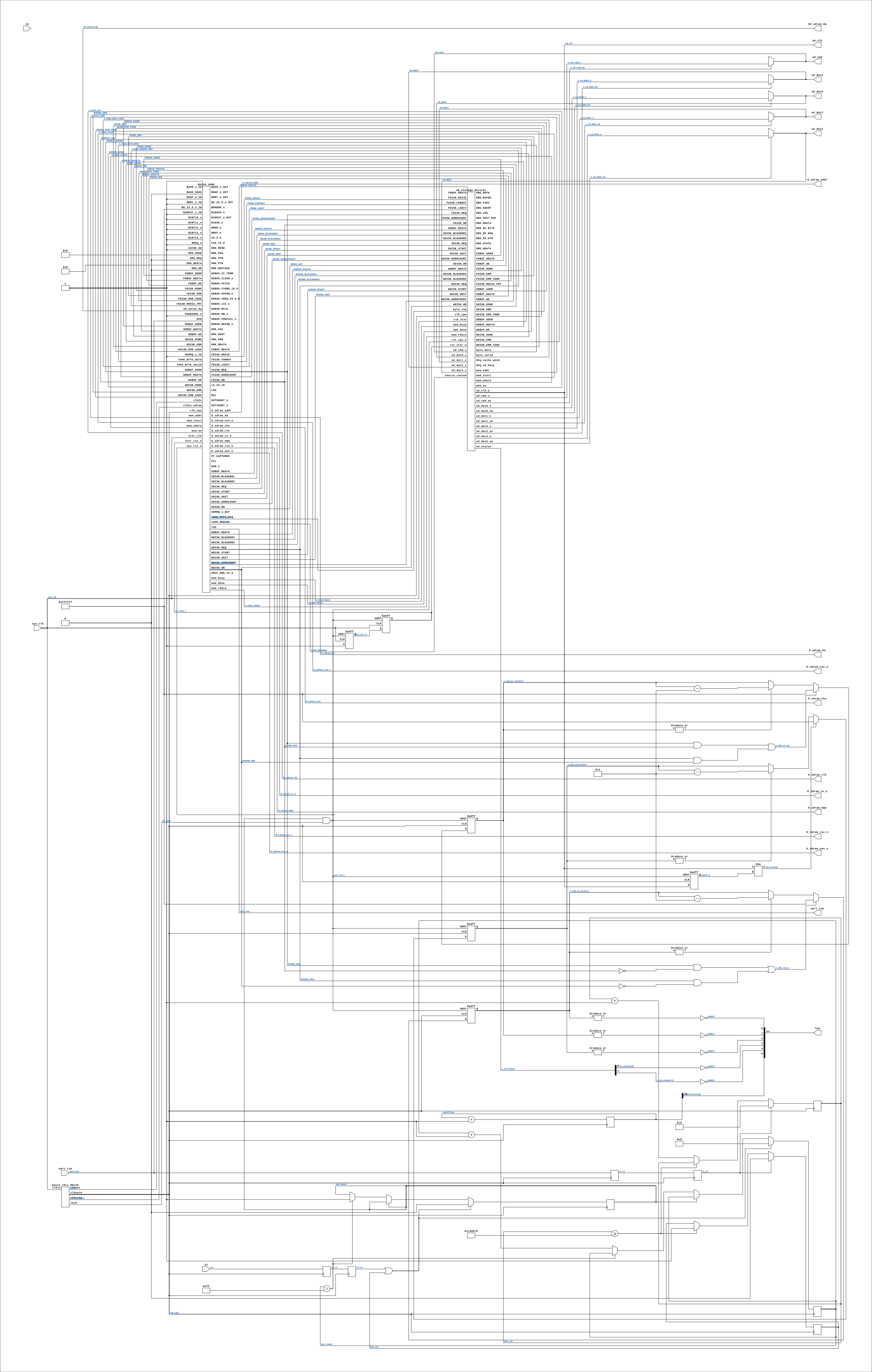
Contains: Gowin_rPLL_ND120 (vendor), ND120_CORE, nd_storage_devices, uart_tx
Module hierarchy - All modules
Schematic
Drawn from the Verilog: the yosys netlist of the Tang Nano 20K build, where it is the top. Sub-modules are boxes (click the picture to open it full size; there every sub-module box links to its page, and every wire shows its Verilog name).
Description
ND120 CPU, MEMORY MANAGEMENT and MEMORY TOP LEVEL FOR THE TANG NANO 20K (Gowin GW2AR-18) Sibling of ND120_TOP.v (the Basys3/Verilator top) - the Basys3 top is untouched by this file. Board decisions (8-JUL-2026): - one rPLL: 27 MHz CPU/bus/OSC + 54 MHz SDRAM clock pair - main memory = embedded 8 MB SDRAM (MEM_RAM_49_SDRAM, 2 banks) - microcode: SKIP_WCS_LOAD bitstream-preloaded WCS, PROM dropped - console: OPCOM UART 9600 on the BL616 USB serial (pins 69/70) - S1 = Master Clear (power-on-reset retrigger), S2 spare Build defines come from src/tang20k_defines.v (first file in the Gowin project). Last reviewed: 8-JUL-2026 Ronny Hansen
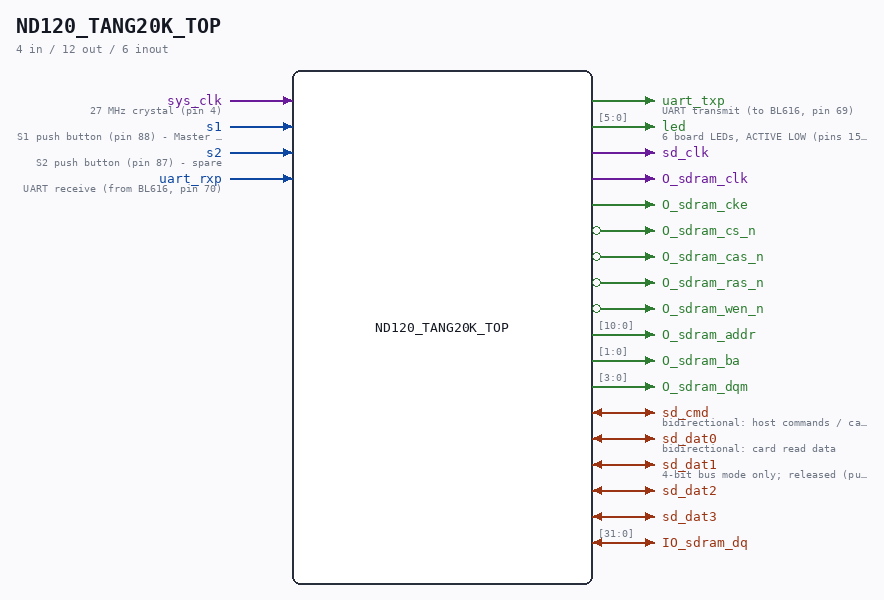
Ports
| Direction | Width | Name | Description |
|---|---|---|---|
| input | 1 |
sys_clk |
27 MHz crystal (pin 4) |
| input | 1 |
s1 |
S1 push button (pin 88) - Master Clear / reset |
| input | 1 |
s2 |
S2 push button (pin 87) - spare |
| input | 1 |
uart_rxp |
UART receive (from BL616, pin 70) |
| output | 1 |
uart_txp |
UART transmit (to BL616, pin 69) |
| output | [5:0] |
led |
6 board LEDs, ACTIVE LOW (pins 15-20) |
| output | 1 |
sd_clk |
|
| inout | 1 |
sd_cmd |
bidirectional: host commands / card responses |
| inout | 1 |
sd_dat0 |
bidirectional: card read data |
| inout | 1 |
sd_dat1 |
4-bit bus mode only; released (pulled high) otherwise |
| inout | 1 |
sd_dat2 |
|
| inout | 1 |
sd_dat3 |
|
| output | 1 |
O_sdram_clk |
|
| output | 1 |
O_sdram_cke |
|
| output | 1 |
O_sdram_cs_n (active low) |
|
| output | 1 |
O_sdram_cas_n (active low) |
|
| output | 1 |
O_sdram_ras_n (active low) |
|
| output | 1 |
O_sdram_wen_n (active low) |
|
| inout | [31:0] |
IO_sdram_dq |
|
| output | [10:0] |
O_sdram_addr |
|
| output | [1:0] |
O_sdram_ba |
|
| output | [3:0] |
O_sdram_dqm |
Verilog source
Verilog/fpga/tang-nano-20k/src/ND120_TANG20K_TOP.v on GitHub.
Show the Verilog of ND120_TANG20K_TOP (2434 lines)
/**************************************************************************
** ND120 CPU, MEMORY MANAGEMENT and MEMORY **
** **
** TOP LEVEL FOR THE TANG NANO 20K (Gowin GW2AR-18) **
** **
** Sibling of ND120_TOP.v (the Basys3/Verilator top) - the Basys3 top **
** is untouched by this file. Board decisions (8-JUL-2026): **
** - one rPLL: 27 MHz CPU/bus/OSC + 54 MHz SDRAM clock pair **
** - main memory = embedded 8 MB SDRAM (MEM_RAM_49_SDRAM, 2 banks) **
** - microcode: SKIP_WCS_LOAD bitstream-preloaded WCS, PROM dropped **
** - console: OPCOM UART 9600 on the BL616 USB serial (pins 69/70) **
** - S1 = Master Clear (power-on-reset retrigger), S2 spare **
** Build defines come from src/tang20k_defines.v (first file in the **
** Gowin project). **
** **
** Last reviewed: 8-JUL-2026 **
** Ronny Hansen **
***************************************************************************/
module ND120_TANG20K_TOP (
input wire sys_clk, //! 27 MHz crystal (pin 4)
input wire s1, //! S1 push button (pin 88) - Master Clear / reset
input wire s2, //! S2 push button (pin 87) - spare
input wire uart_rxp, //! UART receive (from BL616, pin 70)
output wire uart_txp, //! UART transmit (to BL616, pin 69)
output wire [5:0] led, //! 6 board LEDs, ACTIVE LOW (pins 15-20)
// microSD slot (SD-native mode). Pin map and PULL_MODE come from the
// silicon-proven sd-fat-test/src/nano20k_sd.cst - the slot has external
// 10K pull-ups (R53-R57), so released lines idle high. Only CMD and DAT0
// are used: the storage reader is 1-bit (the 4-bit writer is not built in
// this design), so DAT1-3 are not brought out at all.
output wire sd_clk,
inout wire sd_cmd, //! bidirectional: host commands / card responses
inout wire sd_dat0, //! bidirectional: card read data
inout wire sd_dat1, //! 4-bit bus mode only; released (pulled high) otherwise
inout wire sd_dat2,
inout wire sd_dat3,
// Embedded SDRAM ("magic" port names - Gowin EDA connects these to the
// on-package SDRAM die automatically; the OSS flow pins them in a cst)
output O_sdram_clk,
output O_sdram_cke,
output O_sdram_cs_n,
output O_sdram_cas_n,
output O_sdram_ras_n,
output O_sdram_wen_n,
inout [31:0] IO_sdram_dq,
output [10:0] O_sdram_addr,
output [ 1:0] O_sdram_ba,
output [ 3:0] O_sdram_dqm
);
/**********************************************
* Clocks: 27 MHz CPU/bus + 54 MHz SDRAM pair *
***********************************************/
wire clk2x; // 54 MHz - SDRAM controller
wire clk2x_sdram; // 54 MHz shifted - SDRAM chip
wire pll_lock;
`ifdef SIM
// Simulation (iverilog testbench): no rPLL primitive. sys_clk plays the
// 2x clock; clk_cpu is an edge-aligned divide-by-2, clk2x_sdram is the
// 180-degree inversion - same relationships the PLL provides.
reg clk_cpu_div = 0;
always @(posedge sys_clk) clk_cpu_div <= ~clk_cpu_div;
assign clk2x = sys_clk;
assign clk2x_sdram = ~sys_clk;
wire clk_cpu = clk_cpu_div;
assign pll_lock = 1'b1;
`else
wire clk_cpu; // 27 MHz - CPU / bus / OSC domain
Gowin_rPLL_ND120 pll (
.clkout (clk2x),
.clkoutp(clk2x_sdram),
.clkoutd(clk_cpu),
.lock (pll_lock),
.clkin (sys_clk)
);
`endif
/**********************************************
* Reset: power-on + S1 (Master Clear) *
***********************************************/
// Same scheme as ND120_TOP's FPGA branch: hold sys_rst_n low for 256
// clk_cpu cycles after PLL lock; pressing S1 (active high) restarts the
// counter, retriggering the full CPU boot sequence.
reg s1_r1, s1_r2;
always @(posedge clk_cpu) begin
s1_r1 <= s1;
s1_r2 <= s1_r1;
end
// Remote reset: a UART BREAK on the console RX (line held LOW for >=200 ms,
// ~2 character times would be enough but 200 ms rejects any glitch) acts
// exactly like pressing S1. BREAK is out-of-band: normal typed characters
// and ndcomm's binary deposit streams always return the line high between
// frames, so nothing legitimate can fake it. Host side: send a break
// (python termios.tcsendbreak / picocom C-a C-\ ) to reset the board
// without touching it.
localparam integer BREAK_CYCLES = (`BOARD_CLK_FREQ / 5); // 200 ms of low
reg [24:0] brk_cnt = 25'd0;
reg brk_rst = 1'b0;
reg rx_r1 = 1'b1, rx_r2 = 1'b1;
always @(posedge clk_cpu) begin
rx_r1 <= uart_rxp;
rx_r2 <= rx_r1;
if (rx_r2) begin
brk_cnt <= 25'd0;
brk_rst <= 1'b0;
end else if (brk_cnt >= BREAK_CYCLES[24:0]) begin
brk_rst <= 1'b1; // held until the line returns high
end else begin
brk_cnt <= brk_cnt + 1'b1;
end
end
reg [7:0] por_count = 8'd0;
reg por_done = 1'b0;
always @(posedge clk_cpu) begin
if (s1_r2 | brk_rst) begin // S1 pressed or console BREAK: Master Clear
por_count <= 8'd0;
por_done <= 1'b0;
end else if (!por_done) begin
if (por_count == 8'hFF) por_done <= 1'b1;
else por_count <= por_count + 1'b1;
end
end
wire sys_rst_n = por_done & pll_lock;
/**********************************************
* ND-100 bus: tied off (no external bus) *
***********************************************/
wire [12:0] CSA_12_0 /* synthesis syn_keep=1 */; // GAO probe net - see GAO-HOWTO.md
wire [3:0] s_pil_3_0 /* synthesis syn_keep=1 */; // PIL for the grant-capture probe (TANG_GRANT_CAPTURE)
wire [15:0] s_ireq_15_0_n /* synthesis syn_keep=1 */; // raw interrupt-request vector (active low) for grant-source capture
wire [15:0] s_xmic_dbg /* synthesis syn_keep=1 */; // microsequencer address-advance probe (Tang 06000-hang root cause)
wire BREQ_n = 1'b1;
wire BINT10_n = 1'b1;
wire BINT11_n = 1'b1;
wire BINT12_n = 1'b1;
wire BINT13_n = 1'b1;
wire BINT15_n = 1'b1;
wire POWSENSE_n = 1'b1;
wire [23:0] BD_23_0_n_IN = 24'hFFFFFF; // pulled high (inactive)
wire SEMRQ_n_IN = 1'b1;
wire BINPUT_n_IN = 1'b1;
wire BDAP_n_IN = 1'b1;
wire BDRY_n_IN = 1'b1;
wire BAPR_n_IN = 1'b1;
// Installation number, the s_high/s_low helpers, SEL_TESTMUX and the baud
// rate thumbwheel (8 = 9600 baud, BAUDV microcode page 158) are CPU-board
// constants and now live inside ND120_CORE.v -- not duplicated per board.
// UART_BAUD_RATE in tang20k_defines.v must still match 9600.
/**********************************************
* Status / debug wires *
***********************************************/
wire [6:0] s_cpu_led; // ND3202D LED bundle, see ND3202D.v port comment
wire s_run; // RUN_n: low while the CPU is running
wire [4:0] s_debug_cc_term;
wire s_debug_mclk, s_debug_lcs_n, s_debug_fetch;
wire s_debug_mr_n, s_debug_clear_n, s_debug_refrq_n;
wire s_debug_intrq_n, s_debug_powfail_n;
wire [15:0] s_debug_fidbo;
wire [13:0] s_debug_la_23_10;
wire [9:0] s_debug_ca_9_0;
wire [4:0] s_test_4_0;
wire [4:0] s_dp_5_1_n;
wire s_tp1_intrq_n;
wire [63:0] s_csbits;
reg [26:0] clockTicks;
always @(posedge clk_cpu) clockTicks <= clockTicks + 1'b1;
//! WIDE tick counter for timestamping a whole boot.
//! clockTicks above is 27 bits, which at clk_cpu wraps about every 20 s - it
//! is a heartbeat for led[5], not a timebase. The boot reaches the ERRFATAL
//! at roughly 143 s, so timestamping it needs a counter that does not wrap:
//! 40 bits is ~45 hours at 6.75 MHz.
reg [39:0] tickWide = 40'd0;
always @(posedge clk_cpu) tickWide <= tickWide + 1'b1;
/* verilator lint_off UNUSEDSIGNAL */
wire unused_s2 = s2;
/* verilator lint_on UNUSEDSIGNAL */
/**********************************************
* LEDs (ACTIVE LOW): agreed bring-up set *
***********************************************/
// s_cpu_led[3] = LED_CPU_GRANT_INDICATOR (= CGNT_n, low when granted)
// s_cpu_led[4] = LED_BUS_GRANT_INDICATOR (= BGNT_n, low when granted)
// s_cpu_led[2] = LED4_RED_PARITY_ERROR (polarity: verify on first light)
// WRITE-GENERATION ANALYZER BUILD (8-JUL-2026 late): bus retargeted at
// the DGA WRITE chain (see ND3202D.v DBG_MEMW assign for the bit map).
// [7] = wdec (F924 A160 D3 decode input), [6] = WRITE (registered out).
wire [15:0] s_dbg_memw;
wire [15:0] s_dbg_ptw; // page-table write stream from CPU_MMU_24 (23-AUG)
wire [1:0] s_dbg_wdstage; // [0] WD controller active, [1] its DMA busy
wire s_dbg_sd_busy, s_dbg_cache_pend;
wire [15:0] s_dbg_pgw; // SDRAM-bridge page-write watch (24-AUG zero-page campaign)
wire [13:0] s_dbg_ppn; // physical page number PPN[23:10] (24-AUG zero-fetch campaign)
wire [20:0] s_pf_captured; // ND120_PF_CAPTURE: [0] frozen, [1] no-permit access pulse, [2] fault pulse at the matched page, [3] fault pulse ANY address with [13:4]=LA[19:10] [20:14]=PT[15:9] (23-AUG)
wire dbg_dumping;
`ifdef TANG_WD_TRACE_DUMP
wire [19:0] wd_trace_rec;
wire wd_trace_we;
wire wd_trace_done;
`endif
reg wdec_seen, write_seen; // sticky since arm (write-path analyzer)
// The LED assignments live further down, AFTER the storage block declares
// the signals they show - see "STORAGE BRING-UP LED SET".
/**********************************************
* The CPU board *
***********************************************/
/**********************************************
* On-chip write-path analyzer (clk2x domain) *
***********************************************/
// 512 samples of the 16-bit bus at clk2x; trigger = first rising edge of
// the write DECODE (bit [7], the F924 D3 input) after a ~2.5 s arm delay
// (skips boot; deposit at the console fires it). 64 pre-trigger + 448
// post, so the whole decode -> WRITE -> ECREQ -> grant -> RAS/CAS
// sequence lands after the trigger. Then dumps "hhhh\r\n" x512 over the
// UART at 9600 (taking the TX pin over from the CPU console).
// If LED3 (decode seen) never lights, the decode itself never fires on
// silicon - that is a result too.
// Capture source / trigger / pre-post split are switchable:
// - default: the write-path analyzer (source = s_dbg_memw, trigger = write
// decode rising, 64 pre + 448 post).
// - TANG_GRANT_CAPTURE: the masked-level-10 grant probe. Source packs
// {PIL[3:0], CSA[11:0]}; trigger = PIL entering level 10 (0->10 is the
// silicon wedge); 448 PRE + 64 post so the whole lead-up to the switch is
// recorded. Reading back the CSA sequence shows whether PIL->10 goes
// through the normal level-switch microcode (PLINT 01133 / PLVO 01140 /
// LVSWP 01146-01155, as a legit level-13 switch does in sim) or bypasses
// it - the decisive fork for the root cause.
// Ring depth. The free-running capture modes want every one of 512 clocks;
// the WD IOX trace stores one entry per REGISTER ACCESS, and the sequence
// it has to catch is about 33 accesses long. At 20 bits Gowin puts this in
// distributed RAM (SSRAM), not block RAM, so depth is paid for in LOGIC
// cells: 512 deep overflowed the part by 114 cells (20850 of 20736) with
// the Winchester build in, and 128 deep STILL overflowed it by 9 (20745)
// once the Winchester and the floppy were both in - measured 09-AUG-2026.
//
// 64 is still comfortably enough for the sequence that matters. The
// captured File System Investigator trace (nd100x, ND100X_WD_DEBUG=1) is
// 72 accesses END TO END for a whole LIST-FILE-NAMES, and the trigger - a
// read of +0 - first fires at access 17, so a 64-deep ring holds every
// access from power-on up to and including the first failing transfer.
//
// 10-AUG-2026: 64 was NOT enough for the '20500&' mass load. That sequence
// is hundreds of accesses long, so a 64-deep ring wrapped and returned only
// its tail - every transfer in it completed with status 060010 and a
// correctly advanced memory address register, which says nothing about
// where the guest decided the load had failed. 256 buys the whole window,
// and the cells for it come from building this diagnostic with TANG_FLOPPY
// off: the mass load never touches the floppy, and its ND_FLOPPY_DMA plus
// its own DMA master are the largest block that can be removed without
// changing what the Winchester path does.
`ifdef TANG_WD_TRACE_DUMP
localparam CAP_AW = 8;
`else
localparam CAP_AW = 9;
`endif
localparam [CAP_AW-1:0] CAP_LAST = {CAP_AW{1'b1}};
reg [19:0] cap_mem[0:(1<<CAP_AW)-1]; // 20 bits: rw + register + data
reg [CAP_AW-1:0] cap_wptr;
reg [8:0] cap_post;
reg [28:0] arm_cnt; // 30-JUL: widened 25->29 bits (arm ~40s, was ~2.5s) -
// the WCS microcode load keeps CSA STATIC longer than
// 2.5s, so the hang trigger fired mid-load and the
// dumper seized the TX pin before the console ever
// spoke (SRAM-load-no-boot mystery, plan Issue I).
reg cap_armed, cap_trig, cap_done;
`ifdef TANG_PC_HISTORY
reg [19:0] pc_prev = 20'd0; //! previous {PIL,P}; the strobe fires on a change
reg [ 9:0] la_prev_pc = 10'd0; //! previous LA[19:10]; the trigger is its EDGE
//! FALLBACK TRIGGER. The first run (22-AUG-2026) reproduced the ERRFATAL but
//! produced NO dump at all - zero bytes at every baud - and there was no way
//! to tell "the LA trigger never fired" from "the dumper ran and sent
//! nothing". This counter guarantees a dump either way: if the LA match has
//! not fired by ~298 s (the fault lands at ~150 s, so it gets first refusal),
//! trigger anyway. A trail ending in 0644xx means the LA match won; a trail
//! ending anywhere else means it did not, and the ring/dumper chain is
//! nonetheless proven to work.
//!
//! TIMING, worked out rather than guessed: the counter only runs once
//! cap_armed is set, which is arm_cnt reaching 0x1FFFFFFF = 536,870,911
//! clk2x cycles = 39.8 s at 13.5 MHz. Bit 31 then sets after a further
//! 2^31 = 2,147,483,648 cycles = 159.1 s. So the fallback fires about
//! 199 s after reset. The measured boot reaches the ERRFATAL about 143 s
//! after the boot command, and the dump follows cap_done by the ~10 s
//! hold_cnt delay, so a real LA match still dumps first with room to spare.
reg [31:0] fallback_cnt = 32'd0;
reg [ 1:0] post_word = 2'd0; //! which half of the tick to emit after the trigger
reg [39:0] tick_at_trig = 40'd0; //! tickWide latched the cycle the trigger fired
//! LOOP SUPPRESSOR (22-AUG-2026). Run 3 spent 465 of its 502 ring entries on
//! ONE three-instruction loop - the ERRFATAL console print at 0o31444 /
//! 0o31445 / 0o31446 spinning on the 9600-baud transmitter - so the trail
//! never reached back to the page fault. These hold the last FOUR words
//! actually written to the ring; a word that matches any of them is not
//! written again, which collapses any loop of up to four instructions to its
//! first iteration and leaves the 512 entries to cover real forward progress.
//!
//! The comparison is on the FULL 20-bit word {PIL,P}, not on P alone, so the
//! same address executed at a different interrupt level is still recorded -
//! a level switch must never be swallowed by the filter.
//!
//! Once the loop's three words occupy p_r0..p_r2 the shift register stops
//! moving (every iteration matches), so suppression is stable for as long as
//! the loop runs, however many millions of times it goes round.
//!
//! COST OF THIS FILTER, stated so the trail is not misread: the dump is a
//! list of DISTINCT-within-4 program counters, NOT an instruction count. A
//! tight loop appears once. Nothing in the trail says how long anything took.
reg [19:0] p_r0 = 20'd0, p_r1 = 20'd0, p_r2 = 20'd0, p_r3 = 20'd0;
`endif
`ifdef TANG_JPL_CAPTURE
//! MICROCODE-ADDRESS CAPTURE across the two JPL I 111 instructions.
reg [12:0] csa_cap_prev = 13'd0; //! last CSA written to the ring
reg [15:0] pc_cap_prev = 16'd0; //! last PC written to the ring
reg [15:0] fid_cap_prev = 16'd0; //! last FIDBO word written to the ring
reg [13:0] ppn_cap_prev = 14'd0; //! last PPN written to the ring
reg jpl_win = 1'b0; //! open while the window runs
reg jpl_done = 1'b0; //! one window only
reg [ 9:0] jpl_cnt = 10'd0; //! hard bound on the window
`endif
reg wdec_d2;
reg [3:0] pil_prev;
// TRAPN is ACTIVE LOW and is asserted only for the dispatch microcycle, so
// its previous value is what makes a one-record-per-trap strobe possible.
// Sampling at the PIL->14 transition instead is TOO LATE: measured
// 11-AUG-2026, all 255 records came back TVEC=15 TRAPN=1, the idle state.
reg trapn_prev;
// Sticky "has this machine EVER executed the page-in microcode" flags.
// CLPT = 0o5705 unmaps a victim page, ENPT = 0o5706 maps the new one in.
// Set once and never cleared, so a single ring dump answers the question
// even though the ring itself only covers a few microseconds.
reg seen_enpt, seen_clpt;
always @(posedge clk2x or negedge sys_rst_n) begin
if (!sys_rst_n) begin
seen_enpt <= 1'b0;
seen_clpt <= 1'b0;
end else begin
if (CSA_12_0 == 13'o5706) seen_enpt <= 1'b1;
if (CSA_12_0 == 13'o5705) seen_clpt <= 1'b1;
end
end
reg [4:0] estate_prev;
reg [7:0] rxraw_prev;
reg [31:0] lba_prev;
reg [15:0] wdata_prev;
reg [12:0] csa_prev;
reg [21:0] csa_stable; // clk2x cycles the microcode CSA has been unchanged
`ifdef TANG_PF_CAPTURE
// ---------------------------------------------------------------------------
// FIRST PAGE-FAULT FREEZE REGISTER readout (21-AUG-2026).
//
// ND120_PF_CAPTURE (inside CGA) froze the trap-logic inputs at the TCLK edge
// that latched a page-fault vector. It emits that 56-bit word through
// XMIC_DBG_15_0 as four 14-bit slices, slice index in [15:14]:
//
// slice 0 -> frozen[13:0] PT_15_9[6:0], VACC, LA[5:0]
// slice 1 -> frozen[27:14] LA[13:6]
// slice 2 -> frozen[41:28] TVEC, PVIOL, RESTR, ptram CS_n/OE_n,
// captured(bit 2), strobes_valid(bit 3), cycle[9:0]
// slice 3 -> frozen[55:42] cycle[23:10]
//
// Full layout and the decode are in
// Verilog/fpga/tang-nano-20k/PLAN-pagefault-root-cause.md (retired, git 043c460)
//
// NOTE: while this define is set, XMIC_DBG_15_0 carries the capture readout,
// NOT the microsequencer address-advance probe. Do not decode it as the latter.
//
// Trigger: the frozen word's `captured` flag is bit 30, which lands in slice 2
// at bit 2. Latch it when that slice goes past, so the dump fires once the
// evidence actually exists rather than on a rotation of an empty register.
// Slice index is THREE bits ([15:13]) and the payload is 13 bits. The
// `captured` flag is frozen[30], and slice 2 carries frozen[38:26], so it
// arrives at payload bit 30-26 = 4.
//
// Measured 21-AUG-2026: this trigger was left decoding the OLD 2-bit index
// and bit 2 after the word was widened. `[15:14] == 2'd2` then matched
// slices 4 AND 5, bit 2 of those payloads is arbitrary, so pf_seen set at
// power-up, the dumper took the TX pin immediately and streamed zeros. The
// layout has THREE consumers - this file, ND120_PF_CAPTURE.v and
// pf_capture_run.py - and all three must move together.
reg pf_seen = 1'b0;
reg [1:0] pf_s5_cnt = 2'd0;
reg [2:0] pf_slice_prev;
always @(posedge clk_cpu) begin
pf_slice_prev <= s_xmic_dbg[15:13];
// Trigger on c_next_valid (frozen[71]), NOT on `captured` (frozen[30]).
// c_next_valid means the DISCRIMINATOR sample - PT one capturing edge
// AFTER the fault - has actually been taken. Triggering on `captured`
// dumped the ring before that sample existed and the readout came back
// "NOT TAKEN", losing the one field that separates a real page fault from
// a late-arriving page-table entry. frozen[71] is slice 5 payload bit 6.
// Fire only after a COMPLETE post-capture rotation is in the ring.
//
// Measured 21-AUG-2026: triggering on the first sighting of slice 5 ended
// the dump immediately after it, so the rotation never wrapped back to
// slice 0 and the ring held only the STALE pre-capture slice 0 (501 copies
// of 0x0000). Slice 0 carries c_pt and c_vacc, so both came back as zeros
// that were never measured - which is what produced the impossible
// "PVIOL=1 with VACC=0" word.
//
// Counting two sightings of slice 5 guarantees slices 0..5 have all been
// emitted from the frozen, immutable word before the dump starts.
// Trigger on the LAST slice (7), not on a captured-only field. The readout
// now rotates either after a capture OR after a census timeout, so slice 7
// appearing twice means a complete word is in the ring in BOTH cases -
// including the case where nothing was captured and only the census has
// anything to say.
if ((s_xmic_dbg[15:13] == 3'd7) &&
(s_xmic_dbg[15:13] != pf_slice_prev)) begin
if (pf_s5_cnt == 2'd1) pf_seen <= 1'b1;
else pf_s5_cnt <= pf_s5_cnt + 1'b1;
end
end
wire [19:0] s_cap_src = {4'd0, s_xmic_dbg[15:0]};
// One sample per slice: the slice rotates far slower than clk_cpu, so a
// change-detect records each slice exactly once instead of thousands of times.
wire s_cap_stb = (s_xmic_dbg[15:13] != pf_slice_prev);
wire s_cap_arm = cap_armed;
/* verilator lint_off UNUSEDSIGNAL */
wire s_hang = &csa_stable; // deliberately NOT used - see below
/* verilator lint_on UNUSEDSIGNAL */
// TRIGGER ON THE CAPTURED FAULT ONLY. Do NOT or-in s_hang.
//
// Measured 21-AUG-2026: with `pf_seen || s_hang` the board emitted 7940
// NUL bytes and nothing else. s_hang is "CSA unchanged for 2^22 cycles",
// which is exactly what the WCS microcode load looks like, so the dump
// triggered during the load, dump_fin latched permanently, and the dumper
// held the TX pin forever. The console never spoke, the boot command was
// never accepted, and no page fault could ever happen. The comment on
// arm_cnt above warns about precisely this.
//
// This experiment NEEDS the console alive: a human types '20500&' and the
// fault arrives 25+ minutes later. Only the real capture may take the pin.
wire s_cap_event = pf_seen;
// All six slices must be recorded AFTER the trigger, and the rotation is
// slow, so keep collecting well past the event.
localparam [8:0] CAP_POST = 9'd2;
`elsif TANG_PTWR_CAPTURE
// ---------------------------------------------------------------------------
// PAGE-TABLE WRITE HISTORY (23-AUG-2026, zero-read campaign).
//
// Measured that day on silicon: the fault at the VA-064540 page dispatches
// (TVEC=1) and the handler reads the CORRECT page in PGS - yet the page
// never becomes resident and refaults forever. Surviving suspect: the
// handler's page-table entry WRITE is lost or lands at the wrong map-RAM
// index. This variant records the write stream itself.
//
// Source = DBG_PTW from CPU_MMU_24 (via CPU_15/ND3202D/ND120_CORE): on each
// PT-chip write strobe (EPT_n low & WMAP_n low) two words appear on
// consecutive sysclks, idle 16'h0000 otherwise:
// word A = {2'b10, addr[10:0], data[15:13]} addr = raw LA_20_10 index
// word B = {2'b11, data[12:0], 1'b0}
// The ring strobes only on nonzero-tag words, so 512 entries = the last
// ~256 writes (addr+data pairs) before the trigger.
//
// Trigger = the ERRFATAL printer signature (PIL 14 with the microcode at
// 004546, same event as TANG_PC_HISTORY) OR the frozen-CSA detector.
// CAP_POST is small so post-trigger noise cannot evict the history.
//
// The decode: for each A/B pair, addr XOR 0o1400 (top two table bits are
// complemented) = the SOFTWARE page-table index. The question the dump
// answers: does any write land at software 0o432 (raw 0o1032, the page that
// refaults), and if not, where DID the handler's writes go?
wire [19:0] s_cap_src = {4'hB, s_dbg_ptw};
wire s_cap_stb = (s_dbg_ptw[15:14] != 2'b00);
wire s_cap_arm = cap_armed;
wire s_hang = &csa_stable;
wire s_cap_event = ((s_pil_3_0 == 4'd14) && (s_xmic_dbg[15:0] == 16'o004546))
|| s_hang;
localparam [8:0] CAP_POST = 9'd8;
`elsif TANG_STAGE_TIMER
// ---------------------------------------------------------------------------
// WHERE DOES A DISC OPERATION'S ~1 SECOND GO? (24-AUG-2026)
//
// Measured: the oracle needs 221 disc operations to start S3; the Tang takes
// 234 s for the same step, and led[0] blinks about once a second - so the
// COUNT is sane and each operation costs ~1 s. The known terms account for
// ~23 ms of that: 8 ms modelled drive latency (ND120_CORE.v:373), ~6 ms of
// SD wire time, ~7.7 ms of DMA, ~1.4 ms of CDC handshake. ~977 ms per
// operation is unexplained, and guessing which stage owns it has been wrong
// twice, so this measures every stage instead.
//
// Free-running tick accumulators, all on clk_cpu, dumped as totals:
// t_wd ticks while the Winchester controller is ACTIVE (a command is
// outstanding) - the wall clock a disc operation costs
// t_dma ticks while that card's DMA master is busy
// t_sd ticks while the SD writer is reading the card
// t_cache ticks while a cache lookup is outstanding
// n_ops completed operations (falling edge of active)
// t_all total ticks, so shares can be worked out
//
// READING IT: t_wd/n_ops is the true per-operation cost. If t_dma, t_sd and
// t_cache together are far less than t_wd, the card is idle and WAITING -
// and none of the three suspects is the answer.
reg [39:0] t_all = 40'd0, t_wd = 40'd0, t_dma = 40'd0, t_sd = 40'd0, t_cache = 40'd0;
reg [23:0] n_ops = 24'd0;
reg wd_act_d = 1'b0;
always @(posedge clk_cpu) begin
t_all <= t_all + 40'd1;
if (s_dbg_wdstage[0]) t_wd <= t_wd + 40'd1;
if (s_dbg_wdstage[1]) t_dma <= t_dma + 40'd1;
if (s_dbg_sd_busy) t_sd <= t_sd + 40'd1;
if (s_dbg_cache_pend) t_cache <= t_cache + 40'd1;
wd_act_d <= s_dbg_wdstage[0];
if (wd_act_d && !s_dbg_wdstage[0]) n_ops <= n_ops + 24'd1;
end
// Dump on the frozen-CSA detector or on a long timer, whichever comes first;
// the operator simply lets S3 run and the totals cover the whole window.
// 36 bits: bit 33 is the ~5.3 minute mark at 27 MHz (2^33 / 27e6 = 318 s),
// long enough to cover a cold S3 start. A 32-bit counter cannot be indexed
// at [33] - Gowin catches that as EX3784 where a -Wno-fatal lint does not.
reg [35:0] st_tmr = 36'd0;
always @(posedge clk_cpu) if (cap_armed && !cap_trig) st_tmr <= st_tmr + 36'd1;
// Serialise the counters into the ring CONTINUOUSLY, on clk2x (the ring's
// own domain), so the last 18 records before the freeze are always a fresh
// snapshot. The first version emitted records only AFTER cap_trig, which
// cannot work: this ring is a PRE-trigger recorder and `cap_post` counts
// down in clk2x CYCLES, not strobes, so the window shuts microseconds after
// the trigger and nothing was ever written. Measured 24-AUG-2026: zero
// records dumped.
reg [4:0] st_idx = 5'd0;
reg [9:0] st_div = 10'd0;
reg [19:0] st_word = 20'd0;
reg st_stb = 1'b0;
always @(posedge clk2x) begin
st_stb <= 1'b0;
st_div <= st_div + 10'd1;
if (st_div == 10'd0) begin // one record per 1024 clk2x cycles
st_stb <= 1'b1;
st_idx <= (st_idx == 5'd17) ? 5'd0 : st_idx + 5'd1;
case (st_idx)
5'd0: st_word <= {4'h1, t_all[15:0]};
5'd1: st_word <= {4'h1, t_all[31:16]};
5'd2: st_word <= {4'h1, 8'd0, t_all[39:32]};
5'd3: st_word <= {4'h2, t_wd[15:0]};
5'd4: st_word <= {4'h2, t_wd[31:16]};
5'd5: st_word <= {4'h2, 8'd0, t_wd[39:32]};
5'd6: st_word <= {4'h3, t_dma[15:0]};
5'd7: st_word <= {4'h3, t_dma[31:16]};
5'd8: st_word <= {4'h3, 8'd0, t_dma[39:32]};
5'd9: st_word <= {4'h4, t_sd[15:0]};
5'd10: st_word <= {4'h4, t_sd[31:16]};
5'd11: st_word <= {4'h4, 8'd0, t_sd[39:32]};
5'd12: st_word <= {4'h5, t_cache[15:0]};
5'd13: st_word <= {4'h5, t_cache[31:16]};
5'd14: st_word <= {4'h5, 8'd0, t_cache[39:32]};
5'd15: st_word <= {4'h6, n_ops[15:0]};
5'd16: st_word <= {4'h6, 8'd0, n_ops[23:16]};
default: st_word <= {4'h7, 16'hA5A5}; // frame marker
endcase
end
end
wire [19:0] s_cap_src = st_word;
wire s_cap_stb = st_stb;
wire s_cap_arm = cap_armed;
wire s_hang = &csa_stable;
// freeze ~318 s after arming (2^33 clk_cpu ticks at 27 MHz) - mid-S3
wire s_cap_event = st_tmr[33] || s_hang;
localparam [8:0] CAP_POST = 9'd2;
`elsif TANG_PGW_CAPTURE
// ---------------------------------------------------------------------------
// DID ANY WRITE EVER REACH THE PAGE THE CPU FETCHES ZEROS FROM?
// (24-AUG-2026, run 16)
//
// Run 15 measured the fetch at 064544 resolving to PPN 0o3770 = physical
// page 2040 = {BANK2, row 1016} - REAL, POPULATED memory that still reads
// 000000. So the disc data was never stored there. This records every
// access to that page's 8-page neighbourhood (rows 1016..1023, both banks)
// AT THE SDRAM BRIDGE, the last point before the chip, so a transfer that
// never arrives cannot be mistaken for one that did.
//
// {4'hB, DBG_PGW} tag 10 = write word A (bank+row+data[15:13])
// tag 11 = write word B (data[12:0])
// tag 01 = a READ of the same window
//
// Reading it: writes present with real data -> the data WAS stored and
// something cleared or re-mapped it afterwards. Only reads, no writes ->
// the Winchester transfer never targeted this page, and the next question
// is the physical address the DMA presents against the one the MMU resolves.
wire pgw_act = (s_dbg_pgw[15:14] != 2'b00);
reg [15:0] pgw_prev = 16'd0;
always @(posedge clk2x) pgw_prev <= s_dbg_pgw;
wire [19:0] s_cap_src = {4'hB, s_dbg_pgw};
wire s_cap_stb = pgw_act && (s_dbg_pgw != pgw_prev);
wire s_cap_arm = cap_armed;
wire s_hang = &csa_stable;
wire s_cap_event = ((s_pil_3_0 == 4'd14) && (s_xmic_dbg[15:0] == 16'o004546))
|| s_hang;
localparam [8:0] CAP_POST = 9'd8;
`elsif TANG_PTORD_CAPTURE
// ---------------------------------------------------------------------------
// ORDERING: PAGE-TABLE WRITES vs NO-PERMIT ACCESSES, ONE PAGE, ONE RING
// (23-AUG-2026, Phase 1b of PLAN-pf-campaign-prio.md, git 043c460)
//
// THE CONTRADICTION THIS SETTLES. Both were measured on silicon on the same
// boot, and they cannot both describe the same moment:
// - the handler WRITES a granting entry (raw index 0o1032, data 066001)
// for the page that keeps faulting;
// - the freeze register still catches a COMMITTED ACCESS at that same page
// whose entry grants nothing (PT[6:4] == 000).
//
// No shared timestamp is needed: one ring, written in time order, IS the
// order. Both sources strobe the same ring.
// {4'hB, DBG_PTW} page-table write traffic at THIS index
// only (tag 10 = pair word A, 11 = word B,
// 01 = IDB->PT attempt); same word format
// as TANG_PTWR_CAPTURE, so
// ptwr_capture_decode.py decodes it
// {4'hC, 4'd0, acc_cnt[11:0]} a no-permit access at the matched page
// {4'hD, 4'd0, flt_cnt[11:0]} a page-fault vector at the matched page
//
// READING THE DUMP: if a 4'hC marker appears AFTER a granting write pair,
// the map RAM is not retaining or not returning the entry - a defect in the
// page-table RAM read path (the Issue-D family). If every 4'hC precedes the
// write, paging works and the halt cause is elsewhere.
//
// CLOCK NOTE: this ring runs on clk2x while the CPU core runs on clk_cpu
// (half that rate), so every core-cycle event is visible for TWO ring edges.
// Everything below is edge-detected on clk2x so one event makes one record -
// otherwise every write word and every access would be counted twice.
//
// EVICTION GUARD. The page refaults forever, so raw access markers alone
// would fill all 512 entries and push the writes out - and an evicted write
// reads exactly like a write that never happened. So at most 4 consecutive
// access markers are recorded between writes; the 12-bit counter carried in
// every marker states the TRUE total, making any suppression visible rather
// than silent.
reg [15:0] po_ptw_d = 16'd0;
reg po_acc_d = 1'b0;
reg po_flt_d = 1'b0;
always @(posedge clk2x) begin
po_ptw_d <= s_dbg_ptw;
po_acc_d <= s_pf_captured[1];
po_flt_d <= s_pf_captured[2];
end
wire po_ptw_new = (s_dbg_ptw != po_ptw_d) && (s_dbg_ptw[15:14] != 2'b00);
wire po_acc_pls = s_pf_captured[1] && !po_acc_d;
wire po_flt_pls = s_pf_captured[2] && !po_flt_d;
wire po_ptw_a = po_ptw_new && (s_dbg_ptw[15:14] == 2'b10);
wire po_ptw_b = po_ptw_new && (s_dbg_ptw[15:14] == 2'b11);
wire po_ptw_att = po_ptw_new && (s_dbg_ptw[15:14] == 2'b01);
// word A / attempt carry addr[10:0] at [13:3]; LA[19:10] = word bits [12:3]
wire po_idx_hit = (s_dbg_ptw[12:3] == 10'o1032);
reg po_pair_hit = 1'b0; // word A of the current pair matched
wire po_wr_rec = (po_ptw_a && po_idx_hit)
|| (po_ptw_att && po_idx_hit)
|| (po_ptw_b && po_pair_hit);
reg [11:0] po_acc_cnt = 12'd0;
reg [11:0] po_flt_cnt = 12'd0;
reg [ 2:0] po_run = 3'd0; // access markers recorded since last write
reg po_pend_acc = 1'b0; // event arrived while the ring was busy
reg po_pend_flt = 1'b0;
wire po_emit_acc = !po_wr_rec && (po_pend_acc || po_acc_pls)
&& (po_run < 3'd4);
wire po_emit_flt = !po_wr_rec && !po_emit_acc && (po_pend_flt || po_flt_pls);
always @(posedge clk2x) begin
if (po_ptw_a) po_pair_hit <= po_idx_hit;
if (po_acc_pls) po_acc_cnt <= po_acc_cnt + 12'd1;
if (po_flt_pls) po_flt_cnt <= po_flt_cnt + 12'd1;
// pending: set on the pulse, cleared when the word actually reaches the ring
if (po_acc_pls && !po_emit_acc) po_pend_acc <= 1'b1;
else if (po_emit_acc) po_pend_acc <= 1'b0;
if (po_flt_pls && !po_emit_flt) po_pend_flt <= 1'b1;
else if (po_emit_flt) po_pend_flt <= 1'b0;
if (po_wr_rec) po_run <= 3'd0;
else if (po_emit_acc) po_run <= po_run + 3'd1;
end
wire [19:0] s_cap_src = po_wr_rec ? {4'hB, s_dbg_ptw}
: po_emit_acc ? {4'hC, 4'd0, po_acc_cnt}
: {4'hD, 4'd0, po_flt_cnt};
wire s_cap_stb = po_wr_rec || po_emit_acc || po_emit_flt;
wire s_cap_arm = cap_armed;
wire s_hang = &csa_stable;
wire s_cap_event = ((s_pil_3_0 == 4'd14) && (s_xmic_dbg[15:0] == 16'o004546))
|| s_hang;
localparam [8:0] CAP_POST = 9'd8;
`elsif TANG_PFLOG_CAPTURE
// ---------------------------------------------------------------------------
// EVERY PAGE FAULT, ANY ADDRESS - THE LAST ONES ARE THE FATAL ONE
// (23-AUG-2026, run 11, after Phase 1b closed the 0o432 question)
//
// WHAT RUN 10 SETTLED. For raw page 0o1032 (software 0o432) the ordering
// ring showed: entry cleared to 000000, two no-permit accesses, two page
// faults, then the handler writes 062001 and 066001 - both GRANTING. Every
// no-permit access precedes the granting write. That page pages in exactly
// as it should, so "a page is read as zeros instead of faulting" is dead as
// an explanation of the halt.
//
// WHAT IS STILL UNKNOWN. The halt reports Perror 064406, level 1, IIC 3
// Page Fault, with NPIT/APIT = 000012 / 000007. Which page does THAT fault
// hit, and what did its page-table entry say? This ring answers exactly
// that: one record per page-fault vector transition at ANY address,
//
// record[19:17] = 0
// record[16:10] = PT[15:9] of that fault (WPM RPM FPM WIP PGU ring1 ring0)
// record[ 9: 0] = LA[19:10] - the raw page-table index
//
// frozen by the ERRFATAL printer signature. The LAST records are the fault
// that halts SINTRAN, named by page and by entry contents.
//
// CLOCK NOTE: the ring runs on clk2x, the core on clk_cpu (half the rate),
// so the one-core-cycle pulse is edge-detected here to make one record.
reg pl_d = 1'b0;
always @(posedge clk2x) pl_d <= s_pf_captured[3];
wire pl_pls = s_pf_captured[3] && !pl_d;
wire [19:0] s_cap_src = {3'd0, s_pf_captured[20:14], s_pf_captured[13:4]};
wire s_cap_stb = pl_pls;
wire s_cap_arm = cap_armed;
wire s_hang = &csa_stable;
wire s_cap_event = ((s_pil_3_0 == 4'd14) && (s_xmic_dbg[15:0] == 16'o004546))
|| s_hang;
localparam [8:0] CAP_POST = 9'd0; // the fatal fault is the LAST record
`elsif TANG_JPL_CAPTURE
// ---------------------------------------------------------------------------
// MICROCODE ADDRESS ACROSS THE TWO JPL I 111 INSTRUCTIONS (22-AUG-2026)
//
// WHAT IS BEING MEASURED, as opposed to inferred. The Tang executes
// 064540..064547 straight through and takes neither of the two JPL I 111
// calls at 064544/064545 that the oracle takes (to 004600 and 052031, 170
// instructions). A story that FITS is that the decode lost instruction bit
// 11, which is the only bit separating JPL (134000-137000) from the
// conditional jumps (130000-133000): 135111 would become 131111, JAZ 111,
// and with A = 144017 that does not jump - it falls through, exactly as
// observed, on both instructions.
//
// That is a GUESS and it has a hole: SINTRAN executes JPL constantly for the
// 150 seconds before this point, so bit 11 cannot be generally lost. This
// probe replaces the guess with a measurement - it records the microcode
// address the decode actually dispatched to.
//
// From Verilog/tests/instruction-verify/ND110-ND120-MIC-MAP.md:
//
// 007300 JAP 007304 JAN 007310 JAZ 007314 JAF
// 007320 JPC 007324 JNC 007330 JXZ 007334 JXN
// 007340 JPL
//
// CSA reaching 007340 means the decode produced JPL and the fault is inside
// the JPL microroutine. CSA landing on one of 007300-007334 means the decode
// produced a conditional jump instead, and the bit-11 story stops being a
// guess. CSA going somewhere else again means neither.
//
// CSA_12_0 is already routed to this level and is used by the grant-capture
// and trap-capture variants, so unlike the last two probes there is no new
// bus or strobe whose timing has to be assumed.
//
// Two values are tagged into the ring so the microcode trail can be lined up
// against the instruction boundaries. They are separately REGISTERED values
// compared against their own previous copies - not two buses assumed valid in
// the same cycle, which is the mistake that voided the address capture.
//
// tag 0 CSA_12_0, the microcode address
// tag 1 the fetch-qualified program counter
wire csa_chg = (CSA_12_0 != csa_cap_prev);
wire pc_chg = (s_xmic_dbg[15:0] != pc_cap_prev);
// 24-AUG: tag 2 = FIDBO, the word the CPU actually received. Run 13 measured
// the DISPATCHED MICROADDRESS (006000 = STZ) and the instruction word was
// INFERRED from it. That inference has to be replaced by a measurement:
// FIDBO says whether memory really delivered 000000, or delivered 135111 and
// the decode dropped it.
wire fid_chg = (s_debug_fidbo != fid_cap_prev);
// tag 3 = PPN[23:10], the PHYSICAL page the access reaches. PPN20 = [10] and
// PPN21 = [11] are the bank-decode inputs (PAL_44445B.v:65-67):
// PPN[21:20] = 00 -> BANK0, 01 -> BANK2, 10 -> BANK1, 11 -> no bank.
// On this board BANK1 IS NOT POPULATED - MEM_RAM_49_SDRAM.v:18 says
// "never written, reads as 0" and line 415 drops the access. So a page whose
// PPN lands in BANK1 is mapped, granted, writable-looking, and reads ZERO.
wire ppn_chg = (s_dbg_ppn != ppn_cap_prev);
wire [19:0] s_cap_src = csa_chg ? {4'd0, 3'b000, CSA_12_0}
: pc_chg ? {4'd1, s_xmic_dbg[15:0]}
: fid_chg ? {4'd2, s_debug_fidbo}
: {4'd3, 2'b00, s_dbg_ppn};
wire s_cap_stb = jpl_win && (csa_chg || pc_chg || fid_chg || ppn_chg);
wire s_cap_arm = cap_armed;
wire s_cap_event = jpl_done && !jpl_win;
localparam [8:0] CAP_POST = 9'd0;
`elsif TANG_PFPATH_CAPTURE
// ---------------------------------------------------------------------------
// HANDLER PATH AFTER THE 0o1032 FAULT (23-AUG-2026).
// Measured so far on silicon: the fault dispatches (TVEC=1), PGS is correct,
// page-table writes work, LIMCHECK's segment-table reads match the oracle -
// so SINTRAN's PAGEFAULT must reach CALL SEGIN (034721) and yet the page is
// never written. This ring records the {PIL,P} trail of the handler levels
// (14 and 3) starting at the freeze register's capture of the first
// no-permit access to raw page 0o1032, and freezes on the first return to
// level 1 afterwards: the last 512 handler addresses before SINTRAN gave
// the program back. Compare with the oracle's trail for the same fault
// ($ND120_ORACLE_DIR/oracle_fault49_trail.txt): the first address where
// the two paths split names the instruction whose result differs.
// P register on XMIC_DBG via ND120_PC_ON_DBG_PORT (set in CGA.v for this
// define); the freeze register is instantiated but its readout is not on
// the port - only its `captured` flag comes up here.
wire [19:0] pp_word = {s_pil_3_0, s_xmic_dbg[15:0]};
reg [19:0] pp_prev = 20'd0, pp_r0 = 20'd0, pp_r1 = 20'd0, pp_r2 = 20'd0, pp_r3 = 20'd0;
reg pp_seen = 1'b0; // freeze register has captured
reg [3:0] pp_pil_prev = 4'd0;
always @(posedge clk_cpu) begin
pp_prev <= pp_word;
pp_pil_prev <= s_pil_3_0;
if (s_pf_captured[0]) pp_seen <= 1'b1;
if (pp_word != pp_prev) begin
pp_r3 <= pp_r2; pp_r2 <= pp_r1; pp_r1 <= pp_r0; pp_r0 <= pp_word;
end
end
wire pp_dup = (pp_word == pp_r0) || (pp_word == pp_r1)
|| (pp_word == pp_r2) || (pp_word == pp_r3);
wire pp_handler = (s_pil_3_0 == 4'd14) || (s_pil_3_0 == 4'd3);
wire [19:0] s_cap_src = pp_word;
// RUN 3 (23-AUG): record ALL levels after the capture - the oracle services
// this fault through levels 3, 2, 13, 11 and back to 1; the Tang's level
// sequence after CALLMLEV's WAIT is the open question.
/* verilator lint_off UNUSEDSIGNAL */
wire pp_handler_unused = pp_handler;
/* verilator lint_on UNUSEDSIGNAL */
wire s_cap_stb = pp_seen && (pp_word != pp_prev) && !pp_dup;
wire s_cap_arm = cap_armed;
/* verilator lint_off UNUSEDSIGNAL */
wire s_hang = &csa_stable; // not used as a trigger here
/* verilator lint_on UNUSEDSIGNAL */
// Freeze on the first EXIT FROM LEVEL 3 after the capture: PAGEFAULT runs
// at level 3 (IPAGFAULT hands over via ACTMON) and ends with a WAIT, so
// the ring then holds the tail of PAGEFAULT's own path. Run 1 froze on the
// return to level 1 instead and caught SINTRAN's later segment-setup
// sequence (034100-034310), with the fault handling already evicted.
// Note: the P ring records PC+1 transients on jumps/calls/WAIT (the P
// register steps before the target loads) - decode accordingly.
// RUN 3: freeze on the first return to level 1 after the capture (where the
// oracle re-executes 064540 with the page resident).
// RUN 4: freeze on the first entry to level 3 FROM level 2 after the capture.
// Oracle: CALLMLEV's WAIT drops 3->2, the level-2 routine at 035204 runs ~50
// instructions, then 2->3 re-enters at 034020 (EXITA) and SEGIN continues.
// The ring then holds PAGEFAULT, CALLMLEV, the level-2 routine and the
// re-entry point - the last sample names where level 3 resumes on the Tang.
// RUN 5: freeze a fixed number of samples AFTER the SEGIN call at P=036653,
// so the ring holds the CALLMLEV(MLRESERVE) handoff and its return - does
// control reach 036657, and with what A. pp_at_call latches on P=036653
// (level 3); the ring then fills CAP_POST-limited and freezes.
// RUN 6: latch when SEGIN issues CALL CALLMLEV(MLRESERVE) at 036653, then
// freeze when control next reaches the RETURN region at level 3:
// 036657 = returned, then IF <0 test; 036660 = A<0 wait path (MLRESERVE
// failed); 036724 = A>=0, disc read proceeds. If NONE is ever reached
// the capture falls back to the ring's timeout and none appears in the
// tail = control never returned from CALLMLEV to SEGIN (control-flow bug).
reg pp_at_call = 1'b0;
always @(posedge clk_cpu)
if (pp_seen && (s_pil_3_0==4'd3) && (s_xmic_dbg[15:0]==16'o036653)) pp_at_call <= 1'b1;
// RUN 8: the P ring samples P with a +-1 ambiguity, so a single address
// cannot decide a branch. Trigger only on a RANGE well inside SEGIN's
// disc-read body (036724..036736) - three words wide, so the ambiguity
// cannot fake it. If this freezes, the Tang DOES take the disc-read path.
// If instead the timeout fires, the ring tail shows what ran instead.
// RUN 9: freeze the ring the moment the freeze register captures the
// no-permit access to the FATAL page (raw 0o1360) - the ring then holds
// the ~500 instructions that led to it, across all levels.
wire pp_ret = 1'b1;
// own timeout counter: fallback_cnt is declared inside the PC_HISTORY block
// and does not exist in this variant (build 6 failed on exactly that).
reg [31:0] pp_to = 32'd0;
always @(posedge clk_cpu) if (cap_armed && !pp_to[31]) pp_to <= pp_to + 1'b1;
wire s_cap_event = (pp_at_call && pp_ret) || pp_to[31];
localparam [8:0] CAP_POST = 9'd2;
`elsif TANG_PC_HISTORY
// ---------------------------------------------------------------------------
// PC HISTORY - the trail of program counters leading into the ND-500 window
// access (21-AUG-2026).
//
// WHAT IS RECORDED: {PIL[3:0], P[15:0]}. P arrives on the CGA debug port,
// which carries s_pr_15_0 while TANG_PC_HISTORY is defined (CGA.v). PIL is
// already routed here for the grant probe.
//
// TRIGGER: an ACCESS to the ND-500 window page - no fault needed. The nd100x
// oracle NEVER touches this page: measured zero occurrences of PGS PNUMB
// 0o760 in a complete 25,000,000-instruction boot, while the page next to it
// (0o761) is the most-used page in table 7 (288 times). So our first access
// to it IS the divergence and identifies itself; what is missing is how we
// got there, which is exactly what the ring holds.
//
// RAW vs SOFTWARE PNUMB - the trap that has already cost this project a day:
// the page-table index has its TOP TWO BITS COMPLEMENTED in hardware and the
// microcode un-inverts them (TRA PGS XORs 0o1400). SINTRAN's WNDN5 is the
// SOFTWARE value 0o760, which is RAW 0o1360. LA_23_10[9:0] carries the RAW
// LA[19:10], so the comparison below MUST use 0o1360. Matching 0o760 here
// would silently watch software page 0o360 and never fire.
//
// WHY NOT A STREAM COMPARISON AGAINST THE ORACLE: it cannot work. SINTRAN
// multiplexes level 1 among programs from the scheduler at PIL-2 032037, and
// which program is dispatched depends on device and clock timing, so two
// machines diverge at the first scheduling decision however correct both
// CPUs are. Measured: the first 673 normalised level-1 instructions match
// exactly, then the ND-120 runs program 043503 - which the oracle also runs
// 21 times, just at a different moment.
//
// CAP_POST is small on purpose: the ring is 512 deep and the value is in the
// instructions BEFORE the access, not after.
//
// NOTE: TANG_PF_CAPTURE must NOT be defined together with this - there is one
// 16-bit CGA debug port and the capture block wins (see CGA.v). This build
// therefore has no page-fault readout, which is why the trigger is formed
// from LA here instead.
//! The PC word. During the post-trigger window this is replaced by the
//! latched tick so the dump carries WHEN the halt happened as well as the
//! trail leading to it - see tick_at_trig below.
wire [19:0] pc_word = {s_pil_3_0, s_xmic_dbg[15:0]};
wire [19:0] s_cap_src = !cap_trig ? pc_word
: (post_word == 2'd0) ? tick_at_trig[39:20]
: tick_at_trig[19:0];
//! True when this word is one of the last four already recorded.
wire pc_dup = (pc_word == p_r0) || (pc_word == p_r1)
|| (pc_word == p_r2) || (pc_word == p_r3);
//! LEVEL-14 CODE IS NOT RECORDED (22-AUG-2026, after run 4).
//!
//! Run 4 came back with all 502 entries at PIL 14 and only 30 distinct
//! addresses: SINTRAN's error-message printer, a 27-address loop at
//! 0o31354..0o31451 spinning on the 9600-baud console. The last-4 filter had
//! already collapsed the 3-instruction inner loop; this was the loop behind
//! it, and no filter of a sensible width reaches past it.
//!
//! The code that actually touched the ND-500 window page ran at the
//! INTERRUPTED level, not at 14, and none of it was in the ring. Dropping
//! PIL 14 hands all 512 entries to the levels that matter, so the trail ends
//! at the last instruction executed before the trap was taken - which is the
//! address to compare against the oracle.
//!
//! What this gives up: the trap handler's own path is now invisible. That is
//! an acceptable trade because run 4 already recorded it in full.
//!
//! NARROWED FURTHER TO LEVEL 1 ONLY (22-AUG-2026, after run 5).
//!
//! Run 5 answered the first question and posed the next one. Its trail ended:
//!
//! 494 PIL 2 032037 SINTRAN scheduler dispatch
//! 495 PIL 2 032040
//! 496 PIL 1 032040
//! 497 PIL 1 064404 the oracle NEVER executes this
//! 498 PIL 1 064405 "
//! 499 PIL 1 064406 " <- this run's Perror
//! 500 PIL 1 064407 "
//! 501 PIL 12 004377 "
//!
//! Measured against the oracle histogram: 064367 runs 35 times and 064540
//! runs once, but every address from 064370 to 064537 runs ZERO times in a
//! 25,000,000-instruction boot. Those four are the divergence.
//!
//! Only FIVE of the 502 entries were level 1 - the rest were level 3 (362)
//! and level 2 (134) - so there is no level-1 history to say HOW P reached
//! 064404. Recording level 1 alone turns all 512 entries into that history,
//! across many scheduler dispatches. A trail showing 064403 -> 064404 means
//! level 1 walked in; a trail showing some other address -> 064404 means
//! level 1's P was set to it, and the routine that set it is in the same
//! trail.
wire s_cap_stb = !cap_trig ? ((pc_word != pc_prev) && !pc_dup
&& (s_pil_3_0 == 4'd1))
: (post_word < 2'd2);
wire s_cap_arm = cap_armed;
// EDGE-DETECTED, not a level. LA_23_10 holds its last value between accesses,
// so a bare `== 0o1360` would keep matching long after the access and could
// freeze the ring at an arbitrary later moment. Firing only when LA BECOMES
// that value pins the freeze to the access itself.
//
// The ideal qualifier is VACC, which is what ND120_PF_CAPTURE gates its
// identical comparison on - but VACC is not routed out of the CGA, and
// getting it here means adding a port through ND3202D and ND120_CORE as
// well. The residual risk this leaves is a genuine transient in which LA
// settles on 0o1360 at a clk2x edge without a translated access. That is
// detectable after the fact: the decoded trail would not end anywhere near
// the ERRFATAL, and the run can simply be repeated.
// TRIGGER = ENTERING THE MEASURED HALT LOOP (22-AUG-2026, run 3).
//
// Run 2 handed us this for free: its dump was 512 entries containing exactly
// two values, PIL 14 with P = 0o4546 and 0o4547, 252 each - SINTRAN's
// post-ERRFATAL halt loop. Freezing on the FIRST entry into that loop keeps
// the 512 program counters that came BEFORE it, which is the ERRFATAL path
// and whatever led there. Run 2 could not see them because the loop itself
// flushed the ring before the fallback fired at ~199 s.
//
// Why not the page match: run 1 tried the full raw address 0o1360 and never
// fired, and page-only (0o60 in any table) has no fault qualifier here - the
// proven ND120_PF_CAPTURE pairs its page-only match with a fault vector, and
// no fault signal is routed to this level. The halt loop is an exact,
// MEASURED signature and needs no such qualifier.
//
// Caveat to check in the result: 512 entries may not reach back past the
// ERRFATAL console print, which is long. If the trail is all print routine,
// the next step is the two-pass tick approach - which is why the tick is
// captured below.
wire s_cap_event = ((s_pil_3_0 == 4'd14) && (s_xmic_dbg[15:0] == 16'o004546))
|| fallback_cnt[31]; // ~199 s after reset, safety net
localparam [8:0] CAP_POST = 9'd16;
`elsif TANG_GRANT_CAPTURE
// Word = {PIL[3:0], INTRQ, CSA[10:0]}. INTRQ = ~DEBUG_INTRQ_n (already routed
// to this top) shows WHEN the interrupt-request FF is asserted relative to the
// 00017 dispatch: held-from-early (a level-held PAN, i.e. the free-running RTC,
// taken at the first interrupt-enable point => deterministic step 18) vs a late
// pulse. CSA[10:0] still covers the whole dispatch/level-switch region
// (00017 / 03740 / 01xxx); the 06xxx/07xxx SETUP context was captured in v1.
// Word = the 16-bit interrupt-request vector, active-HIGH (bit n set = IREQ[n]
// pending). Trigger = PIL entering level 10. The 448 pre-trigger samples cover
// the 00214 dispatch and the 00017/00053 RVECT read, so this shows EXACTLY
// which request bit (if any) is pending when the spurious grant fires:
// all-zero => a phantom grant with NO real request (empty-vector -> level 10)
// bit 0 set => a real level-10 (BINT10 terminal) request
// bit 8-15 => a HIGH-group/internal request collapsing to a level-10 read
// Word = {PIL[3:0], CSA[11:0]} - the microcode path. Trigger on EITHER the
// PIL->10 wedge OR the microcode HANGING (CSA unchanged for 2^22 clk2x ~ 78 ms
// = the free-run 0! cold start stalled). 480 pre + 32 post, so the dump shows
// the CSA sequence LEADING INTO the stall/wedge - i.e. exactly where and how
// the cold start dies. This is the free-run root-cause tool (single-stepping
// injects its own panel-stop PAN pulses; free-run does not, so this catches
// the REAL 0! failure).
// Word = the MEMORY ADDRESS being accessed, bits [23:8] = {LA_23_10[13:0],
// CA_9_0[9:8]}. When the cold start stalls at STZ (06000) waiting for a memory
// write to terminate, this captures WHICH address the write targets - the high
// bits show the region (in-range main mem < addr 21, vs bit22/23 = storage /
// out-of-range), which points at the SDRAM-controller condition that never
// asserts TERM. Trigger = microcode HANG (CSA stable) or PIL->10.
// Word = the CYCLE-FSM / arbitration state that gates TERM_n (why the STZ
// memory write never terminates). DEBUG_CC_TERM = {TERM_n,CC3_n,CC2_n,CC1_n,
// CC0_n}. Plus INTRQ / REFRQ / FETCH / MR_n / LCS_n so we see if an interrupt
// break, a refresh, or a stuck cycle state is holding TERM_n high at the hang.
// bit4:0 = CC_TERM {TERM_n,CC3_n,CC2_n,CC1_n,CC0_n}
// bit5=INTRQ(=~INTRQ_n) bit6=REFRQ(=~REFRQ_n) bit7=FETCH bit8=MR_n
// bit9=LCS_n bit10=CLEAR_n bit11=POWFAIL_n bit12=MCLK bit15:13=0
// Word = the microsequencer address-advance probe (from CGA_MIC XMIC_DBG):
// bit15=SC6 bit14=s_mclk_n (regW mux-select = ~mclk_pa routed LEVEL)
// bit13=MCLK_EN (microsequencer clock-tick pulse) bit12:0=regIW (captured
// next-address). Captured at the 06000 hang: shows which signal is FROZEN.
// MCLK_EN stuck-low => word never retires (mem/CYC, case A); s_mclk_n stuck
// => regW mux frozen; regIW stuck 06000 vs jump target 0145 (case B).
// STACK-hang investigation: capture the STALLED microcode address (CSA) so we
// know WHERE the STACK test wedges (map to the microcode listing), the same
// first step that located the boot hang at CSA 06000.
// bit12:0 = CSA_12_0 (octal microcode address at the stall) bit15:13 = 0
wire [19:0] s_cap_src = {4'd0, 3'b0, CSA_12_0[12:0]};
wire s_cap_stb = 1'b1;
wire s_cap_arm = cap_armed;
wire s_hang = &csa_stable;
wire s_cap_event = ((s_pil_3_0 == 4'd10) && (pil_prev != 4'd10)) || s_hang;
localparam [8:0] CAP_POST = 9'd32;
`elsif TANG_TRAP_CAPTURE
// Issue-D (PAGING test 3 eject) probe. Word = {TVEC[3:0], TRAPN, CSA[10:0]}:
// TVEC/TRAPN arrive via the repacked XMIC_DBG (CGA_MIC.v, same define), CSA
// is the local GAO net. Trigger = CSA held at octal 7 for 16 clk2x cycles
// (the unimplemented-vector-7 self-jump; a transit through address 7 does
// not persist) OR the frozen-CSA hang detector. 480 pre + 32 post so the
// dump shows the trap dispatch LEADING INTO vector 7 - in particular
// whether TVEC=7 at the jump (trap generator really computed 7 on silicon)
// or TVEC!=7 (the CSA latch captured a mid-transition value = comb-path
// setup failure in the TVEC->CSA path).
wire [19:0] s_cap_src = {4'd0, s_xmic_dbg[15:11], CSA_12_0[10:0]};
wire s_cap_stb = 1'b1;
wire s_cap_arm = cap_armed;
reg [4:0] csa7_cnt;
always @(posedge clk2x) begin
if (!sys_rst_n) csa7_cnt <= 5'd0;
else if (CSA_12_0 == 13'd7) begin
if (!(&csa7_cnt)) csa7_cnt <= csa7_cnt + 1'b1;
end else csa7_cnt <= 5'd0;
end
wire s_hang = &csa_stable;
wire s_cap_event = (csa7_cnt == 5'd16) || s_hang;
localparam [8:0] CAP_POST = 9'd32;
`elsif TANG_WD_TRACE_DUMP
// One ring entry per COMPLETED IOX access to the Winchester, not per clock:
// s_cap_stb gates the ring write, so 128 entries are 128 register accesses
// and the pointer wraps, always holding the MOST RECENT 128.
//
// TRIGGER ON THE END OF THE OPERATION, NOT ON A REGISTER. The first version
// triggered on a read of +0 - but that is the diagnostic's very FIRST
// access (op 1 of the captured oracle trace is `RD +0 -> 0`), so it fired
// immediately, at the "Sector" prompt, and dumped a ring that was still
// almost entirely empty. The interesting accesses are the LAST ones, so
// wait until the card has been quiet for about a second instead: DISC-TEMA
// stops touching it once the transfer is reported.
// ND_WD_TRACE_DBUF: capture what the ADAPTER FORWARDS into the controller's
// sector buffer, instead of the IOX register traffic.
//
// WHY, 09-AUG-2026. The silicon zero-read is now narrowed to exactly two
// components: the c_buf_we -> dbuf_we forwarding window inside
// nd_storage_disc_adapter (S_CWAIT / s_in_win), or the s_buffer BSRAM read
// inside ND_WINCHESTER. Both pass in simulation, so only a probe on real
// hardware can separate them, and black-box A/B has been exhausted:
// the fault is independent of the file (BOOT.TAP reads fine through the
// TAPE client and returns zeros through the WINCHESTER client), of the
// cache, of the clock domain and of the LBA.
//
// This records every word the adapter writes into the buffer, tagged 4'hE.
// ring full of E<data> with REAL values -> the adapter forwards fine,
// so the fault is the controller's BSRAM read path.
// ring EMPTY, or full of E0000 -> the adapter never forwards, so the
// fault is the window in the adapter.
// Either way it names the culprit in one run.
// Fill-path diagnostic seam from nd_storage (see nd_storage_engine.v).
wire [4:0] DBG_STATE;
wire [31:0] DBG_LBA;
wire [15:0] DBG_WDATA;
wire [15:0] DBG_RDATA;
wire [15:0] DBG_BUFW;
wire DBG_BUFWE;
wire [15:0] DBG_FSEC;
wire DBG_RX_STB;
wire [7:0] DBG_RX_RAW, DBG_RX_BYTE;
wire DBG_PAST_EOF;
wire [2:0] DBG_GRANT;
`ifdef ND_WD_TRACE_FILL
// Capture CARD BYTES arriving during a fill, raw AND after the end-of-file
// gate, tagged with the granted client:
// tag = {1'b1, grant[2:0]}
// data = {raw byte from the card, byte actually written to staging}
// raw != 0 while gated == 0 -> the s_past_eof gate is zeroing real data.
// raw == 0 -> the card itself delivered nothing.
//
// BIT 19 IS A WRITTEN-MARKER AND MUST STAY 1. It was 1'b0 until 09-AUG-2026,
// which made the probe undecidable: the TAPE client is grant 0, so a genuine
// record of a zero card byte encoded as 00000 - exactly what an unwritten
// cap_mem entry reads back as (cap_mem has no reset). Two silicon runs came
// back 64/64 zeros and neither could be interpreted. With bit 19 set, any
// record that is still 00000 was never written, full stop.
wire [19:0] s_cap_src = {1'b1, DBG_GRANT, DBG_RX_RAW, DBG_RX_BYTE};
`elsif ND_WD_TRACE_REGION
// Capture what the SDRAM REGION actually returns on a read completion.
//
// The dbuf probe (ND_WD_TRACE_DBUF) showed the adapter forwarding 63 words
// that were ALL ZERO, which cleared both the adapter window and the
// controller BSRAM and pushed the fault back inside nd_storage: the words
// are already zero when the client buffer is written, i.e. s_bridge_rd_data
// is zero, i.e. the REGION READ returned nothing. This probe tests that
// directly at the SDRAM device port, which is the last place the data can
// still be checked from outside nd_storage.
//
// ring full of D<data> with REAL values -> SDRAM returns the data and it
// is lost between the region read and the client write (the bridge).
// ring full of D0000 -> the region itself holds zeros, so the staging ->
// region WRITE never landed, and the fault is on the write side.
wire [19:0] s_cap_src = {4'hD, s_mem_rdata[15:0]};
`elsif ND_WD_TRACE_DBUF
wire [19:0] s_cap_src = {4'hE, WDBUF_WDATA};
`elsif ND_WD_TRACE_ESTATE
// Every CHANGE of the storage engine's state, tagged F, with the granted
// client. Answers "which states does a Winchester read actually visit"
// directly, instead of inferring it from a byte strobe that has now come
// back empty three times for three different reasons.
wire [19:0] s_cap_src = {4'hF, 8'd0, DBG_GRANT, DBG_STATE};
`elsif ND_WD_TRACE_PIL
// Every CHANGE of the CPU's priority interrupt level, tagged B. Added
// 09-AUG-2026 because the Winchester-register trace had gone as far as it
// can: the File System Investigator's device-open sequence matches the
// nd100x oracle access for access, and then LI-FI issues no IOX at all and
// reports the status it cached at open. That decision is taken CPU-side, so
// the question is no longer what the controller returned but whether the
// machine ever runs the level-11 handler. Recording only transitions keeps
// the 64-entry ring useful - PIL sampled every clk2x would fill it in
// microseconds and show nothing but the idle level.
wire [19:0] s_cap_src = {4'hB, 12'd0, s_pil_3_0};
`elsif ND_WD_TRACE_TVEC
// TRAP DISPATCH. Word = {tag, TVEC[3:0], TRAPN, PIL[3:0]}, so each record
// says WHICH internal interrupt was dispatched and at what level. TVEC is
// the ND-100 internal interrupt code: 1 = monitor call, 2 = memory
// protection violation, 3 = page fault.
//
// The reference number, measured 11-AUG-2026: in an nd100x boot of the SAME
// WD0.IMG, the 65536-instruction window following the block-3643 read holds
// EIGHT monitor calls (IID bit 1) and NO page fault and NO protection
// violation. So a ring full of code 2 or code 3 here IS the divergence,
// and a ring full of code 1 says the machine is re-taking monitor calls.
`elsif ND_WD_TRACE_CSATRAP
// The microcode addresses LEADING INTO a trap. Sampling CSA at the trap
// instant is useless - on a trap the micro-address bus IS the trap vector
// (docs/SIGNALS.md: MA muxes WCA/W/TVEC/CD on EWCA/MAP_n/TRAP_n), so it
// just reads back the vector, which is what the previous build measured.
// Free-run CSA instead and let the TRAP be the TRIGGER, so the ring holds
// the ~256 clk2x cycles (~19 us) of microcode before the fault.
wire [19:0] s_cap_src = {4'd0, 3'b0, CSA_12_0[12:0]};
`elsif ND_WD_TRACE_TVEC_CSA
// CSA, not PIL, in the low bits: the PAGING test-3 analysis
// (docs/HANDOFF-paging-test3-pof-dispatch-rootcause.md, retired - git
// 202c606; the cause proved to be the PAL 44306A EIPL term, PAL_44306A.v)
// pins its D2
// defect to the overlapped COMM,AREAD dispatch word at CSA 04420. If
// the SINTRAN hang traps at the same microcode address, it is the same
// defect and not merely the same symptom.
// CSA dropped: it was measured to equal TVEC in every one of 255 records, so
// it carried nothing. CGA.v now packs the ring evidence into the low bits
// instead - see the repack note there.
// [19:9] CSA[10:0] [8:5] TVEC [4] TRAPN [3] VACC [2] PGF [1] TCLK [0] 0
//
// The FULL low CSA is carried, not the top bits: the handlers that identify
// the vector actually used sit at LOW addresses (vector 1 -> 00020 = 16,
// vector 3 -> 00040 = 32), so CSA[10:0] is what distinguishes them and
// CSA[10:7] would read 0 for both. PT_15_9 is dropped to make room - it is
// already known to be 000 at the fault from the previous capture.
// DEMAND-PAGING PROBE (17-AUG-2026). The oracle shows that servicing a page
// fault ALWAYS runs the same microcode sequence, and 126 of 126 faults in a
// healthy boot end in a disc read:
// PF -> CLPT (unmap victim) -> seek/read -> IDENT level 11
// -> ENPT (map the page in) -> resume
// Our machine produces faults with NO disc read, so the question is whether
// it ever reaches those routines at all. From the microcode listing
// (the nd120uc repository, source/nd-120-delilah.uc):
// CLPT = CSA 0o5705, ENPT = CSA 0o5706, CLPT1 = 0o4071, CLPT3 = 0o4115
//
// NOTE 0o5705 = 3013 decimal - that needs TWELVE bits. The previous record
// carried only CSA[10:0], which would have truncated bit 11 and shown 0o1705,
// i.e. "never reached" for a routine that was in fact running. Carry the full
// 13-bit CSA here.
//
// The sticky flags matter more than the live CSA: a 256-record window is only
// microseconds, so it may simply miss a routine that does execute. Once set,
// seen_enpt/seen_clpt stay set, so ANY dump answers "has this machine EVER
// mapped a page in".
// [19:16] CSA[3:0] [15:4] LA_21_10 [3] VACC [2] PGF [1] TRAPN [0] TCLK
//
// PGS reconstruction: PGS is the last LA_21_10 loaded while VACC was high
// (CGA_IDBCTL_PGSREG, drawing page 98 - self-holding scan FFs, TE = VACC).
// SINTRAN masks PGS & 001777 to get PT<<6|VPN and keys its serviceable/fatal
// decision on it. Oracle known-good at the first serviced fault: 040762
// (PT=7, VPN 0o62). L-reg 072627 implies ours reported 000760.
// Capturing LA + VACC free-running around the fault shows both the value AND
// whether it is overwritten before SINTRAN reads it.
wire [19:0] s_cap_src = {CSA_12_0[3:0], s_xmic_dbg[15:0]}; // [0] PTM (STS bit 0)
`elsif ND_WD_TRACE_FSEC
// The mount's first_sector for the granted client, low 16 bits, strobed on
// entry to C_SEC_GO so it is captured at the moment a fetch is launched.
// Compare against the ND_WD_TRACE_LBA capture of the SAME run configuration:
// for block 0 they must be equal. Client 6 / WD0.IMG resolved to 64672 on
// 10-AUG-2026; if first_sector is also 64672 the resolve is right and the
// card really holds zeros there, and if it differs the resolve is wrong for
// large files. Neither answer needs the card's layout.
wire [19:0] s_cap_src = {1'b1, DBG_GRANT, DBG_FSEC};
`elsif ND_WD_TRACE_BUFW
// The word the engine hands to the granted client's buffer, strobed by that
// buffer's own write enable. THE LAST UNMEASURED SIGNAL in the read chain.
// Everything either side is now proven on silicon: the region reads back
// real file text (10-AUG-2026), and the adapter forwards words that are
// zero. If this is non-zero, the loss is inside nd_storage_disc_adapter -
// which is the Winchester's adapter and NOT the tape's, matching a fault
// that follows the client. If this is zero, the loss is in the engine's
// clk_cpu client front-end between the bridge and the buffer.
//
// The strobe is safe here where the clk_stor ones were not: clk_cpu is HALF
// of clk2x, so this write enable is two clk2x cycles wide.
wire [19:0] s_cap_src = {1'b1, DBG_GRANT, DBG_BUFW};
`elsif ND_WD_TRACE_RDATA
// What the SDRAM region RETURNS on read-back, tagged with the client, taken
// at R_PUSH_HI where mem_rdata is valid. The write side is now PROVEN good:
// 10-AUG-2026, 63 of 63 region writes for client 6 were non-zero and carried
// readable ASCII straight off the card. So staging is filled and the region
// is written with real data; if it reads back zero, the fault is the region
// read or the SDRAM device port, not the storage engine's fetch path.
wire [19:0] s_cap_src = {1'b1, DBG_GRANT, DBG_RDATA};
`elsif ND_WD_TRACE_WDATA
// The word the engine writes into the SDRAM region, tagged with the client.
// The resolve is now PROVEN correct (10-AUG-2026: pointed at BOOT.TAP,
// client 6 fetched sectors 21920-21923 - four consecutive sectors, block 0
// of the file, in the same card region the tape client reads). So the card
// is read from the right place and the region still ends up zero. This
// splits the last span: non-zero here means staging was filled and the
// fault is in the region write or read-back; zero here means the received
// bytes never reached staging.
wire [19:0] s_cap_src = {1'b1, DBG_GRANT, DBG_WDATA};
`elsif ND_WD_TRACE_LBA
// The resolved card sector of each fetch, low 16 bits, tagged with the
// granted client. Bit 19 is 1 so an unwritten ring slot (00000) stays
// distinguishable from a genuine record.
//
// Why this value: the card fetch demonstrably RUNS for client 6 (four
// C_SEC_WAIT per block in the engine-state trace) and completes with no
// error, yet the region ends up zero. A read of the WRONG sector produces
// exactly that - it lands in blank card space, sdw_err never asserts, and
// every word is zero. BOOT.TAP reads correctly as client 0 and returns
// zeros as client 6, same file and same card, so the fault follows the
// CLIENT, and the sector is the per-client value.
wire [19:0] s_cap_src = {1'b1, DBG_GRANT, DBG_LBA[15:0]};
`else
wire [19:0] s_cap_src = wd_trace_rec;
`endif
// RISING EDGE ONLY, and that is not a detail. This capture block is clocked
// by clk2x while ND_WINCHESTER runs on clk_cpu, which is clk2x/2, so its
// one-cycle trace_we pulse is TWO clk2x cycles
// wide and the ring recorded every single event TWICE - halving the usable
// depth from 64 entries to 32. Measured on silicon 09-AUG-2026: the whole
// dump came back in exact pairs, including the interrupt-edge record, and
// an edge-detected pulse cannot legitimately fire twice. Confined to this
// trace mode: the other capture modes tie s_cap_stb high and sample every
// clk2x cycle on purpose.
reg wd_trace_we_q;
always @(posedge clk2x) begin
if (!sys_rst_n) wd_trace_we_q <= 1'b0;
else wd_trace_we_q <= wd_trace_we;
end
`ifdef ND_WD_TRACE_FILL
// LEVEL change, not the strobe. DBG_RX_STB is a ONE-CYCLE pulse in the
// clk_stor domain (27 MHz) and this ring samples on clk2x (13.5 MHz), so a
// single-cycle pulse is simply not observable here - it can fall entirely
// between two sampling edges. That, and not "the card delivered nothing",
// is why three separate fill captures came back with an empty ring on
// 09-AUG-2026. DBG_RX_RAW is held between bytes, so a change-detect on the
// value samples reliably at half rate. It will MISS repeats of the same
// byte value; that is fine, because the question is only whether the bytes
// arriving from the card are non-zero.
wire s_cap_stb = (DBG_RX_RAW != rxraw_prev);
`elsif ND_WD_TRACE_REGION
wire s_cap_stb = s_mem_done && !s_mem_we; // read completions only
`elsif ND_WD_TRACE_DBUF
wire s_cap_stb = WDBUF_WE;
`elsif ND_WD_TRACE_ESTATE
// The per-WORD serve loop is NOT recorded. R_WAIT(4) -> R_PUSH_HI(5) ->
// R_PUSH_LO(6) repeats once per word, 512 times per block, and on 09-AUG-2026
// it filled all 64 ring slots by itself - the capture showed nothing but the
// tail of the serve loop and evicted every state that says HOW the block was
// obtained (E_GRANT, C_SEC_GO/C_SEC_WAIT for a card read, W_MEM for the
// staging->region write). Those are the states in question, so the loop is
// filtered out exactly like the foreign IOX records were.
// There are TWO per-word loops and both must go. The serve loop is
// R_WAIT(4)/R_PUSH_HI(5)/R_PUSH_LO(6); the staging->region write loop is
// W_MEM(10)/W_MEM_WAIT(11). Each runs once per word, 512 times per block.
// Filtering only the first (09-AUG-2026) simply handed the whole ring to the
// second. What is left is low-rate and is the actual question: E_GRANT,
// C_SEC_GO/C_SEC_WAIT (four per fill - a real card read), C_ALLOC, R_MEM,
// E_DONE.
wire s_cap_stb = (DBG_STATE != estate_prev)
&& (DBG_STATE != 5'd4)
&& (DBG_STATE != 5'd5)
&& (DBG_STATE != 5'd6)
&& (DBG_STATE != 5'd10)
&& (DBG_STATE != 5'd11);
`elsif ND_WD_TRACE_FSEC
wire s_cap_stb = (DBG_STATE == 5'd14) && (estate_prev != 5'd14);
`elsif ND_WD_TRACE_BUFW
wire s_cap_stb = DBG_BUFWE;
`elsif ND_WD_TRACE_RDATA
wire s_cap_stb = (DBG_STATE == 5'd5) && (estate_prev != 5'd5);
`elsif ND_WD_TRACE_WDATA
// Strobe on ENTRY TO W_MEM(10), not on a change of the data.
//
// A change-detector cannot answer this question, and 10-AUG-2026 proved it
// the hard way: `DBG_WDATA != wdata_prev` produces an empty ring both when
// the probe is broken AND when the value is constantly zero - which is the
// exact hypothesis under test. Same undecidable design as the first fill
// probe, made twice.
//
// W_MEM entry is a level transition the ESTATE trace already PROVED happens
// (once per word, 512 per block). So records carrying 0000 mean the region
// really is being written with zeros, and NO records at all means the probe
// itself is dead. The two are finally distinguishable.
wire s_cap_stb = (DBG_STATE == 5'd10) && (estate_prev != 5'd10);
`elsif ND_WD_TRACE_LBA
wire s_cap_stb = (DBG_LBA != lba_prev);
`elsif ND_WD_TRACE_PIL
wire s_cap_stb = (s_pil_3_0 != pil_prev);
`elsif ND_WD_TRACE_TVEC
// One record per DISPATCHED trap: strobe on entry to level 14, the
// internal-interrupt level, not on every clock. A machine re-taking the
// same trap forever therefore fills the ring with that trap's code.
`elsif ND_WD_TRACE_CSATRAP
wire s_cap_stb = 1'b1;
`elsif ND_WD_TRACE_TVEC_CSA
// Falling edge of TRAPN = a trap is being DISPATCHED, which is the only
// moment TVEC is valid. One record per trap - but ONLY a REAL one.
//
// TVEC 15 is excluded (measured 17-AUG-2026). A first capture came back with
// all 256 slots holding the identical record AF00F = TVEC 15, CSA 0o17: the
// TRAPN edge fires constantly with vector 15, so the ring filled with those
// and evicted every real trap. This is not a new discovery - the repo's own
// trap probe already treats it as noise and prints nothing for it
// (DELILAH-CPU/CGA_TRAP/circuit/CGA_TRAP.v:117 tests
// `s_tvec_3_0_out != 4'd15` on exactly this edge).
//
// With vector 15 filtered out, the OPCOM idle loop after the ERRFATAL halt
// no longer consumes slots, so the card-idle trigger 45 s later still leaves
// the ring holding the last 256 REAL traps - the ones taken on the way into
// the fault.
// FREE-RUN (17-AUG-2026). One record per trap has no time axis, and that is
// now the limiting factor: the vector bits are TCLK-registered while TRAPN is
// combinational (CGA_TRAP_BRKDET.v has no clock port), so a sample taken at
// the TRAPN edge may read the vector BEFORE the capturing edge. That cannot
// be told apart from a genuinely wrong dispatch without consecutive clocks.
//
// Free-running at clk2x makes each record one clock, so the sequence shows
// TCLK rising, the vector settling, and - critically - which microcode
// address the sequencer actually RUNS afterwards. Vector 3 jumps to 00040,
// vector 1 jumps to 00020, so the handler entered names the vector that was
// really used.
wire s_cap_stb = 1'b1;
`else
// FOREIGN ACCESSES ARE NOT RECORDED. They were excluded from the TRIGGER on
// 09-AUG-2026 but still consumed ring slots, and with a 64-entry ring that
// loses the evidence outright: the tape reader at IOX 400/402/403 polls
// continuously, so a captured File System Investigator session came back
// with 59 of 63 slots holding tape polls and only the last four Winchester
// accesses surviving. The failing read had been evicted by the very traffic
// this filter now drops. Foreign records still reach wd_trace_foreign for
// the trigger logic below - only the ring write is gated. The tag test is
// spelled out rather than reusing wd_trace_foreign, which is declared below
// this point; module-level nets may legally be used before declaration but
// there is no reason to lean on that through the Gowin front end.
`ifdef ND_WD_TRACE_OPSONLY
// ONE OPERATION PER THREE RECORDS: the block address (+3), the word count
// (+7), and the control word (+5) that actually ACTIVATES the card (bit 2).
// The four device-clear words each operation writes to +5 carry bit 2 = 0
// and are dropped, as are the status polls, the IDENT, the interrupt and
// the address readback. 256 entries therefore hold 85 operations, which
// reaches back past the block-0 retry loop the block-only capture found at
// operation 121 of 158 - the full trace reaches back only thirteen.
//
// Tags: 4'hB = write to +3, 4'hF = write to +7, 4'hD = write to +5.
wire s_cap_stb = wd_trace_we && !wd_trace_we_q
&& ((wd_trace_rec[19:16] == 4'hB)
|| (wd_trace_rec[19:16] == 4'hF)
|| ((wd_trace_rec[19:16] == 4'hD)
&& wd_trace_rec[2]));
`elsif ND_WD_TRACE_BLKONLY
// BLOCK ADDRESSES ONLY - one record per disc operation instead of the
// nineteen a full operation costs (block address, two address halves, word
// count, control word, status polls, IDENT, interrupt, address readback,
// four device clears). The whole '20500&' SINTRAN load writes 251 block
// addresses end to end, measured from the nd100x trace of the same WD0.IMG,
// so a 256-entry ring holds EVERY disc address the boot asks for, from the
// first to the last. The unfiltered trace cannot do that: at nineteen
// records per operation a 256-entry ring reaches back only thirteen
// operations, which is the last five percent of the load.
//
// Tag 4'hB is a WRITE (bit 19) to register 3 (bits 18:16), the block
// address register.
wire s_cap_stb = wd_trace_we && !wd_trace_we_q
&& (wd_trace_rec[19:16] == 4'hB);
`else
wire s_cap_stb = wd_trace_we && !wd_trace_we_q
&& (wd_trace_rec[19:16] != 4'hC);
`endif
`endif
// THE ARM DELAY DOES NOT APPLY HERE. cap_armed only goes high ~40 s after
// reset, which exists so the CPU-debug capture modes do not trigger during
// boot. For this trace it silently DISCARDS events: a mass-load hang three
// seconds after reset trips the idle trigger at ~6 s, long before arming,
// and the result is no dump at all - indistinguishable from "the card was
// never touched". That ambiguity produced a wrong conclusion once already.
wire s_cap_arm = 1'b1;
// COUNT ONLY REAL CARD ACCESSES. ND_WINCHESTER.v's trace_we bundles FIVE
// kinds of record into one strobe (see its trace_rec assignment): register
// write, register read, IDENT answer, interrupt edge, and - top nibble
// 4'hC - a FOREIGN IOX, i.e. somebody ELSE'S device being addressed while
// the Winchester just watches the bus go by. Feeding all five into the
// trigger made the probe fire on traffic that has nothing to do with this
// card: measured 09-AUG-2026 on silicon, a plain '400$' tape load filled
// the entire 64-entry ring with C0100 / C0102 / C0103 - octal 400, 402,
// 403, the PAPER TAPE READER's own registers - and tripped the trigger
// before the Winchester had been touched at all. Twice that dump was read
// as "the ring came back empty"; it never was, it was full of the tape.
//
// So the idle timer and the access count now advance ONLY on records that
// are really this card's. Foreign records are still RECORDED - seeing the
// surrounding IOX traffic is the whole point of having them - they simply
// do not arm anything.
wire wd_trace_foreign = (wd_trace_rec[19:16] == 4'hC);
// The IOX one-shot, kept SEPARATE from s_cap_stb: when ND_WD_TRACE_DBUF
// makes the ring capture buffer writes, the TRIGGER must still key off the
// card's IOX activity going idle, not off buffer writes.
wire wd_iox_own = wd_trace_we && !wd_trace_we_q && !wd_trace_foreign;
wire wd_trace_own = wd_iox_own;
reg [29:0] wd_idle; // clk2x cycles since the last access to the card
reg [7:0] wd_count; // OWN accesses seen (saturating)
reg wd_ran; // a device OPERATION has completed
always @(posedge clk2x) begin
if (!sys_rst_n) begin
wd_idle <= 30'd0;
wd_count <= 8'd0;
wd_ran <= 1'b0;
end else begin
if (wd_trace_done) wd_ran <= 1'b1;
if (wd_trace_own) begin
wd_idle <= 30'd0;
if (!(&wd_count)) wd_count <= wd_count + 1'b1;
end else if (!(&wd_idle)) begin
wd_idle <= wd_idle + 1'b1;
end
end
end
// COMPARE WITH >=, NEVER ==. wd_idle saturates, so an equality test matches
// for exactly one cycle and is lost if anything gates it that cycle - which
// is the other half of how the last capture came back empty.
//
// Two ways in, because the two failures look different from here:
// - a COMPLETED operation then ~1 s of quiet: the DISC-TEMA case, where
// the memory-address readback is the last thing to happen;
// - at least 4 accesses then ~4 s of quiet with nothing completing: the
// mass-load hang. The count requirement stops a lone probe during the
// floppy boot from tripping it, which is what made an earlier version
// fire early and dump an empty ring.
// The idle threshold has to exceed the LONGEST gap DISC-TEMA leaves while
// collecting Disc name / Unit / Cylinder / Surface / Sector / Amount from
// the operator. Measured: about 15 s with the scripted driver, longer with
// a human. A 4 s window fired at the "Amount" prompt and dumped only the
// seven opening probe accesses. 30 s clears it; the mass-load hang is
// permanent, so any threshold works there.
//
// The completion path stays at ~1 s and fires FIRST in every healthy run,
// so this long window only ever matters when nothing completes at all.
// 09-AUG-2026: BOTH terms now also require a MINIMUM ACCESS COUNT, because
// the old thresholds fired during the boot probe and dumped an empty ring -
// exactly the failure this comment block warned about, just at a different
// scale. Loading the File System Investigator from tape and getting it to
// its first Winchester read takes well over the 30 s idle window, so a
// 2-access boot probe armed the capture long before the traffic of
// interest existed. The captured File System Investigator sequence
// (nd100x, ND100X_WD_DEBUG=1) reaches its first completed transfer at
// access 12 and runs to 72, so 8 and 40 sit clear of a probe and well
// inside the real run.
// THRESHOLDS MEASURED, NOT GUESSED. 09-AUG-2026 on silicon: a complete
// File System Investigator session - load from tape, open DISC-74MB-1
// unit 0, read the geometry, then LI-FI - produces only FOUR accesses of
// this card's own (status read, the M7 return-to-zero, the completion
// interrupt, status read). With the old >=8 requirement the trigger could
// therefore NEVER fire, and a 180 s idle capture came back with no dump
// at all - which reads exactly like "the probe is broken" and is why the
// numbers are now tied to a measurement instead of a guess.
//
// The counts exist only to stop a ONE-access probe from arming, so 3 is
// enough. The second term (no completion at all) drops in proportion.
// 09-AUG-2026, SECOND correction, measured not guessed: the completion-path
// idle window was 13_500_000 = ONE SECOND at 13.5 MHz, and that makes an
// interactive File System Investigator session impossible to capture. The
// console floor is 0.30 s per character (below 0.20 s OPCOM drops input), so
// typing "LI-FI" alone takes 1.5 s, and the operator gap between answering
// "Device unit :" and issuing the command is several seconds more. None of
// that touches the Winchester, so wd_idle runs free and the capture closes
// during the DIALOGUE - long before the read it exists to record. Observed
// exactly that: the ring dumped while LI-FI was still printing, holding only
// the three opening probe accesses. 45 s clears any scripted dialogue gap
// and still fires well inside a listen window. Both terms move together so
// the 30 s term cannot pre-empt the 45 s one.
`ifdef ND_WD_TRACE_CSATRAP
// Trigger on the trap itself, keeping a few records after it so the ring
// shows the dispatch as well as the run-up.
// Gated on the card having gone QUIET first (same 45 s idle the register
// trace uses). Traps happen constantly during a healthy boot; without the
// gate the ring would capture the first one and be long gone by the time
// the machine livelocks.
wire s_cap_event = (!s_xmic_dbg[11] && trapn_prev)
&& (wd_count >= 8'd3)
&& (wd_idle >= 30'd607_500_000);
localparam [8:0] CAP_POST = 9'd16;
`elsif ND_WD_TRACE_TVEC_CSA
// Keep the card-idle trigger; the STROBE above now filters vector 15, which
// is what makes it work. Triggering on the page fault itself (TVEC == 1) was
// tried on 17-AUG-2026 and produced ZERO records - the condition never became
// true in the whole 146 s run up to the ERRFATAL halt, even though SINTRAN
// then printed "IIC : 000003 Page Fault". That is worth knowing but it is
// NOT usable as a trigger, and it is NOT yet proof of anything: it means
// either page faults here are not delivered as microcode trap vector 1, or
// PGF never asserted. Recording every REAL trap and reading what the machine
// actually takes settles that without assuming the answer first.
// Trigger on the PAGE-FAULT dispatch itself: TRAPN falling with PGF live.
// The card-idle trigger is useless with a free-running strobe - 256 clk2x
// cycles is a window of microseconds, and the idle trigger only becomes true
// 45 s AFTER the halt.
//
// CAP_POST 200 of 256 puts most of the ring AFTER the trap, which is the
// whole question: does the sequencer run the vector-1 handler (00020) or the
// vector-3 handler (00040)? The ~56 records before the trigger still show the
// vector settling across the TCLK edge.
// BIT POSITIONS FOLLOW THE CGA REPACK. XMIC_DBG is now the PT/APT record
// [15:12] PT [11:8] APT [7:4] table used [3] FETCH_n [2] PTM
// [1] PGF [0] TRAPN
// so TRAPN is bit 0 and PGF is bit 1. Every earlier packing put them
// somewhere else; leaving a stale index here makes the trigger test an
// address bit and it silently never fires - that cost a build+boot on
// 17-AUG-2026 and is what scratchpad/preflight_capture.py now checks.
wire s_cap_event = (!s_xmic_dbg[0] && trapn_prev) && s_xmic_dbg[1];
localparam [8:0] CAP_POST = 9'd200;
`else
wire s_cap_event = (wd_ran && (wd_count >= 8'd3)
&& (wd_idle >= 30'd607_500_000))
|| ((wd_count >= 8'd6) && (wd_idle >= 30'd607_500_000));
localparam [8:0] CAP_POST = 9'd0; // the trigger IS the end - nothing after
`endif
`else
wire [19:0] s_cap_src = {4'd0, s_dbg_memw};
wire s_cap_stb = 1'b1;
wire s_cap_arm = cap_armed;
wire s_cap_event = !wdec_d2 && s_dbg_memw[7];
localparam [8:0] CAP_POST = 9'd448;
`endif
always @(posedge clk2x) begin
if (!sys_rst_n) begin
cap_wptr <= 0; cap_post <= 0; arm_cnt <= 0;
cap_armed <= 0; cap_trig <= 0; cap_done <= 0; wdec_d2 <= 0;
wdec_seen <= 0; write_seen <= 0; pil_prev <= 0; estate_prev <= 0; rxraw_prev <= 0; lba_prev <= 0; wdata_prev <= 0;
trapn_prev <= 1'b1;
csa_prev <= 0; csa_stable <= 0;
end else begin
if (!cap_armed) begin
arm_cnt <= arm_cnt + 1'b1;
if (arm_cnt == 29'h1FFFFFFF) cap_armed <= 1; // ~40 s at 13.5 MHz
end
// microcode-hang detector: count clk2x cycles CSA stays unchanged
csa_prev <= CSA_12_0;
if (CSA_12_0 != csa_prev) csa_stable <= 0;
else if (!(&csa_stable)) csa_stable <= csa_stable + 1'b1;
wdec_d2 <= s_dbg_memw[7];
pil_prev <= s_pil_3_0;
`ifdef TANG_PC_HISTORY
pc_prev <= s_cap_src;
la_prev_pc <= s_debug_la_23_10[9:0];
if (cap_armed && !cap_trig && !fallback_cnt[31]) fallback_cnt <= fallback_cnt + 1'b1;
if (!cap_trig) tick_at_trig <= tickWide; // tracks until the trigger freezes it
if (cap_trig && post_word < 2'd2) post_word <= post_word + 1'b1;
//! Shift only on an entry that really goes into the ring, so p_r0..p_r3
//! are the last four RECORDED words and not the last four seen.
if (!cap_done && !cap_trig && s_cap_stb) begin
p_r3 <= p_r2; p_r2 <= p_r1; p_r1 <= p_r0; p_r0 <= pc_word;
end
`endif
`ifdef TANG_JPL_CAPTURE
//! Track only what actually went into the ring, so the "changed" test
//! stays honest when both values change in the same cycle.
if (jpl_win && csa_chg) csa_cap_prev <= CSA_12_0;
if (jpl_win && !csa_chg && pc_chg) pc_cap_prev <= s_xmic_dbg[15:0];
if (jpl_win && !csa_chg && !pc_chg && fid_chg) fid_cap_prev <= s_debug_fidbo;
if (jpl_win && !csa_chg && !pc_chg && !fid_chg && ppn_chg) ppn_cap_prev <= s_dbg_ppn;
//! Open on the fetch of 064544, close on 064547 or after 1023 cycles -
//! the ring is 512 deep and CSA changes every few cycles, so a longer
//! window would wrap and lose the JPL itself.
if (cap_armed && !jpl_win && !jpl_done
&& (s_xmic_dbg[15:0] == 16'o064544)) begin
jpl_win <= 1'b1;
jpl_cnt <= 10'd0;
csa_cap_prev <= ~CSA_12_0; // force a first CSA entry
pc_cap_prev <= ~s_xmic_dbg[15:0]; // force a first PC entry
fid_cap_prev <= ~s_debug_fidbo; // force a first FIDBO entry
ppn_cap_prev <= ~s_dbg_ppn; // force a first PPN entry
end else if (jpl_win) begin
jpl_cnt <= jpl_cnt + 1'b1;
if ((s_xmic_dbg[15:0] == 16'o064547) || (&jpl_cnt)) begin
jpl_win <= 1'b0;
jpl_done <= 1'b1;
end
end
`endif
trapn_prev <= s_xmic_dbg[0]; // TRAPN, see the repack note above
estate_prev <= DBG_STATE;
rxraw_prev <= DBG_RX_RAW;
lba_prev <= DBG_LBA;
wdata_prev <= DBG_WDATA;
if (cap_armed && s_dbg_memw[7]) wdec_seen <= 1;
if (cap_armed && s_dbg_memw[6]) write_seen <= 1;
if (!cap_done) begin
if (s_cap_stb) begin
cap_mem[cap_wptr] <= s_cap_src;
cap_wptr <= cap_wptr + 1'b1;
end
if (!cap_trig && s_cap_arm && s_cap_event) begin
cap_trig <= 1;
cap_post <= CAP_POST;
end else if (cap_trig) begin
cap_post <= cap_post - 1'b1;
if (cap_post == 0) cap_done <= 1;
end
end
end
end
// hex dumper: 512 lines of 4 hex digits, oldest sample first
function [7:0] hexd(input [3:0] n);
hexd = (n < 4'd10) ? (8'h30 + {4'b0, n}) : (8'h37 + {4'b0, n});
endfunction
// Separate registered read port (simple-dual-port BRAM; write happens
// only during capture, read only during dump - Gowin PA2122 otherwise)
reg [CAP_AW-1:0] cap_raddr;
reg [19:0] cap_rd;
always @(posedge clk2x) cap_rd <= cap_mem[cap_raddr];
reg [CAP_AW-1:0] dump_i;
reg [2:0] dump_c;
reg dump_run, dump_fin;
reg [26:0] hold_cnt; // ~10 s at 13.5 MHz: keep the console on the CPU
// after the trigger so the deposit echo and a
// post-deposit examine get through before the dump
reg d_tx_valid;
reg [7:0] d_tx_data;
wire d_tx_busy, dbg_txd;
assign dbg_dumping = dump_run | dump_fin;
always @(posedge clk2x) begin
if (!sys_rst_n) begin
dump_i <= 0; dump_c <= 0; dump_run <= 0; dump_fin <= 0; d_tx_valid <= 0;
cap_raddr <= 0; hold_cnt <= 0;
end else begin
d_tx_valid <= 0;
if (cap_done && !dump_run && !dump_fin && hold_cnt != 27'h7FFFFFF)
hold_cnt <= hold_cnt + 1'b1;
if (cap_done && !dump_run && !dump_fin && hold_cnt == 27'h7FFFFFF) begin
dump_run <= 1; dump_i <= 0; dump_c <= 0;
cap_raddr <= cap_wptr; // oldest sample first (cap_rd valid next cycle)
end else if (dump_run && !d_tx_busy && !d_tx_valid) begin
case (dump_c)
3'd0: d_tx_data <= hexd(cap_rd[19:16]); // rw + register offset
3'd1: d_tx_data <= hexd(cap_rd[15:12]);
3'd2: d_tx_data <= hexd(cap_rd[11:8]);
3'd3: d_tx_data <= hexd(cap_rd[7:4]);
3'd4: d_tx_data <= hexd(cap_rd[3:0]);
3'd5: d_tx_data <= 8'h0D;
default: d_tx_data <= 8'h0A;
endcase
d_tx_valid <= 1;
if (dump_c == 3'd6) begin
dump_c <= 0;
dump_i <= dump_i + 1'b1;
cap_raddr <= cap_raddr + 1'b1; // settled long before next char
if (dump_i == CAP_LAST) begin dump_run <= 0; dump_fin <= 1; end
end else dump_c <= dump_c + 1'b1;
end
end
end
// FIXED 24-AUG-2026: this was hardcoded 1406, i.e. 13.5 MHz / 9600, which is
// right ONLY for the slow bring-up variant. The dumper is clocked on clk2x,
// which is 2 x BOARD_CLK_FREQ - so at -Variant full (clk2x 54 MHz) every
// capture dump went out at ~38400 baud while the reader listened at 9600,
// and arrived as garbage. Measured: two stage-timer runs produced "no
// records" and looked like a stripped probe. Derive it instead.
uart_tx #(
.DELAY_FRAMES((2 * `BOARD_CLK_FREQ) / `UART_BAUD_RATE)
) u_dbg_tx (
.clk(clk2x),
.rst_n(sys_rst_n),
.tx_data(d_tx_data),
.tx_valid(d_tx_valid),
.tx_busy(d_tx_busy),
.txd(dbg_txd)
);
wire cpu_txd;
// The write-path analyzer served its purpose: with the P3 strobe
// conversion the write decode fires during normal boot, so the dump
// would trigger every boot and hold the TX pin forever (dump_fin never
// clears). Only let it take the console when explicitly enabled.
`ifdef TANG_PC_HISTORY
// PC history: once an access to the ND-500 window page has frozen the ring,
// the dumper takes the TX pin and streams the preceding {PIL,P} samples as
// hex. The console is dead afterwards - expected, and the machine is about
// to halt in ERRFATAL anyway.
//
// WITHOUT this branch the dump never reaches a pin, the ring is dead logic
// and synthesis removes everything feeding it - including the probe. That
// exact failure was measured on 21-AUG-2026 for TANG_PF_CAPTURE: the netlist
// contained no capture registers at all and the readout streamed constants.
assign uart_txp = dbg_dumping ? dbg_txd : cpu_txd;
`elsif TANG_JPL_CAPTURE
// JPL-read capture: once the two-instruction window at 064544/064545 has
// closed, the dumper takes the TX pin and streams the 512 tagged samples.
//
// THIS BRANCH IS NOT OPTIONAL AND ITS ABSENCE IS SILENT. Measured 22-AUG-2026
// on the first JPL-capture run: without it uart_txp falls through to the
// `else` below, the dumper drives nothing, the ring becomes dead logic and
// synthesis removes the whole probe. The board booted normally straight to
// the ERRFATAL and produced ZERO dump bytes, which looks exactly like "the
// trigger never fired" - 20 minutes of build and boot spent on nothing. The
// same trap is recorded for TANG_PF_CAPTURE two branches down; adding a
// capture variant means adding a branch HERE as well.
assign uart_txp = dbg_dumping ? dbg_txd : cpu_txd;
`elsif TANG_PF_CAPTURE
// Page-fault freeze readout: once ND120_PF_CAPTURE has frozen a fault the
// dumper takes the TX pin and streams the ring, which holds the four 14-bit
// slices of the frozen word. The console is dead afterwards - expected, the
// machine has already halted in ERRFATAL.
//
// WITHOUT this branch the dump never reaches a pin, so the ring is dead
// logic and synthesis removes everything feeding it - including the capture
// block itself. Measured 21-AUG-2026: the netlist contained no PF_CAPTURE
// registers at all and the readout would have streamed constants.
assign uart_txp = dbg_dumping ? dbg_txd : cpu_txd;
`elsif TANG_PTWR_CAPTURE
// Page-table write history: after the ERRFATAL/frozen-CSA trigger the
// dumper takes the TX pin and streams the ring of {tag,addr,data} write
// records. WITHOUT this branch the ring is dead logic and synthesis strips
// the whole probe (the TANG_PF_CAPTURE lesson two branches up).
assign uart_txp = dbg_dumping ? dbg_txd : cpu_txd;
`elsif TANG_STAGE_TIMER
// Stage timer: the dumper streams the tick totals once the window closes.
// Without this branch synthesis strips the whole probe.
assign uart_txp = dbg_dumping ? dbg_txd : cpu_txd;
`elsif TANG_PGW_CAPTURE
// Page-write watch: after the ERRFATAL/frozen-CSA trigger the dumper takes
// the TX pin and streams the ring of bridge-level accesses to the failing
// page's neighbourhood. Without this branch synthesis strips the probe.
assign uart_txp = dbg_dumping ? dbg_txd : cpu_txd;
`elsif TANG_PTORD_CAPTURE
// Ordering capture: after the ERRFATAL/frozen-CSA trigger the dumper takes
// the TX pin and streams the interleaved ring of page-table writes and
// no-permit-access markers for raw page 0o1032. WITHOUT this branch the ring
// is dead logic and synthesis strips the whole probe (the TANG_PF_CAPTURE
// lesson three branches up).
assign uart_txp = dbg_dumping ? dbg_txd : cpu_txd;
`elsif TANG_PFLOG_CAPTURE
// Fault stream: after the ERRFATAL trigger the dumper takes the TX pin and
// streams the last 512 page faults (page + entry). Without this branch
// synthesis strips the probe (the TANG_PF_CAPTURE lesson).
assign uart_txp = dbg_dumping ? dbg_txd : cpu_txd;
`elsif TANG_PFPATH_CAPTURE
// Handler-path capture: dumper takes the TX pin after the first return to
// level 1 following the 0o1032 fault. Without this branch synthesis strips
// the probe (the TANG_PF_CAPTURE lesson).
assign uart_txp = dbg_dumping ? dbg_txd : cpu_txd;
`elsif TANG_WRITE_ANALYZER_DUMP
assign uart_txp = dbg_dumping ? dbg_txd : cpu_txd;
`elsif TANG_WD_TRACE_DUMP
// The dump takes the console only after the diagnostic has printed.
assign uart_txp = dbg_dumping ? dbg_txd : cpu_txd;
`elsif TANG_GRANT_CAPTURE
// Grant-capture: after PIL->10 fires the capture, the dumper takes the TX
// pin and streams the 512 {PIL,CSA} samples as hex. The console is dead
// after that (expected - the CPU has wedged at level 10 anyway).
assign uart_txp = dbg_dumping ? dbg_txd : cpu_txd;
`elsif TANG_TRAP_CAPTURE
// Trap-capture: after the vector-7 / hang trigger fires, the dumper takes
// the TX pin and streams the 512 {TVEC,TRAPN,CSA} samples as hex. Console
// dead afterwards (expected - the CPU is spinning at vector 7 / wedged).
assign uart_txp = dbg_dumping ? dbg_txd : cpu_txd;
`else
/* verilator lint_off UNUSEDSIGNAL */
wire unused_dbg_txd = dbg_txd;
/* verilator lint_on UNUSEDSIGNAL */
assign uart_txp = cpu_txd;
`endif
// Phase 2 of the ND120_CORE extraction (14-JUL-2026): the core now carries
// the ND-BUS tape device (INCLUDE_TAPE=1) and nd_storage_devices hangs off
// the TAPE_BYTE_* seam, so '400$' at the console boots BOOT.BPUN off the real
// SD card - the same RTL proven in the runSim harness against a simulated
// card. Floppy and SMD stay out until their phases (they need the sync-read
// buffer refactor first - see BSRAM-BUDGET.md).
//
// installation_number, the s_high/s_low helpers, OC_1_0, SEL_TESTMUX and
// the baud-rate switch now live INSIDE ND120_CORE (CPU-board constants),
// so this board no longer declares them.
//
// installation_number is no longer a constant: ND120_CORE holds a real
// 16-byte BACK-WIRING PROM (BACKWIRING_PROM, addressed by PIL 3:0) that
// SINTRAN reads with VERSN / IDBS,INR=35. To bake a CPU NUMBER / CPU TYPE /
// legal-user count into THIS bitstream, add the `defines to
// src/tang20k_defines.v (compiled first, so it wins over the defaults):
// `define ND120_SYSNO 16'd42
// `define ND120_HWINFO2 16'd102
// `define ND120_NLEGU 8'd32
// Defaults + "not present" sentinels live in
// ../../Shared/support/nd120_backwiring_defaults.vh; mechanism in
// ../../docs/backwiring-prom-installation-number.md.
/**********************************************
* Storage: BOOT.BPUN off the SD card *
***********************************************/
// Clock choice - deliberate, do not "simplify" to clk_cpu/clk2x:
// sd_file_reader's identification clock is a HARDCODED divide (INIT_HALF=99,
// sd_file_reader.v:124), i.e. clk/198. The SD spec requires 100-400 kHz for
// card identification, so ONLY the 27 MHz crystal is legal:
// 27.00 MHz -> 136.4 kHz OK (and what sd-fat-test proved on silicon)
// 13.50 MHz -> 68.2 kHz OUT OF SPEC
// 6.75 MHz -> 34.1 kHz OUT OF SPEC
// Running the stack from sys_clk also keeps the card at one fixed speed for
// every VARIANT (slow/crawl/full only move the CPU). The SDRAM device port
// is built for exactly this: stor_clk is its own domain, toggle-CDC'd into
// clk2x inside MEM_RAM_49_SDRAM.
wire clk_stor = sys_clk;
// sys_rst_n is generated in the clk_cpu domain; 2-FF synchronize its release
// into the storage domain (async assert, synchronous deassert).
reg stor_rst_r1, stor_rst_r2;
always @(posedge clk_stor or negedge sys_rst_n)
if (!sys_rst_n) begin
stor_rst_r1 <= 1'b0;
stor_rst_r2 <= 1'b0;
end else begin
stor_rst_r1 <= 1'b1;
stor_rst_r2 <= stor_rst_r1;
end
wire rst_stor_n = stor_rst_r2;
wire TAPE_BYTE_REQ, TAPE_REWIND;
wire s_tape_byte_valid;
wire [7:0] s_tape_byte_data;
wire s_sd_clk_o;
wire s_sd_cmd_o, s_sd_cmd_oe;
wire s_sd_dat0_o, s_sd_dat0_oe;
wire s_sd_dat1_o, s_sd_dat1_oe;
wire s_sd_dat2_o, s_sd_dat2_oe;
wire s_sd_dat3_o, s_sd_dat3_oe;
wire [ 1:0] s_sd_status;
// SDRAM device port (clk_stor domain) into MEM_RAM_49_SDRAM's upper half
wire s_mem_start, s_mem_we;
wire [19:0] s_mem_addr;
wire [31:0] s_mem_wdata, s_mem_rdata;
wire s_mem_busy, s_mem_done;
// Storage device select: TANG_FLOPPY adds the floppy (1560&); the tape
// (400$) is carried in EVERY build - Ronny 06-AUG-2026: the tape driver is
// small, keep it alongside the floppy. What stays dropped in a floppy build
// is LONG-FILENAME parsing (SDFAT_NO_LFN, ~1800 LUT), which is why the
// tape's boot file on the Tang is the 8.3 name BOOT.TAP, not BOOT.BPUN -
// see the BOOT_NAME override at the nd_storage_devices instantiation.
`ifdef TANG_FLOPPY
localparam TANG_INC_TAPE = 1;
localparam TANG_INC_FLOPPY = 1;
`else
localparam TANG_INC_TAPE = 1;
localparam TANG_INC_FLOPPY = 0;
`endif
// TANG_SMD (src/tang20k_defines.v) adds the SMD disk at 1540 (SMD0.IMG via
// nd_storage client 3) on top of whichever base build is selected. It is a
// separate gate so it can be dropped alone if resources overflow.
`ifdef TANG_SMD
localparam TANG_INC_SMD = 1;
`else
localparam TANG_INC_SMD = 0;
`endif
// TANG_WD adds the Winchester at 500 (WD0.IMG via nd_storage client 6)
// INSTEAD of the SMD - the two are mutually exclusive on BSRAM, which
// tang20k_defines.v enforces at elaboration.
`ifdef TANG_WD
localparam TANG_INC_WD = 1;
`ifdef TANG_SMD
// Both disc controllers selected. There is no 47th BSRAM block: each owns a
// 1024x16 buffer and TANG_SMD alone already sits at 46/46 (see the note on
// `define TANG_SMD in tang20k_defines.v). Pick one. This deliberately
// instantiates a module that does not exist, so the build stops with a
// message that names the problem rather than failing later in place-and-
// route with an opaque resource error.
TANG_SMD_AND_TANG_WD_ARE_MUTUALLY_EXCLUSIVE_ONLY_ONE_BSRAM_BUFFER_IS_FREE u_pick_one();
`endif
`else
localparam TANG_INC_WD = 0;
`endif
// ---------------------------------------------------------------------
// STORAGE SEAM NETS - declared HERE, ABOVE their first use.
//
// Moved 24-AUG-2026. These were declared several hundred lines BELOW the
// instantiations that use them, so every one was created as an IMPLICIT
// 1-bit net at first use and the real declaration came too late - 42
// EX3638 warnings in the Gowin log. Implicit nets are 1 bit wide, which
// silently truncates every multi-bit member of this group, and it left
// the block-activity LEDs reading a net nothing drove.
// ---------------------------------------------------------------------
// Floppy seam (1560&) is WIRED to the SD-FAT stack (FLOPPY1.IMG via the
// nd_storage floppy adapter inside TAPE_SDFAT_SOURCE). The SMD seam (1540&)
// is wired the same way (SMD0.IMG via nd_storage_disc_adapter, client 3)
// when TANG_SMD is defined; otherwise the source ties it idle and the core
// leaves the device out.
wire [15:0] DMA_RDATA;
wire DMA_ACK, DMA_ERR, DMA_BUSY;
// core -> floppy backend (request)
wire FDISK_REQ, FDISK_WR;
wire [15:0] FDISK_LSECT;
wire [1:0] FDISK_FORMAT, FDISK_DRIVE;
wire [10:0] FDISK_WORDCOUNT;
wire [15:0] FDBUF_RDATA;
// floppy backend -> core (completion + buffer fill + media format)
wire FDISK_DONE, FDISK_ERR;
wire [ 3:0] FDISK_ERR_CODE;
wire [3:0] FDISK_MEDIA_FMT;
wire [9:0] FDBUF_ADDR;
wire [15:0] FDBUF_WDATA;
wire FDBUF_WE;
wire SDISK_START, SDISK_REQ, SDISK_WR;
wire WDISK_START, WDISK_REQ, WDISK_WR;
wire [15:0] SDISK_BLKADDR1, SDISK_BLKADDR2;
wire [2:0] SDISK_UNIT;
wire [10:0] SDISK_WORDCOUNT;
wire [15:0] SDBUF_RDATA;
wire [15:0] WDISK_BLKADDR1, WDISK_BLKADDR2;
wire [ 2:0] WDISK_UNIT;
wire [10:0] WDISK_WORDCOUNT;
wire WDISK_DONE, WDISK_ERR;
wire [ 3:0] WDISK_ERR_CODE;
wire [ 9:0] WDBUF_ADDR;
wire [15:0] WDBUF_WDATA;
wire WDBUF_WE;
wire [15:0] WDBUF_RDATA;
// SMD backend -> core (completion + buffer fill); tied idle by the
// source's gen_no_smd when TANG_SMD is absent
wire SDISK_DONE, SDISK_ERR;
wire [ 3:0] SDISK_ERR_CODE;
wire [9:0] SDBUF_ADDR;
wire [15:0] SDBUF_WDATA;
wire SDBUF_WE;
nd_storage_devices #(
// 24-AUG-2026: 4-bit did NOT boot (no banner in 420 s; the CPU was alive -
// OPCOM echoed 20500& - so the SD read path failed). Two variables had
// been changed together, the bit clock 2.7->13.5 MHz AND the width.
// Back to 1-bit to test the clock change ALONE.
// 4-bit DAT bus. DAT1-3 are wired on the board (J7 -> FPGA 85/80/81,
// schematic table in doc/SD-SLOT-WIRING.md). This was 0 until 25-AUG
// because nd_storage tied the writer's CMD55 argument to rca=0, so the
// card never accepted the ACMD6 width switch and every 4-bit transfer
// read garbage; the reader's published card_rca is now wired through
// (gate: make test-nds-mount-4bit in SD-FAT/sim).
.USE_4BIT (1),
.SIMULATE(0), // real card: full-length SD init
.INCLUDE_TAPE(TANG_INC_TAPE),
.INCLUDE_FLOPPY(TANG_INC_FLOPPY),
.INCLUDE_SMD(TANG_INC_SMD),
.INCLUDE_WD(TANG_INC_WD),
// The Tang boots the tape from BOOT.TAP, not the default BOOT.BPUN:
// ".BPUN" is a 4-character extension, which FAT can only store via a
// VFAT long-filename entry, and the floppy/WD builds strip LFN parsing
// (SDFAT_NO_LFN). An 8.3 name is readable by every build variant.
.BOOT_NAME("BOOT.TAP"),
.BOOT_LEN(8'd8)
) TAPE_SDFAT_SOURCE (
.clk_stor (clk_stor),
.rst_stor_n(rst_stor_n),
.clk_cpu (clk_cpu),
.rst_cpu_n (sys_rst_n),
.byte_req (TAPE_BYTE_REQ),
.byte_valid (s_tape_byte_valid),
.byte_data (s_tape_byte_data),
.source_rewind(TAPE_REWIND),
// floppy disk-image backend seam (client 1 = FLOPPY1.IMG) <-> the core
.FDISK_REQ (FDISK_REQ),
.FDISK_WR (FDISK_WR),
.FDISK_LSECT (FDISK_LSECT),
.FDISK_FORMAT (FDISK_FORMAT),
.FDISK_DRIVE (FDISK_DRIVE),
.FDISK_WORDCOUNT(FDISK_WORDCOUNT),
.FDISK_DONE (FDISK_DONE),
.FDISK_ERR (FDISK_ERR),
.FDISK_ERR_CODE (FDISK_ERR_CODE),
.FDISK_MEDIA_FMT(FDISK_MEDIA_FMT),
.FDBUF_ADDR (FDBUF_ADDR),
.FDBUF_WDATA (FDBUF_WDATA),
.FDBUF_WE (FDBUF_WE),
.FDBUF_RDATA (FDBUF_RDATA),
// SMD disk-image backend seam (client 3 = SMD0.IMG) <-> the core
.SDISK_START (SDISK_START),
.SDISK_REQ (SDISK_REQ),
.SDISK_WR (SDISK_WR),
.SDISK_BLKADDR1 (SDISK_BLKADDR1),
.SDISK_BLKADDR2 (SDISK_BLKADDR2),
.SDISK_UNIT (SDISK_UNIT),
.SDISK_WORDCOUNT(SDISK_WORDCOUNT),
.SDISK_DONE (SDISK_DONE),
.SDISK_ERR (SDISK_ERR),
.SDISK_ERR_CODE (SDISK_ERR_CODE),
.SDBUF_ADDR (SDBUF_ADDR),
.SDBUF_WDATA (SDBUF_WDATA),
.SDBUF_WE (SDBUF_WE),
.SDBUF_RDATA (SDBUF_RDATA),
// Winchester disk-image backend (client 6 = WD0.IMG)
.WDISK_START (WDISK_START),
.WDISK_REQ (WDISK_REQ),
.WDISK_WR (WDISK_WR),
.WDISK_BLKADDR1 (WDISK_BLKADDR1),
.WDISK_BLKADDR2 (WDISK_BLKADDR2),
.WDISK_UNIT (WDISK_UNIT),
.WDISK_WORDCOUNT(WDISK_WORDCOUNT),
.WDISK_DONE (WDISK_DONE),
.WDISK_ERR (WDISK_ERR),
.WDISK_ERR_CODE (WDISK_ERR_CODE),
.WDBUF_ADDR (WDBUF_ADDR),
.WDBUF_WDATA (WDBUF_WDATA),
.WDBUF_WE (WDBUF_WE),
.WDBUF_RDATA (WDBUF_RDATA),
.sd_clk_o (s_sd_clk_o),
.sd_cmd_i (sd_cmd),
.sd_cmd_o (s_sd_cmd_o),
.sd_cmd_oe (s_sd_cmd_oe),
.sd_dat0_i (sd_dat0),
.sd_dat0_o (s_sd_dat0_o),
.sd_dat0_oe(s_sd_dat0_oe),
.dbg_sd_busy (s_dbg_sd_busy),
.dbg_cache_pend(s_dbg_cache_pend),
.sd_dat1_i (sd_dat1),
.sd_dat1_o (s_sd_dat1_o),
.sd_dat1_oe(s_sd_dat1_oe),
.sd_dat2_i (sd_dat2),
.sd_dat2_o (s_sd_dat2_o),
.sd_dat2_oe(s_sd_dat2_oe),
.sd_dat3_i (sd_dat3),
.sd_dat3_o (s_sd_dat3_o),
.sd_dat3_oe(s_sd_dat3_oe),
.mem_start(s_mem_start),
.mem_we (s_mem_we),
.mem_addr (s_mem_addr),
.mem_wdata(s_mem_wdata),
.mem_rdata(s_mem_rdata),
.mem_busy (s_mem_busy),
.mem_done (s_mem_done),
.DBG_STATE (DBG_STATE),
.DBG_LBA (DBG_LBA),
.DBG_WDATA (DBG_WDATA),
.DBG_RDATA (DBG_RDATA),
.DBG_BUFW (DBG_BUFW),
.DBG_BUFWE (DBG_BUFWE),
.DBG_FSEC (DBG_FSEC),
.DBG_RX_STB (DBG_RX_STB),
.DBG_RX_RAW (DBG_RX_RAW),
.DBG_RX_BYTE (DBG_RX_BYTE),
.DBG_PAST_EOF(DBG_PAST_EOF),
.DBG_GRANT (DBG_GRANT),
.sd_status(s_sd_status)
);
/**********************************************
* SD pads - the ONLY tristates (repo rule) *
***********************************************/
// Single-ternary form oe ? val : 1'bz is mandatory: it is the only idiom
// yosys maps to a real IOBUF. A 'z' in an INNER ternary branch silently
// collapses to a plain driver and shorts the bus - the silicon-only bug
// documented in sd-fat-test/src/sd_fat_test_top.v. Verified by 'make check'
// (check_tristate.py) below. DAT1-3 are not driven at all; the slot's
// external 10K pull-ups hold them high, which is what keeps the card out of
// SPI mode at CMD0.
assign sd_clk = s_sd_clk_o;
assign sd_cmd = s_sd_cmd_oe ? s_sd_cmd_o : 1'bz;
assign sd_dat0 = s_sd_dat0_oe ? s_sd_dat0_o : 1'bz;
// EVERY pad below MUST stay in this single-ternary oe ? val : 1'bz form.
// A nested ternary (e.g. park-driven-high with 1'bz in the inner branch) is
// silently collapsed by yosys into an always-driving OBUF: the FPGA then
// fights the card on DAT1-3 through every 4-bit read data phase, which
// simulates perfectly and fails on silicon. Proven from the synthesis
// netlist 12-JUL-2026 - see fpga/tang-nano-20k/sd-fat-test/README.md. The pads idle
// released and the slot's external 10K pull-ups hold the lines high,
// including DAT3 at CMD0 (SD-native mode select).
assign sd_dat1 = s_sd_dat1_oe ? s_sd_dat1_o : 1'bz;
assign sd_dat2 = s_sd_dat2_oe ? s_sd_dat2_o : 1'bz;
assign sd_dat3 = s_sd_dat3_oe ? s_sd_dat3_o : 1'bz;
/**********************************************
* STORAGE BRING-UP LED SET (ACTIVE LOW) *
***********************************************/
// The board's only window into the SD stack. It answers "did the card
// mount?" and "did the CPU ever ask the tape for a byte?" SEPARATELY, so a
// silent console can be attributed to the CPU or to storage instead of
// guessed at.
//
// led[5] heartbeat ~0.8 Hz - clk_cpu alive at all
// led[4] sd_status[1] \ 00 = NOTCHK (the mount never ran) 01 = NOCARD
// led[3] sd_status[0] / 10 = ERROR (mount/FAT failed) 11 = OK
// led[2] a tape byte was served - the SD->tape path delivered data
// led[1] the SD clock has toggled - the card is being talked to at all
// led[0] the CPU asked the tape for a byte - '400$' reached ND_TAPE_400
//
// Reading it: led[4] AND led[3] both lit = the whole SD-FAT chain works
// (card init, FAT walk, BOOT.BPUN located and preloaded into the SDRAM
// region). led[0] dark after typing 400$ = the CPU never drove the device,
// i.e. a CPU/bus problem and NOT a storage one.
//
// sd_status is a clk_stor signal sampled into clk_cpu here with no CDC: it
// drives an LED for a human eye, where a torn sample is unobservable.
// The write-path analyzer keeps its stickies (still live behind
// TANG_WRITE_ANALYZER_DUMP) - they just no longer own the LEDs.
reg s_tape_byte_seen, s_tape_req_seen, s_sdclk_seen, s_sdclk_d;
always @(posedge clk_cpu or negedge sys_rst_n)
if (!sys_rst_n) begin
s_tape_byte_seen <= 1'b0;
s_tape_req_seen <= 1'b0;
s_sdclk_seen <= 1'b0;
s_sdclk_d <= 1'b0;
end else begin
s_sdclk_d <= s_sd_clk_o;
if (s_tape_byte_valid) s_tape_byte_seen <= 1'b1;
if (TAPE_BYTE_REQ) s_tape_req_seen <= 1'b1;
if (s_sd_clk_o != s_sdclk_d) s_sdclk_seen <= 1'b1;
end
// led[0]/led[1] repurposed 07-AUG-2026 (Ronny): storage BLOCK activity.
// A block op lasts microseconds, so each event loads a ~150 ms stretcher
// (22 bits at 27 MHz) - one flash per block, a solid glow under load.
// Sources are the device-side backend seams (clk_cpu domain): floppy and
// Winchester block requests, direction from the WR flag. The old meanings
// (tape-req-seen / sd-clk-seen) served bring-up and are retired.
//
// 24-AUG-2026: widened from 22 to 24 bits (~155 ms -> ~620 ms at 27 MHz).
// A block op is microseconds and SINTRAN's disc bursts are short, so the
// old stretch was easy to miss by eye. A THIRD stretcher watches the SD
// card clock itself, so there is an indicator that lights for ANY card
// traffic even if a device seam is mis-wired.
reg [23:0] s_led_rd_stretch, s_led_wr_stretch, s_led_sd_stretch;
wire s_blk_rd_ev = (FDISK_REQ & ~FDISK_WR) | (WDISK_REQ & ~WDISK_WR);
wire s_blk_wr_ev = (FDISK_REQ & FDISK_WR) | (WDISK_REQ & WDISK_WR);
// s_sdclk_d is already registered at line 1989 for s_sdclk_seen - reuse it
// rather than declaring a second copy of the same delayed sample.
wire s_sd_activity = (s_sd_clk_o != s_sdclk_d);
always @(posedge clk_cpu or negedge sys_rst_n)
if (!sys_rst_n) begin
s_led_rd_stretch <= 24'd0;
s_led_wr_stretch <= 24'd0;
s_led_sd_stretch <= 24'd0;
end else begin
if (s_blk_rd_ev) s_led_rd_stretch <= {24{1'b1}};
else if (|s_led_rd_stretch) s_led_rd_stretch <= s_led_rd_stretch - 24'd1;
if (s_blk_wr_ev) s_led_wr_stretch <= {24{1'b1}};
else if (|s_led_wr_stretch) s_led_wr_stretch <= s_led_wr_stretch - 24'd1;
if (s_sd_activity) s_led_sd_stretch <= {24{1'b1}};
else if (|s_led_sd_stretch) s_led_sd_stretch <= s_led_sd_stretch - 24'd1;
end
assign led[0] = ~|s_led_rd_stretch; // ON = storage BLOCK READ in the last ~150 ms
assign led[1] = ~|s_led_wr_stretch; // ON = storage BLOCK WRITE in the last ~150 ms
`ifdef TANG_PC_HISTORY
// Repurposed for the PC-history probe: the board otherwise gives NO indication
// of whether the dumper ever started, which is exactly what the first run
// could not determine. ON = dbg_dumping (the dumper has taken the TX pin).
assign led[2] = ~dbg_dumping;
`elsif TANG_JPL_CAPTURE
assign led[2] = ~dbg_dumping;
`else
// 24-AUG-2026: was ~s_tape_byte_seen (a bring-up indicator). Now RAW SD CARD
// TRAFFIC: ON = the SD clock toggled in the last ~620 ms. led[0]/led[1] say
// a device asked for a block; this one says the card was actually talked to,
// so a dark led[2] with a lit led[0] means the request never reached the
// card.
assign led[2] = ~|s_led_sd_stretch;
`endif
assign led[3] = ~s_sd_status[0]; // sd_status low bit
assign led[4] = ~s_sd_status[1]; // sd_status high bit (both lit = OK)
assign led[5] = clockTicks[24]; // heartbeat ~0.8 Hz (clock alive)
/* verilator lint_off UNUSEDSIGNAL */
wire unused_analyzer_leds = &{1'b0, s_dbg_memw, dbg_dumping, wdec_seen,
write_seen, s_cpu_led[2], s_tape_req_seen,
s_sdclk_seen, 1'b0};
/* verilator lint_on UNUSEDSIGNAL */
/* verilator lint_off UNUSEDSIGNAL */
// FDISK_*/FDBUF_* and (under TANG_SMD) SDISK_*/SDBUF_* are used; only the
// external DMA test-client port stays unused in this build.
wire unused_core_seam = &{1'b0, DMA_RDATA,
DMA_ACK, DMA_ERR, DMA_BUSY, 1'b0};
/* verilator lint_on UNUSEDSIGNAL */
ND120_CORE #(
.INCLUDE_TAPE (TANG_INC_TAPE),
.INCLUDE_FLOPPY(TANG_INC_FLOPPY),
.INCLUDE_SMD (TANG_INC_SMD),
.INCLUDE_WD (TANG_INC_WD)
) CORE (
.BAUD_9600(1'b0), // no baud switch on this board - console fixed 115200
.clk_cpu(clk_cpu), // CPU core, OSC and bus all on 27 MHz
.sys_rst_n(sys_rst_n),
.CACHE_SW(1'b1), // console SW1: no free switch here; ND120_NO_CACHE overrides it to off
// C-PLUG bus: no external bus on this board (tied off above)
.BREQ_n(BREQ_n),
.BINT10_n(BINT10_n),
.BINT11_n(BINT11_n),
.BINT12_n(BINT12_n),
.BINT13_n(BINT13_n),
.BINT15_n(BINT15_n),
.POWSENSE_n(POWSENSE_n),
.BD_23_0_n_IN(BD_23_0_n_IN),
.BD_23_0_n_OUT(),
.SEMRQ_n_IN(SEMRQ_n_IN),
.SEMRQ_n_OUT(),
.BINPUT_n_IN(BINPUT_n_IN),
.BINPUT_n_OUT(),
.BDAP_n_IN(BDAP_n_IN),
.BDAP_n_OUT(),
.BDRY_n_IN(BDRY_n_IN),
.BDRY_n_OUT(),
.BAPR_n_IN(BAPR_n_IN),
.BAPR_n_OUT(),
.BREF_n(),
.BERROR_n(),
.BINACK_n(),
.BIOXE_n(),
.BMEM_n(),
.OUTGRANT_n(),
.OUTIDENT_n(),
.MCL(),
// UART console (BL616 USB serial)
.RXD(uart_rxp),
.TXD(cpu_txd),
// Storage seam: the tape reads BOOT.BPUN off the SD card
.TAPE_BYTE_REQ(TAPE_BYTE_REQ),
.TAPE_BYTE_VALID(s_tape_byte_valid),
.TAPE_BYTE_DATA(s_tape_byte_data),
.TAPE_REWIND(TAPE_REWIND),
.DMA_REQ(1'b0),
.DMA_WR(1'b0),
.DMA_ADDR(24'd0),
.DMA_WDATA(16'd0),
.DMA_RDATA(DMA_RDATA),
.DMA_ACK(DMA_ACK),
.DMA_ERR(DMA_ERR),
.DMA_BUSY(DMA_BUSY),
.FDISK_REQ(FDISK_REQ),
.FDISK_WR(FDISK_WR),
.FDISK_LSECT(FDISK_LSECT),
.FDISK_FORMAT(FDISK_FORMAT),
.FDISK_DRIVE(FDISK_DRIVE),
.FDISK_WORDCOUNT(FDISK_WORDCOUNT),
.FDISK_DONE(FDISK_DONE),
.FDISK_ERR(FDISK_ERR),
.FDISK_ERR_CODE(FDISK_ERR_CODE),
.FDISK_MEDIA_FMT(FDISK_MEDIA_FMT),
.FDBUF_ADDR(FDBUF_ADDR),
.FDBUF_WDATA(FDBUF_WDATA),
.FDBUF_WE(FDBUF_WE),
.FDBUF_RDATA(FDBUF_RDATA),
.SDISK_START(SDISK_START),
.SDISK_REQ(SDISK_REQ),
.SDISK_WR(SDISK_WR),
.SDISK_BLKADDR1(SDISK_BLKADDR1),
.SDISK_BLKADDR2(SDISK_BLKADDR2),
.SDISK_UNIT(SDISK_UNIT),
.SDISK_WORDCOUNT(SDISK_WORDCOUNT),
.SDISK_DONE(SDISK_DONE),
.SDISK_ERR(SDISK_ERR),
.SDISK_ERR_CODE(SDISK_ERR_CODE),
.SDBUF_ADDR(SDBUF_ADDR),
.SDBUF_WDATA(SDBUF_WDATA),
.SDBUF_WE(SDBUF_WE),
.SDBUF_RDATA(SDBUF_RDATA),
// Winchester disk-image backend (TANG_WD; tied idle otherwise)
.WDISK_START(WDISK_START),
.WDISK_REQ(WDISK_REQ),
.WDISK_WR(WDISK_WR),
.WDISK_BLKADDR1(WDISK_BLKADDR1),
.WDISK_BLKADDR2(WDISK_BLKADDR2),
.WDISK_UNIT(WDISK_UNIT),
.WDISK_WORDCOUNT(WDISK_WORDCOUNT),
.WDISK_DONE(WDISK_DONE),
.WDISK_ERR(WDISK_ERR),
.WDISK_ERR_CODE(WDISK_ERR_CODE),
.WDBUF_ADDR(WDBUF_ADDR),
.WDBUF_WDATA(WDBUF_WDATA),
.WDBUF_WE(WDBUF_WE),
.WDBUF_RDATA(WDBUF_RDATA),
// Debug / status
.LED(s_cpu_led[6:0]),
.RUN_n(s_run),
.CSA_12_0(CSA_12_0),
.PIL(s_pil_3_0),
.LA_23_10(s_debug_la_23_10),
.CA_9_0(s_debug_ca_9_0),
.DEBUG_CC_TERM(s_debug_cc_term),
.DEBUG_MCLK(s_debug_mclk),
.DEBUG_LCS_n(s_debug_lcs_n),
.DEBUG_FETCH(s_debug_fetch),
.DEBUG_MR_n(s_debug_mr_n),
.DEBUG_CLEAR_n(s_debug_clear_n),
.DEBUG_REFRQ_n(s_debug_refrq_n),
.DEBUG_INTRQ_n(s_debug_intrq_n),
.DEBUG_POWFAIL_n(s_debug_powfail_n),
.DEBUG_FIDBO_15_0(s_debug_fidbo),
.DEBUG_IREQ_15_0_N(s_ireq_15_0_n),
.XMIC_DBG_15_0(s_xmic_dbg),
// SDRAM main memory (MAIN_RAM_SDRAM, threaded down to MEM_RAM_49_SDRAM)
.clk2x(clk2x),
.clk2x_sdram(clk2x_sdram),
.O_sdram_clk(O_sdram_clk),
.O_sdram_cke(O_sdram_cke),
.O_sdram_cs_n(O_sdram_cs_n),
.O_sdram_cas_n(O_sdram_cas_n),
.O_sdram_ras_n(O_sdram_ras_n),
.O_sdram_wen_n(O_sdram_wen_n),
.IO_sdram_dq(IO_sdram_dq),
.O_sdram_addr(O_sdram_addr),
.O_sdram_ba(O_sdram_ba),
.O_sdram_dqm(O_sdram_dqm),
.DBG_MEMW(s_dbg_memw),
.DBG_PTW(s_dbg_ptw), // page-table write stream (23-AUG, zero-read campaign)
.PF_CAPTURED(s_pf_captured),
.DBG_WDSTAGE(s_dbg_wdstage),
.DBG_PPN(s_dbg_ppn),
.DBG_PGW(s_dbg_pgw),
// nd_storage device port -> MEM_RAM_49_SDRAM's upper-half region
.stor_clk (clk_stor),
.stor_rst_n(rst_stor_n),
.mem_start (s_mem_start),
.mem_we (s_mem_we),
.mem_addr (s_mem_addr),
.mem_wdata (s_mem_wdata),
.mem_rdata (s_mem_rdata),
.mem_busy (s_mem_busy),
.mem_done (s_mem_done)
`ifdef TANG_WD_TRACE_DUMP
,
.wd_trace_rec (wd_trace_rec),
.wd_trace_we (wd_trace_we),
.wd_trace_done(wd_trace_done)
`endif
);
endmodule