nd_storage_devices
Source: Verilog/SD-FAT/circuit/nd_storage_devices.v
Where it sits (Simulation): ND120_TOP > nd_storage_devices
- instance path: TAPE_SDFAT_SOURCE
Used in: nd120_nexys4ddr_top (Nexys), nd120_qmtech_top (QMTECH), ND120_TANG20K_TOP (Tang), ND120_TOP (Simulation)
Contains: nd_storage, nd_storage_disc_adapter (only on Tang, Nexys, QMTECH), nd_storage_floppy_adapter (only on Tang, Nexys, QMTECH), nd_storage_tape_adapter
Module hierarchy - All modules
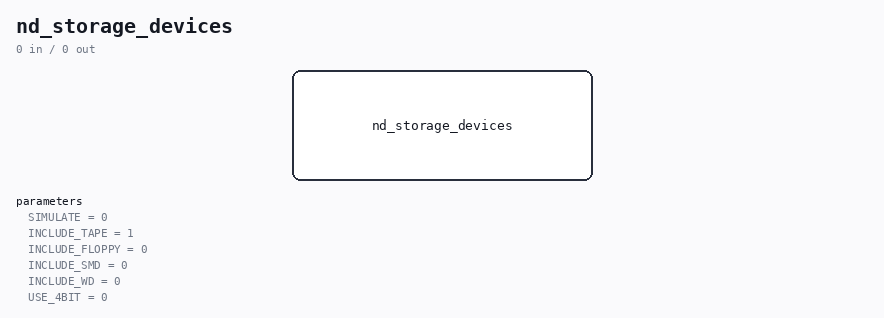
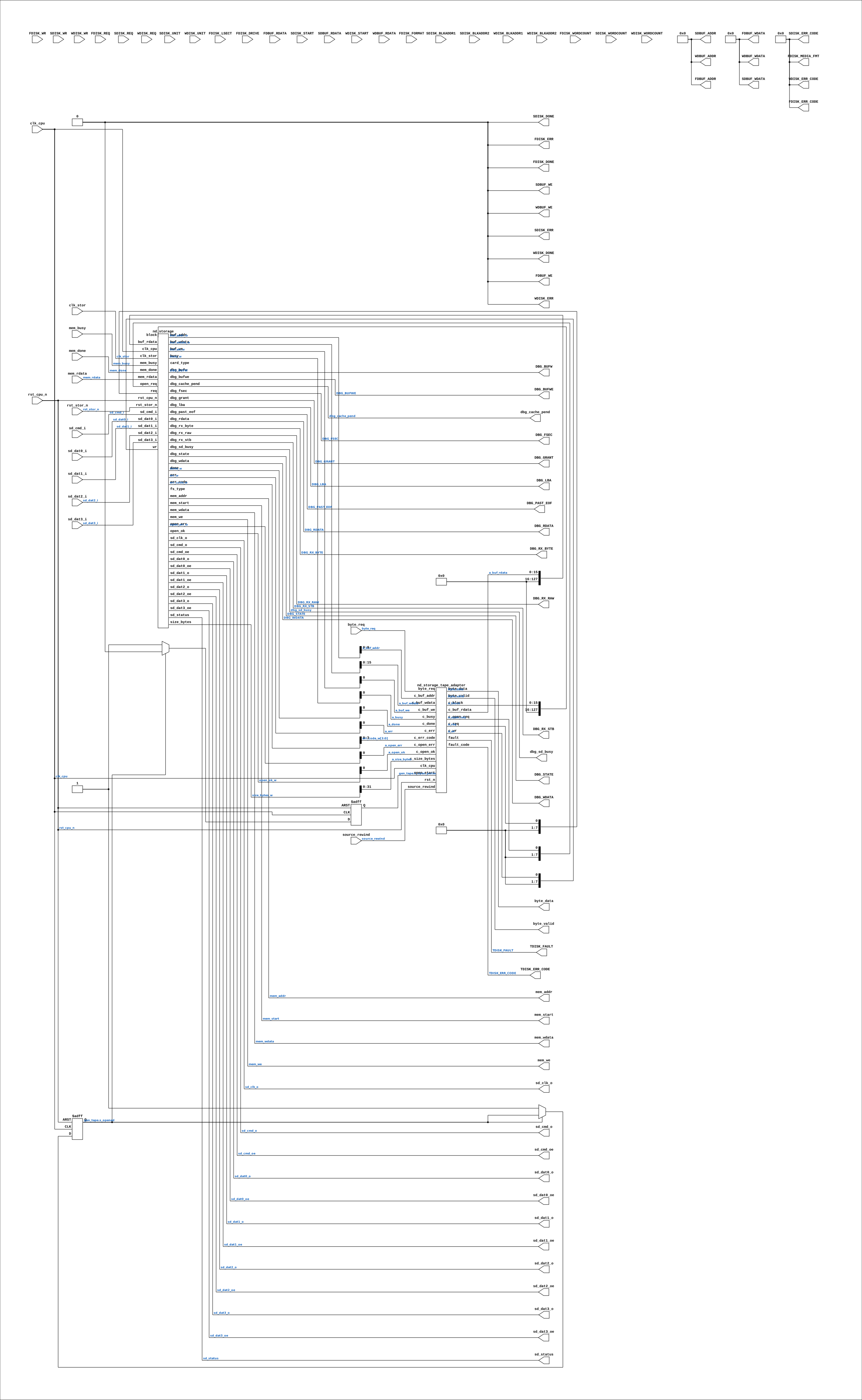
Schematic
Drawn from the Verilog: the yosys netlist of the Simulation (Verilator) build, instance TAPE_SDFAT_SOURCE. Sub-modules are boxes (click the picture to open it full size; there every sub-module box links to its page, and every wire shows its Verilog name).
Description
nd_storage_devices - board-agnostic BOOT.BPUN byte source for the ND_TAPE_400 paper-tape device, backed by the SD-FAT storage stack. Packages, in one reusable block for BOTH the Verilator sim and the Tang hardware top: nd_storage (SD-FAT mount + reader + engine; client 0 = BOOT.BPUN, preloaded into the SDRAM region) nd_storage_tape_adapter(serves that file to ND_TAPE_400's byte source port, big-endian, read-only) a mount->open sequencer(pulses the adapter's open_start ONCE after the mount reports OK) The instantiating top supplies the physical backends: - SD pads (sim: sd_card_model.v with IMAGE=nd_boot_card.img; Tang: the real SD card) - SDRAM device port mem_* (sim: nds_mem_model.v; Tang: the SDRAM bridge, same contract as nds_mem_model.v / MEM_RAM_49_SDRAM.v) - the byte source port wires straight to ND_TAPE_400 (byte_req / byte_valid / byte_data / source_rewind, pin-for-pin). Two clocks (as nd_storage requires): clk_stor (SD/SDRAM domain) and clk_cpu (the ND-120 bus/client domain). sd_status is 2-FF synchronized into clk_cpu before it gates the one-shot open. Only client 0 is used; clients 1-7 are tied idle. Tape is DIRECT (not in CACHE_MASK): the card is quick enough and nothing is preloaded. only BOOT.BPUN is preloaded (the boot card carries no other files). Ronny Hansen
Parameters
| Parameter | Default |
|---|---|
SIMULATE |
0 |
INCLUDE_TAPE |
1 |
INCLUDE_FLOPPY |
0 |
INCLUDE_SMD |
0 |
INCLUDE_WD |
0 |
USE_4BIT |
0 |
Verilog source
Verilog/SD-FAT/circuit/nd_storage_devices.v on GitHub.
Show the Verilog of nd_storage_devices (687 lines)
/****************************************************************************
** nd_storage_devices - board-agnostic BOOT.BPUN byte source for the **
** ND_TAPE_400 paper-tape device, backed by the SD-FAT storage stack. **
** **
** Packages, in one reusable block for BOTH the Verilator sim and the **
** Tang hardware top: **
** nd_storage (SD-FAT mount + reader + engine; client 0 = **
** BOOT.BPUN, preloaded into the SDRAM region) **
** nd_storage_tape_adapter(serves that file to ND_TAPE_400's byte source **
** port, big-endian, read-only) **
** a mount->open sequencer(pulses the adapter's open_start ONCE after **
** the mount reports OK) **
** **
** The instantiating top supplies the physical backends: **
** - SD pads (sim: sd_card_model.v with IMAGE=nd_boot_card.img; **
** Tang: the real SD card) **
** - SDRAM device port mem_* (sim: nds_mem_model.v; Tang: the SDRAM **
** bridge, same contract as nds_mem_model.v / MEM_RAM_49_SDRAM.v) **
** - the byte source port wires straight to ND_TAPE_400 (byte_req / **
** byte_valid / byte_data / source_rewind, pin-for-pin). **
** **
** Two clocks (as nd_storage requires): clk_stor (SD/SDRAM domain) and **
** clk_cpu (the ND-120 bus/client domain). sd_status is 2-FF synchronized **
** into clk_cpu before it gates the one-shot open. **
** **
** Only client 0 is used; clients 1-7 are tied idle. Tape is DIRECT (not **
** in CACHE_MASK): the card is quick enough and nothing is preloaded. **
** only BOOT.BPUN is preloaded (the boot card carries no other files). **
** **
** Ronny Hansen **
*****************************************************************************/
module nd_storage_devices #(
parameter SIMULATE = 0, // 1 = short SD init (Verilator), 0 = real card
parameter INCLUDE_TAPE = 1, // 1 = serve BOOT.BPUN to ND_TAPE_400 (client 0)
parameter INCLUDE_FLOPPY = 0, // 1 = also serve FLOPPY1.IMG to the DMA floppy
parameter INCLUDE_SMD = 0, // 1 = also serve SMD0.IMG to ND_SMD (client 3)
parameter INCLUDE_WD = 0, // 1 = also serve WD0.IMG to ND_WINCHESTER (client 6)
// SD 4-bit data bus. Off by default: it needs DAT1-3 pinned and wired at
// the board top, so a board that only brings out DAT0 stays correct.
parameter USE_4BIT = 0,
// client-0 (tape) file name on the card. Default BOOT.BPUN (the boot tape);
// a tb can point it at another 8.3 name on a shared test image.
parameter [52*8-1:0] BOOT_NAME = "BOOT.BPUN",
parameter [7:0] BOOT_LEN = 8'd9
) (
input wire clk_stor,
input wire rst_stor_n,
input wire clk_cpu,
input wire rst_cpu_n,
// ND_TAPE_400 byte source port (pin-for-pin)
input wire byte_req,
output wire byte_valid,
output wire [7:0] byte_data,
input wire source_rewind,
// Sticky tape diagnostic. The ND-400 reader has no status register in
// which "no SD card" could be expressed, so it stays silent to the guest
// exactly as before and publishes the reason HERE instead - for a
// testbench, a probe or a board LED, never for ND logic. Without this,
// a missing card and the end of the tape are the same observation.
output wire TDISK_FAULT,
output wire [3:0] TDISK_ERR_CODE,
// ND_FLOPPY_DMA disk-image backend seam (client 1 = FLOPPY1.IMG). Present
// regardless; driven only when INCLUDE_FLOPPY=1, tied idle otherwise. Wired
// pin-for-pin to ND120_CORE's FDISK_*/FDBUF_* (nd_storage_floppy_adapter).
input wire FDISK_REQ,
input wire FDISK_WR,
input wire [15:0] FDISK_LSECT,
input wire [ 1:0] FDISK_FORMAT,
input wire [ 1:0] FDISK_DRIVE,
input wire [10:0] FDISK_WORDCOUNT,
output wire FDISK_DONE,
output wire FDISK_ERR,
output wire [ 3:0] FDISK_ERR_CODE,
output wire [ 3:0] FDISK_MEDIA_FMT,
output wire [ 9:0] FDBUF_ADDR,
output wire [15:0] FDBUF_WDATA,
output wire FDBUF_WE,
input wire [15:0] FDBUF_RDATA,
// ND_SMD disk-image backend seam (client 3 = SMD0.IMG). Present
// regardless; driven only when INCLUDE_SMD=1, tied idle otherwise. Wired
// pin-for-pin to ND120_CORE's SDISK_*/SDBUF_* (nd_storage_disc_adapter).
input wire SDISK_START,
input wire SDISK_REQ,
input wire SDISK_WR,
input wire [15:0] SDISK_BLKADDR1,
input wire [15:0] SDISK_BLKADDR2,
input wire [ 2:0] SDISK_UNIT,
input wire [10:0] SDISK_WORDCOUNT,
output wire SDISK_DONE,
output wire SDISK_ERR,
output wire [ 3:0] SDISK_ERR_CODE,
output wire [ 9:0] SDBUF_ADDR,
output wire [15:0] SDBUF_WDATA,
output wire SDBUF_WE,
input wire [15:0] SDBUF_RDATA,
// ND_WINCHESTER disk-image backend seam (client 6 = WD0.IMG). Present
// regardless; driven only when INCLUDE_WD=1, tied idle otherwise. Wired
// pin-for-pin to ND120_CORE's WDISK_*/WDBUF_*. Winchester images are
// WDn.IMG, NEVER SMDn.IMG.
input wire WDISK_START,
input wire WDISK_REQ,
input wire WDISK_WR,
input wire [15:0] WDISK_BLKADDR1,
input wire [15:0] WDISK_BLKADDR2,
input wire [ 2:0] WDISK_UNIT,
input wire [10:0] WDISK_WORDCOUNT,
output wire WDISK_DONE,
output wire WDISK_ERR,
output wire [ 3:0] WDISK_ERR_CODE,
output wire [ 9:0] WDBUF_ADDR,
output wire [15:0] WDBUF_WDATA,
output wire WDBUF_WE,
input wire [15:0] WDBUF_RDATA,
// SD pads (single tristate resolved at the top)
output wire sd_clk_o,
input wire sd_cmd_i,
output wire sd_cmd_o,
output wire sd_cmd_oe,
input wire sd_dat0_i,
output wire sd_dat0_o,
output wire sd_dat0_oe,
// DAT1-3: 4-bit data bus (USE_4BIT). Released when not in 4-bit mode.
//! DEBUG stage-timer taps (24-AUG-2026)
output wire dbg_sd_busy,
output wire dbg_cache_pend,
input wire sd_dat1_i,
output wire sd_dat1_o,
output wire sd_dat1_oe,
input wire sd_dat2_i,
output wire sd_dat2_o,
output wire sd_dat2_oe,
input wire sd_dat3_i,
output wire sd_dat3_o,
output wire sd_dat3_oe,
// SDRAM device port (clk_stor domain) - same contract as nds_mem_model.v
output wire mem_start,
output wire mem_we,
output wire [19:0] mem_addr,
output wire [31:0] mem_wdata,
input wire [31:0] mem_rdata,
input wire mem_busy,
input wire mem_done,
// Fill-path diagnostic seam from nd_storage. Pure observation.
output wire [4:0] DBG_STATE,
output wire [31:0] DBG_LBA,
output wire [15:0] DBG_WDATA,
output wire [15:0] DBG_RDATA,
output wire [15:0] DBG_BUFW,
output wire DBG_BUFWE,
output wire [15:0] DBG_FSEC,
output wire DBG_RX_STB,
output wire [7:0] DBG_RX_RAW,
output wire [7:0] DBG_RX_BYTE,
output wire DBG_PAST_EOF,
output wire [2:0] DBG_GRANT,
// status passthrough (board LEDs / debug)
output wire [1:0] sd_status
);
// MUST match nd_storage's N_CLIENTS. It is a mirror of that default, not a
// choice: a mismatch connects the client vectors at the wrong width and
// Verilog pads or truncates silently. Went 7 -> 8 on 04-AUG-2026 when
// SMD3.IMG was replaced by WD0/WD1.IMG (the Winchester).
localparam N = 8; // nd_storage's fixed client count
// ---- flattened client-port buses; only client 0 is driven/used ----
wire [N-1:0] open_req_w, open_ok_w, open_err_w, req_w, wr_w;
wire [N-1:0] busy_w, done_w, err_w, buf_we_w;
wire [N*4-1:0] err_code_w; // WHY each client failed (nd_storage_status.vh)
wire [N*32-1:0] size_bytes_w;
wire [N*16-1:0] block_w, buf_wdata_w, buf_rdata_w;
wire [N*10-1:0] buf_addr_w;
// client 0 <-> tape adapter
wire a_open_ok, a_open_err;
wire a_open_req, a_req, a_wr, a_busy, a_done, a_err;
wire [31:0] a_size_bytes;
wire [15:0] a_block, a_buf_wdata, a_buf_rdata;
wire [9:0] a_buf_addr;
wire a_buf_we;
// client 1 <-> floppy adapter (driven in the INCLUDE_FLOPPY generate below,
// tied idle otherwise)
wire f_open_req, f_req, f_wr;
wire [15:0] f_block, f_buf_rdata;
// client 3 <-> SMD adapter (driven in the INCLUDE_SMD generate below,
// tied idle otherwise)
wire m_open_req, m_req, m_wr;
wire [15:0] m_block, m_buf_rdata;
// client 6 <-> Winchester adapter (WD0.IMG). Driven in the INCLUDE_WD
// generate below, tied idle otherwise.
wire w_open_req, w_req, w_wr;
wire [15:0] w_block, w_buf_rdata;
// ---- client port fan-out -------------------------------------------------
// ONE CONTIGUOUS BLOCK PER CLIENT, indexed by a named constant. Adding a
// client means adding one block; a missing line is a VISIBLE gap in that
// block, not an invisible zero somewhere else in the file.
//
// This replaced five hand-written flat concatenations, one per bus, each
// carrying its own bit-counting arithmetic - e.g.
//
// assign buf_rdata_w = {{((N-4)*16){1'b0}}, m_buf_rdata, 16'd0,
// f_buf_rdata, a_buf_rdata};
//
// Adding a client meant editing all five expressions and getting five
// separate bit counts right, and NOTHING checked that you had. On
// 10-AUG-2026 exactly one of them - buf_rdata_w - was left in its older
// (N-4) form when the Winchester client was added, so clients 4..7 were
// tied to zero and w_buf_rdata reached nothing. Only WRITES read that bus
// (reads travel the other way on buf_wdata/buf_we), and only reads had ever
// been exercised, so every Winchester write silently staged 16'd0 for every
// word while the DMA fetched the payload correctly and the controller's own
// buffer held it correctly. Zeros went to the SD card with no error raised
// anywhere. On the Tang, SINTRAN mass-loaded off the disc, started, and
// died with "DISC TRANSFER ERROR IN SEGMENT HANDLING" the moment the
// swapper wrote - after overwriting the image's master block with zeros.
//
// Gated by SD-FAT/sim/nd_storage_clientbus_tb.v (test-nds-clientbus).
localparam integer CL_TAPE = 0;
localparam integer CL_FLOPPY = 1;
localparam integer CL_SMD = 3;
localparam integer CL_WD = 6;
// client 0 - tape (read-only: a_buf_rdata is tied 0 in the adapter itself)
assign open_req_w [CL_TAPE] = a_open_req;
assign req_w [CL_TAPE] = a_req;
assign wr_w [CL_TAPE] = a_wr;
assign block_w [16*CL_TAPE +: 16] = a_block;
assign buf_rdata_w[16*CL_TAPE +: 16] = a_buf_rdata;
// client 1 - floppy
assign open_req_w [CL_FLOPPY] = f_open_req;
assign req_w [CL_FLOPPY] = f_req;
assign wr_w [CL_FLOPPY] = f_wr;
assign block_w [16*CL_FLOPPY +: 16] = f_block;
assign buf_rdata_w[16*CL_FLOPPY +: 16] = f_buf_rdata;
// client 3 - SMD disc
assign open_req_w [CL_SMD] = m_open_req;
assign req_w [CL_SMD] = m_req;
assign wr_w [CL_SMD] = m_wr;
assign block_w [16*CL_SMD +: 16] = m_block;
assign buf_rdata_w[16*CL_SMD +: 16] = m_buf_rdata;
// client 6 - Winchester disc
assign open_req_w [CL_WD] = w_open_req;
assign req_w [CL_WD] = w_req;
assign wr_w [CL_WD] = w_wr;
assign block_w [16*CL_WD +: 16] = w_block;
assign buf_rdata_w[16*CL_WD +: 16] = w_buf_rdata;
// clients 2, 4, 5, 7 - no adapter exists. Driven explicitly rather than
// left undriven: an undriven net is z, not 0, and would propagate x.
genvar ci;
generate
for (ci = 0; ci < N; ci = ci + 1) begin : gen_idle_clients
if ((ci != CL_TAPE) && (ci != CL_FLOPPY) &&
(ci != CL_SMD) && (ci != CL_WD)) begin : gen_idle
assign open_req_w [ci] = 1'b0;
assign req_w [ci] = 1'b0;
assign wr_w [ci] = 1'b0;
assign block_w [16*ci +: 16] = 16'd0;
assign buf_rdata_w[16*ci +: 16] = 16'd0;
end
end
endgenerate
assign a_open_ok = open_ok_w[0];
assign a_open_err = open_err_w[0];
assign a_size_bytes = size_bytes_w[31:0];
assign a_busy = busy_w[0];
assign a_done = done_w[0];
assign a_err = err_w[0];
assign a_buf_addr = buf_addr_w[9:0];
assign a_buf_wdata = buf_wdata_w[15:0];
assign a_buf_we = buf_we_w[0];
// ---- the tape adapter (client 0 -> ND_TAPE_400 byte source), OPTIONAL ----
// Floppy-only builds (INCLUDE_TAPE=0) drop the tape entirely; the floppy
// (client 1) then triggers the mount on its own. When both are in, the tape
// open triggers the mount and the floppy open (held, below) follows.
generate
if (INCLUDE_TAPE) begin : gen_tape
// one-shot open sequencer (clk_cpu). Do NOT gate on sd_status==OK: that
// deadlocks (no open -> no mount -> status never updates). The mount IS
// the card bring-up (CMD0/CMD8/ACMD41, FAT scan, preload); pulse open once
// after reset and check status afterwards, as every proven tb does.
reg s_opened, s_open_pulse;
always @(posedge clk_cpu or negedge rst_cpu_n)
if (!rst_cpu_n) begin s_opened <= 1'b0; s_open_pulse <= 1'b0; end
else begin
s_open_pulse <= 1'b0;
if (!s_opened) begin s_open_pulse <= 1'b1; s_opened <= 1'b1; end
end
nd_storage_tape_adapter u_tape_adapter (
.clk_cpu (clk_cpu),
.rst_n (rst_cpu_n),
.byte_req (byte_req),
.byte_valid (byte_valid),
.byte_data (byte_data),
.source_rewind(source_rewind),
.open_start (s_open_pulse),
.c_open_req (a_open_req),
.c_open_ok (a_open_ok),
.c_open_err (a_open_err),
.c_size_bytes (a_size_bytes),
.c_req (a_req),
.c_wr (a_wr),
.c_block (a_block),
.c_busy (a_busy),
.c_done (a_done),
.c_err (a_err),
.c_err_code (err_code_w[3:0]),
.fault (TDISK_FAULT),
.fault_code (TDISK_ERR_CODE),
.c_buf_addr (a_buf_addr),
.c_buf_wdata (a_buf_wdata),
.c_buf_we (a_buf_we),
.c_buf_rdata (a_buf_rdata)
);
end else begin : gen_no_tape
// tape excluded: client 0 idle, byte source outputs quiet
assign a_open_req = 1'b0;
assign a_req = 1'b0;
assign a_wr = 1'b0;
assign a_block = 16'd0;
assign a_buf_rdata = 16'd0;
assign byte_valid = 1'b0;
assign byte_data = 8'd0;
assign TDISK_FAULT = 1'b0;
assign TDISK_ERR_CODE = 4'd0;
end
endgenerate
// ---- the floppy adapter (client 1 -> ND_FLOPPY_DMA disk-image backend) ----
generate
if (INCLUDE_FLOPPY) begin : gen_floppy
// Open FLOPPY1.IMG (client 1). The tape (client 0) and floppy open
// requests both fire at reset, but nd_storage services only ONE client's
// open per mount and the adapters only PULSE c_open_req (they do not hold
// it), so a single floppy pulse coincident with the tape's is lost. HOLD
// open_start high (the adapter re-pulses c_open_req every cycle) until the
// client reports open - nd_storage picks it up once it is idle after the
// tape-triggered mount. No deadlock: the tape open still triggers the mount.
reg s_fopened;
always @(posedge clk_cpu or negedge rst_cpu_n)
if (!rst_cpu_n) s_fopened <= 1'b0;
else if (open_ok_w[1]) s_fopened <= 1'b1;
wire s_fopen_pulse = !s_fopened;
// media format from the FLOPPY1.IMG size, matching the C reference
// (simDevices/NDBus.cpp / deviceFloppyDMA.c READ FORMAT): 315392 B =
// 8-inch 512 B/sector -> 0x0; else the 1.2 MB 1024 B/sector double-
// sided/double-density descriptor -> 0xF. Only READ FORMAT reads it;
// the 1560& boot forces format 3, so this does not gate boot.
wire [31:0] f_size = size_bytes_w[63:32];
assign FDISK_MEDIA_FMT = (f_size == 32'd315392) ? 4'h0 : 4'hF;
nd_storage_floppy_adapter #(.DRIVE(2'd0)) u_floppy_adapter (
.clk_cpu (clk_cpu),
.rst_n (rst_cpu_n),
.disk_req (FDISK_REQ),
.disk_wr (FDISK_WR),
.disk_lsect (FDISK_LSECT),
.disk_format (FDISK_FORMAT),
.disk_drive (FDISK_DRIVE),
.disk_wordcount(FDISK_WORDCOUNT),
.disk_done (FDISK_DONE),
.disk_err (FDISK_ERR),
.disk_err_code (FDISK_ERR_CODE),
.dbuf_addr (FDBUF_ADDR),
.dbuf_wdata (FDBUF_WDATA),
.dbuf_we (FDBUF_WE),
.dbuf_rdata (FDBUF_RDATA),
.open_start (s_fopen_pulse),
.c_open_req (f_open_req),
.c_open_ok (open_ok_w[1]),
.c_open_err (open_err_w[1]),
.c_size_bytes (f_size),
.c_req (f_req),
.c_wr (f_wr),
.c_block (f_block),
.c_busy (busy_w[1]),
.c_done (done_w[1]),
.c_err (err_w[1]),
.c_err_code (err_code_w[7:4]),
.c_buf_addr (buf_addr_w[19:10]),
.c_buf_wdata (buf_wdata_w[31:16]),
.c_buf_we (buf_we_w[1]),
.c_buf_rdata (f_buf_rdata)
);
end else begin : gen_no_floppy
// floppy excluded: client 1 idle, backend seam driven to safe defaults
assign f_open_req = 1'b0;
assign f_req = 1'b0;
assign f_wr = 1'b0;
assign f_block = 16'd0;
assign f_buf_rdata = 16'd0;
assign FDISK_DONE = 1'b0;
assign FDISK_ERR = 1'b0;
assign FDISK_ERR_CODE = 4'd0;
assign FDISK_MEDIA_FMT = 4'd0;
assign FDBUF_ADDR = 10'd0;
assign FDBUF_WDATA = 16'd0;
assign FDBUF_WE = 1'b0;
end
endgenerate
// ---- the SMD adapter (client 3 -> ND_SMD disk-image backend) ----
generate
if (INCLUDE_SMD) begin : gen_smd
// Open SMD0.IMG (client 3). Same held-open mechanism as the floppy:
// hold open_start (the adapter re-pulses c_open_req every cycle) until
// the client reports open - nd_storage serves one open per mount, so a
// pulse coincident with another client's open would be lost.
reg s_mopened;
always @(posedge clk_cpu or negedge rst_cpu_n)
if (!rst_cpu_n) s_mopened <= 1'b0;
else if (open_ok_w[3]) s_mopened <= 1'b1;
wire s_mopen_pulse = !s_mopened;
nd_storage_disc_adapter #(.UNIT(3'd0)) u_smd_adapter (
.clk_cpu (clk_cpu),
.rst_n (rst_cpu_n),
.disk_start (SDISK_START),
.disk_req (SDISK_REQ),
.disk_wr (SDISK_WR),
.disk_blkaddr1 (SDISK_BLKADDR1),
.disk_blkaddr2 (SDISK_BLKADDR2),
.disk_unit (SDISK_UNIT),
.disk_wordcount(SDISK_WORDCOUNT),
.disk_done (SDISK_DONE),
.disk_err (SDISK_ERR),
.disk_err_code (SDISK_ERR_CODE),
.dbuf_addr (SDBUF_ADDR),
.dbuf_wdata (SDBUF_WDATA),
.dbuf_we (SDBUF_WE),
.dbuf_rdata (SDBUF_RDATA),
.open_start (s_mopen_pulse),
.c_open_req (m_open_req),
.c_open_ok (open_ok_w[3]),
.c_open_err (open_err_w[3]),
.c_size_bytes (size_bytes_w[127:96]),
.c_req (m_req),
.c_wr (m_wr),
.c_block (m_block),
.c_busy (busy_w[3]),
.c_done (done_w[3]),
.c_err (err_w[3]),
.c_err_code (err_code_w[15:12]),
.c_buf_addr (buf_addr_w[39:30]),
.c_buf_wdata (buf_wdata_w[63:48]),
.c_buf_we (buf_we_w[3]),
.c_buf_rdata (m_buf_rdata)
);
end else begin : gen_no_smd
// SMD excluded: client 3 idle, backend seam driven to safe defaults
assign m_open_req = 1'b0;
assign m_req = 1'b0;
assign m_wr = 1'b0;
assign m_block = 16'd0;
assign m_buf_rdata = 16'd0;
assign SDISK_DONE = 1'b0;
assign SDISK_ERR = 1'b0;
assign SDISK_ERR_CODE = 4'd0;
assign SDBUF_ADDR = 10'd0;
assign SDBUF_WDATA = 16'd0;
assign SDBUF_WE = 1'b0;
end
endgenerate
// ---- the Winchester adapter (client 6 -> ND_WINCHESTER disk-image backend)
// The SAME nd_storage_disc_adapter, with Winchester geometry. That adapter
// has nothing SMD-specific in it: its CHS->LBA is driven entirely by
// GEO_HEADS/GEO_SPT and its one hard assumption - a 1024-byte sector - is
// equally true of this card (ND-11.015.01 sec 2.1). Proven by
// ND-BUS-DEVICES/WINCHESTER/sim/nd_winchester_adapter_tb.v, which also
// covers a cylinder near the top of the platter.
generate
if (INCLUDE_WD) begin : gen_wd
// Open WD0.IMG (client 6), same held-open mechanism as the others.
reg s_wopened;
always @(posedge clk_cpu or negedge rst_cpu_n)
if (!rst_cpu_n) s_wopened <= 1'b0;
else if (open_ok_w[6]) s_wopened <= 1'b1;
wire s_wopen_pulse = !s_wopened;
nd_storage_disc_adapter #(
.UNIT (3'd0),
.GEO_HEADS(16'd8), // Micropolis 1325 / DISC-74-1
.GEO_SPT (16'd9)
) u_wd_adapter (
.clk_cpu (clk_cpu),
.rst_n (rst_cpu_n),
.disk_start (WDISK_START),
.disk_req (WDISK_REQ),
.disk_wr (WDISK_WR),
.disk_blkaddr1 (WDISK_BLKADDR1),
.disk_blkaddr2 (WDISK_BLKADDR2),
.disk_unit (WDISK_UNIT),
.disk_wordcount(WDISK_WORDCOUNT),
.disk_done (WDISK_DONE),
.disk_err (WDISK_ERR),
.disk_err_code (WDISK_ERR_CODE),
.dbuf_addr (WDBUF_ADDR),
.dbuf_wdata (WDBUF_WDATA),
.dbuf_we (WDBUF_WE),
.dbuf_rdata (WDBUF_RDATA),
.open_start (s_wopen_pulse),
.c_open_req (w_open_req),
.c_open_ok (open_ok_w[6]),
.c_open_err (open_err_w[6]),
.c_size_bytes (size_bytes_w[223:192]),
.c_req (w_req),
.c_wr (w_wr),
.c_block (w_block),
.c_busy (busy_w[6]),
.c_done (done_w[6]),
.c_err (err_w[6]),
.c_err_code (err_code_w[27:24]),
.c_buf_addr (buf_addr_w[69:60]),
.c_buf_wdata (buf_wdata_w[111:96]),
.c_buf_we (buf_we_w[6]),
.c_buf_rdata (w_buf_rdata)
);
end else begin : gen_no_wd
// Winchester excluded: client 6 idle, backend seam driven to safe defaults
assign w_open_req = 1'b0;
assign w_req = 1'b0;
assign w_wr = 1'b0;
assign w_block = 16'd0;
assign w_buf_rdata = 16'd0;
assign WDISK_DONE = 1'b0;
assign WDISK_ERR = 1'b0;
assign WDISK_ERR_CODE = 4'd0;
assign WDBUF_ADDR = 10'd0;
assign WDBUF_WDATA = 16'd0;
assign WDBUF_WE = 1'b0;
end
endgenerate
// ---- the SD-FAT storage engine, BOOT.BPUN as client 0 ----
nd_storage #(
.SIMULATE (SIMULATE),
// preload the served clients: client 0 (BOOT.BPUN) when tape is in,
// client 1 (FLOPPY1.IMG) when floppy is in, client 3 (SMD0.IMG) when
// the SMD is in - staged reads/writes from/to the region
// Phase 4: CACHE_MASK replaces PRELOAD_MASK. Nothing is preloaded any
// more, so every included client simply opens. Tape and floppy stay
// DIRECT (bit 0) - the card is quick enough for them and caching them
// would only spend region. The disc classes are CACHED, which is what
// lets a 75 MB image be served at all. Flipping the floppy to cached
// later is one bit here.
// ND_STORAGE_DISCS_UNCACHED: force the disc classes DIRECT.
//
// DIAGNOSTIC LEVER, added 09-AUG-2026. On silicon the Winchester read
// returns ZEROS with a perfectly clean status (060011, error-OR bit
// clear) while block 0 of WD0.IMG demonstrably holds data - measured
// with an 11-instruction program deposited through OPCOM, so no
// driver, no FSI and no SINTRAN are involved. The same RTL chain
// PASSES in simulation (WINCHESTER/sim test-wd-storage, and again
// against a real SDRAM model). The one structural difference between
// the client that works on silicon and the one that does not is this
// mask: the tape (client 0) is DIRECT and loads fine off the same
// card, the Winchester (client 6) is CACHED and comes back empty.
//
// Defining this makes every disc client DIRECT - each request fetches
// through the shared staging line inside its own grant, so image size
// is still unbounded, it is just slower (no reuse across requests).
// If the read then returns real data, the fault is in the Phase-4
// cache path on hardware, not in the controller or the FAT stack.
`ifdef ND_STORAGE_DISCS_UNCACHED
.USE_4BIT (USE_4BIT),
.CACHE_MASK (8'b00000000),
`else
.USE_4BIT (USE_4BIT),
.CACHE_MASK ((INCLUDE_SMD ? 8'b00111000 : 8'b00000000) |
(INCLUDE_WD ? 8'b11000000 : 8'b00000000)),
`endif
.FILE0_NAME (BOOT_NAME), .FILE0_LEN(BOOT_LEN),
// ND_STORAGE_WD_BADNAME: CONTROL EXPERIMENT, 09-AUG-2026. Points the
// Winchester client at a filename that cannot be on the card, so the
// mount MUST fail. The whole silicon zero-read diagnosis rests on
// "the status came back clean, therefore the file mounted and the read
// really happened" - and that error plumbing has only ever been proven
// in simulation. If this build ALSO reports a clean 060011 instead of
// b7 disk fault, the instrument is lying and the mount may have been
// failing silently all along.
`ifdef ND_STORAGE_WD_BADNAME
.FILE6_NAME ("ZZNOSUCH.IMG"), .FILE6_LEN(8'd12),
`endif
// ND_STORAGE_WD_USE_BOOTTAP: DISCRIMINATOR, 09-AUG-2026. Points the
// Winchester client at BOOT.TAP - the SMALL file the tape client
// demonstrably reads correctly off this very card (400$ loads the File
// System Investigator from it). Everything else stays identical.
//
// If the Winchester then returns REAL DATA, the fault depends on the
// FILE - size or position on the card - and WD0.IMG at 75 MB is 4600x
// larger than anything the simulation testbenches ever exercised
// (WD_BYTES = 16384). If it STILL returns zeros, the fault is in the
// Winchester client path itself and is independent of the file.
`ifdef ND_STORAGE_WD_USE_BOOTTAP
.FILE6_NAME ("BOOT.TAP"), .FILE6_LEN(8'd8),
`endif
// No slot remap any more. Slots used to bound the image size, and this
// wrapper enlarged SMD0's to squeeze a bigger file in; with the cache
// the image size is unbounded by the region, so the remap is dead and
// its overlap hazard (the enlarged slot 3 covered clients 6 and 7)
// goes with it.
.STAGE_BASE_BLK(32'd0), .POOL_BASE_BLK(32'd1)
) u_nd_storage (
.clk_stor (clk_stor),
.rst_stor_n(rst_stor_n),
.clk_cpu (clk_cpu),
.rst_cpu_n (rst_cpu_n),
.sd_clk_o (sd_clk_o),
.sd_cmd_i (sd_cmd_i),
.sd_cmd_o (sd_cmd_o),
.sd_cmd_oe (sd_cmd_oe),
.sd_dat0_i (sd_dat0_i),
.sd_dat0_o (sd_dat0_o),
.sd_dat0_oe(sd_dat0_oe),
.dbg_sd_busy (dbg_sd_busy),
.dbg_cache_pend(dbg_cache_pend),
.sd_dat1_i (sd_dat1_i),
.sd_dat1_o (sd_dat1_o),
.sd_dat1_oe(sd_dat1_oe),
.sd_dat2_i (sd_dat2_i),
.sd_dat2_o (sd_dat2_o),
.sd_dat2_oe(sd_dat2_oe),
.sd_dat3_i (sd_dat3_i),
.sd_dat3_o (sd_dat3_o),
.sd_dat3_oe(sd_dat3_oe),
.mem_start (mem_start),
.mem_we (mem_we),
.mem_addr (mem_addr),
.mem_wdata (mem_wdata),
.mem_rdata (mem_rdata),
.mem_busy (mem_busy),
.mem_done (mem_done),
.open_req (open_req_w),
.open_ok (open_ok_w),
.open_err (open_err_w),
.size_bytes(size_bytes_w),
.req (req_w),
.wr (wr_w),
.block (block_w),
.busy (busy_w),
.done (done_w),
.err (err_w),
.err_code (err_code_w),
.dbg_state (DBG_STATE),
.dbg_lba (DBG_LBA),
.dbg_wdata (DBG_WDATA),
.dbg_rdata (DBG_RDATA),
.dbg_bufw (DBG_BUFW),
.dbg_bufwe (DBG_BUFWE),
.dbg_fsec (DBG_FSEC),
.dbg_rx_stb (DBG_RX_STB),
.dbg_rx_raw (DBG_RX_RAW),
.dbg_rx_byte (DBG_RX_BYTE),
.dbg_past_eof(DBG_PAST_EOF),
.dbg_grant (DBG_GRANT),
.buf_addr (buf_addr_w),
.buf_wdata (buf_wdata_w),
.buf_we (buf_we_w),
.buf_rdata (buf_rdata_w),
.sd_status (sd_status),
.card_type (),
.fs_type ()
);
endmodule