nd_storage_cache
Source: Verilog/SD-FAT/circuit/nd_storage_cache.v
Where it sits (Simulation): ND120_TOP > nd_storage_devices > nd_storage > nd_storage_cache
- instance path: TAPE_SDFAT_SOURCE.u_nd_storage.u_cache
Used in: nd_storage (Simulation, Tang, Nexys)
Contains: no other modules.
Module hierarchy - All modules
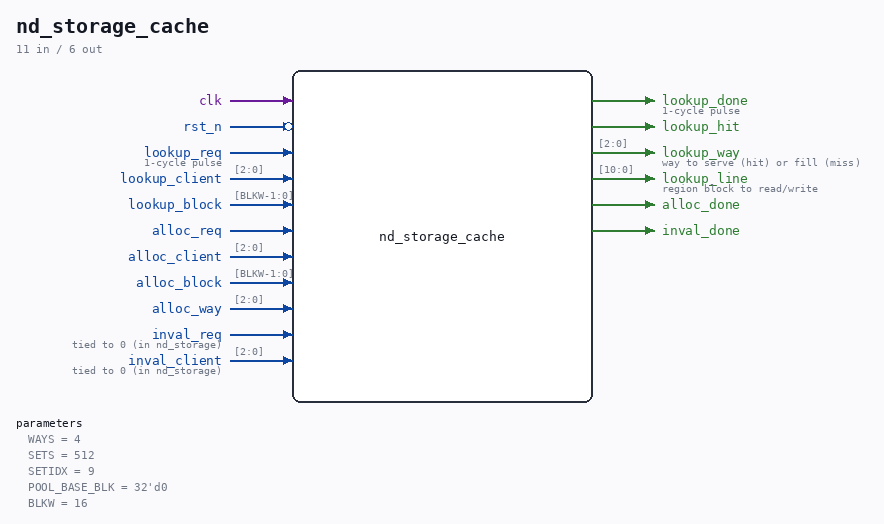
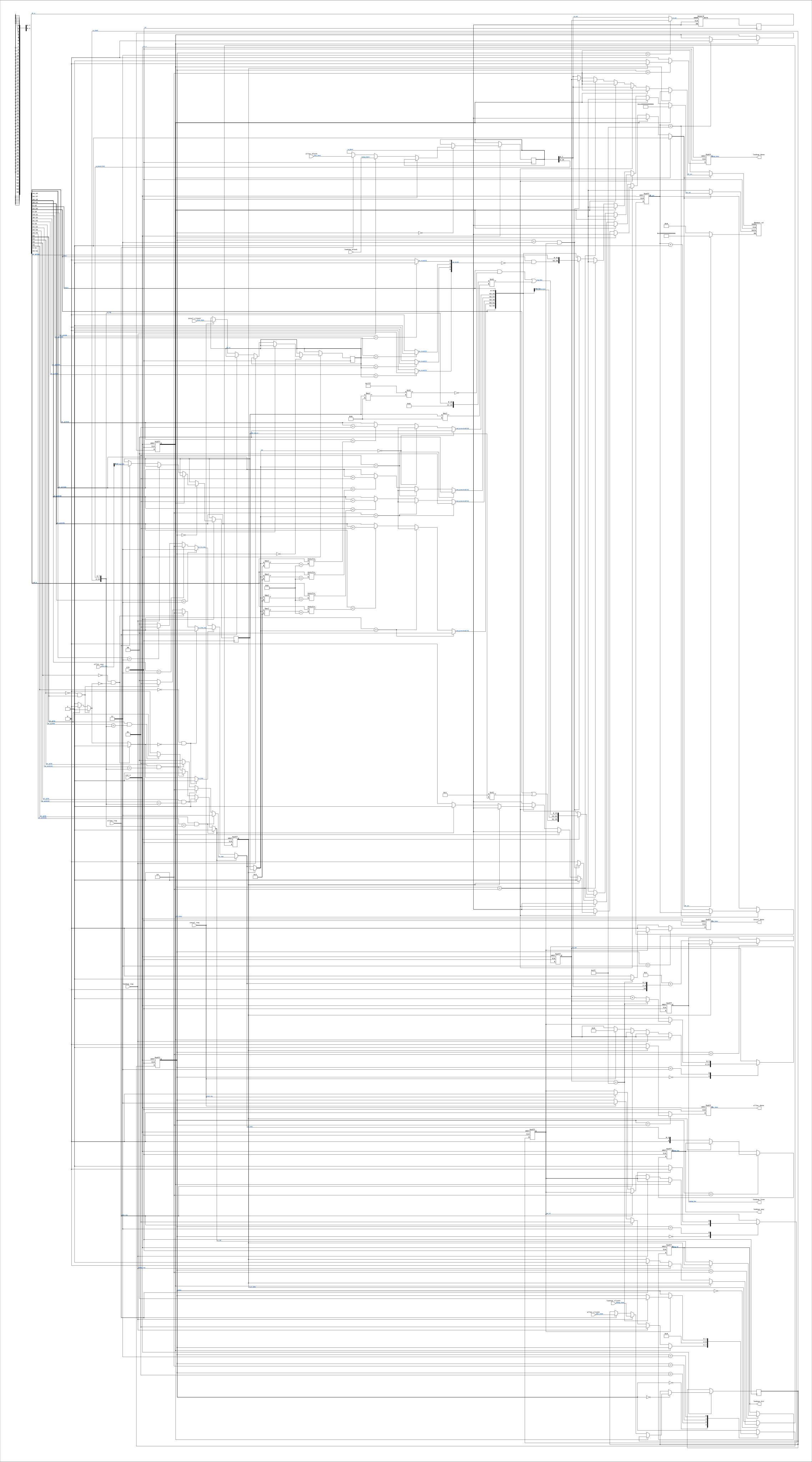
Schematic
Drawn from the Verilog: the yosys netlist of the Simulation (Verilator) build, instance TAPE_SDFAT_SOURCE.u_nd_storage.u_cache. Sub-modules are boxes (click the picture to open it full size; there every sub-module box links to its page, and every wire shows its Verilog name).
Description
nd_storage_cache - tag / LRU directory for the shared block cache Phase 4 of the storage facade. docs/nd-storage-design.md section 2.1 named "the Phase-4 tag-based cache" but never specified it; this module and the engine changes that use it ARE that specification. WHY v1 mapped a client block straight onto a region block in one line (nd_storage_engine.v: s_blk_abs <= slot_base + op_block), so an image could never exceed its slot and the mount refused size > slot. A real Winchester image is 75 MB against a 256 KB slot. The region is 2048 blocks = 4 MB and cannot be widened cheaply (s_blk_abs is [10:0] and feeds mem_addr into ND120_CORE / ND3202D / MEM_43), so the region stops being a COPY of the image and becomes a CACHE of it: every block of an arbitrarily large image is reachable and the resident set is whatever the guest is actually touching. WHAT IS CACHED Per client, via CACHE_MASK in nd_storage: 1 = through this directory, 0 = DIRECT (block requests go straight to the card, region untouched). Tape and floppy are DIRECT - the card is quick enough for them, and caching them would spend region on devices that do not need it. The disc classes (SMD, Winchester) are CACHED because SINTRAN's working set is what decides whether the machine feels quick. Enabling the floppy later is one bit in CACHE_MASK and nothing else. ORGANISATION ONE SHARED pool over all cached clients, not a fixed window per unit: the tag carries the client id, so the disc doing the work gets the whole pool and an idle second unit costs nothing. line = one 2048-byte region block (the block granularity the whole stack already uses) set index = client_block[SETIDX-1:0] tag = { client[2:0], client_block[BLKW-1:SETIDX] } region block = POOL_BASE_BLK + set*WAYS + way STORAGE SHAPE - the thing that decides whether this fits the FPGA ONE array. A set's tags AND ranks AND valid bits live in a single word, so a set is one registered read, all ways compare in the same cycle, and the whole directory is a single-clock BSRAM with one write port. Two rules that are not optional: - NEVER reset the array with a loop over its entries. That infers flip-flops instead of block RAM; at 512 sets it cost ~26k flip- flops in the first version of this module, more than the part has. The mass clear is a WALKING clear instead (SETS cycles after reset), invisible because the first open spends hundreds of thousands of cycles in SD card init before any lookup arrives. - NEVER split rank or valid into their own arrays read combinationally. The second version did exactly that, because the valid bits need a mass clear, and it measured 187283 AND gates at 512x4 under yosys/synth_gowin - tens of thousands of LUT4 on a part with 20736, nearly all of it the SETS-deep read multiplexer and write decoder that an indexed FF array builds per bit. Folded into the BSRAM word there is no multiplexer at all. ONE OUTSTANDING LOOKUP The engine serializes: one granted client, one block op at a time. So there is no pipeline hazard here and no bypass network - IDLE -> RD -> CMP and back. A lookup costs 3 cycles, which is noise against the four-sector card read a miss then performs. LRU 2 bits of rank per way per set: 0 = most recently used, WAYS-1 = least. A hit or a fill promotes its way to 0 and pushes every way that outranked it down one. The victim is the way at rank WAYS-1. Invalid ways are taken before any valid way, so a cold pool fills before it evicts anything. Ranks are read-modify-written in CMP. WRITE POLICY Write-through, write-allocate. The engine commits to the card FIRST, then the region copy, then reports done - the existing ordering rule, so a failed CMD24 never leaves the region holding data the card does not have. No dirty bit and no writeback exists here, which is what makes a reset or a card pull safe at any instant. INVALIDATION inval_req drops every line of one client - used when a client is re-opened (card swap, remount) so lines from the old file cannot survive into the new one. Walks the sets, two cycles each, and only ever runs at open. Ronny Hansen
Parameters
| Parameter | Default |
|---|---|
WAYS |
4 |
SETS |
512 |
SETIDX |
9 |
POOL_BASE_BLK |
32'd0 |
BLKW |
16 |
Ports
| Direction | Width | Name | Description |
|---|---|---|---|
| input | 1 |
clk |
|
| input | 1 |
rst_n (active low) |
|
| input | 1 |
lookup_req |
1-cycle pulse |
| input | [2:0] |
lookup_client |
|
| input | [BLKW-1:0] |
lookup_block |
|
| output | 1 |
lookup_done |
1-cycle pulse |
| output | 1 |
lookup_hit |
|
| output | [2:0] |
lookup_way |
way to serve (hit) or fill (miss) |
| output | [10:0] |
lookup_line |
region block to read/write |
| input | 1 |
alloc_req |
|
| input | [2:0] |
alloc_client |
|
| input | [BLKW-1:0] |
alloc_block |
|
| input | [2:0] |
alloc_way |
|
| output | 1 |
alloc_done |
|
| input | 1 |
inval_req |
tied to 0 (in nd_storage) |
| input | [2:0] |
inval_client |
tied to 0 (in nd_storage) |
| output | 1 |
inval_done |
Verilog source
Verilog/SD-FAT/circuit/nd_storage_cache.v on GitHub.
Show the Verilog of nd_storage_cache (397 lines)
/****************************************************************************
** nd_storage_cache - tag / LRU directory for the shared block cache       **
**                                                                         **
** Phase 4 of the storage facade. docs/nd-storage-design.md section 2.1    **
** named "the Phase-4 tag-based cache" but never specified it; this module **
** and the engine changes that use it ARE that specification.              **
**                                                                         **
** WHY                                                                     **
**   v1 mapped a client block straight onto a region block in one line     **
**   (nd_storage_engine.v: s_blk_abs <= slot_base + op_block), so an image **
**   could never exceed its slot and the mount refused size > slot. A real **
**   Winchester image is 75 MB against a 256 KB slot. The region is 2048   **
**   blocks = 4 MB and cannot be widened cheaply (s_blk_abs is [10:0] and  **
**   feeds mem_addr into ND120_CORE / ND3202D / MEM_43), so the region     **
**   stops being a COPY of the image and becomes a CACHE of it: every      **
**   block of an arbitrarily large image is reachable and the resident set **
**   is whatever the guest is actually touching.                           **
**                                                                         **
** WHAT IS CACHED                                                          **
**   Per client, via CACHE_MASK in nd_storage: 1 = through this directory, **
**   0 = DIRECT (block requests go straight to the card, region untouched).**
**   Tape and floppy are DIRECT - the card is quick enough for them, and   **
**   caching them would spend region on devices that do not need it. The   **
**   disc classes (SMD, Winchester) are CACHED because SINTRAN's working   **
**   set is what decides whether the machine feels quick. Enabling the     **
**   floppy later is one bit in CACHE_MASK and nothing else.               **
**                                                                         **
** ORGANISATION                                                            **
**   ONE SHARED pool over all cached clients, not a fixed window per unit: **
**   the tag carries the client id, so the disc doing the work gets the    **
**   whole pool and an idle second unit costs nothing.                     **
**                                                                         **
**     line         = one 2048-byte region block (the block granularity    **
**                    the whole stack already uses)                        **
**     set index    = client_block[SETIDX-1:0]                             **
**     tag          = { client[2:0], client_block[BLKW-1:SETIDX] }         **
**     region block = POOL_BASE_BLK + set*WAYS + way                       **
**                                                                         **
** STORAGE SHAPE - the thing that decides whether this fits the FPGA       **
**   ONE array. A set's tags AND ranks AND valid bits live in a single     **
**   word, so a set is one registered read, all ways compare in the same   **
**   cycle, and the whole directory is a single-clock BSRAM with one write **
**   port. Two rules that are not optional:                                **
**                                                                         **
**     - NEVER reset the array with a loop over its entries. That infers   **
**       flip-flops instead of block RAM; at 512 sets it cost ~26k flip-   **
**       flops in the first version of this module, more than the part     **
**       has. The mass clear is a WALKING clear instead (SETS cycles after **
**       reset), invisible because the first open spends hundreds of       **
**       thousands of cycles in SD card init before any lookup arrives.    **
**                                                                         **
**     - NEVER split rank or valid into their own arrays read              **
**       combinationally. The second version did exactly that, because the **
**       valid bits need a mass clear, and it measured 187283 AND gates at **
**       512x4 under yosys/synth_gowin - tens of thousands of LUT4 on a    **
**       part with 20736, nearly all of it the SETS-deep read multiplexer  **
**       and write decoder that an indexed FF array builds per bit. Folded **
**       into the BSRAM word there is no multiplexer at all.               **
**                                                                         **
** ONE OUTSTANDING LOOKUP                                                  **
**   The engine serializes: one granted client, one block op at a time. So **
**   there is no pipeline hazard here and no bypass network - IDLE -> RD   **
**   -> CMP and back. A lookup costs 3 cycles, which is noise against the  **
**   four-sector card read a miss then performs.                           **
**                                                                         **
** LRU                                                                     **
**   2 bits of rank per way per set: 0 = most recently used, WAYS-1 =      **
**   least. A hit or a fill promotes its way to 0 and pushes every way     **
**   that outranked it down one. The victim is the way at rank WAYS-1.     **
**   Invalid ways are taken before any valid way, so a cold pool fills     **
**   before it evicts anything. Ranks are read-modify-written in CMP.      **
**                                                                         **
** WRITE POLICY                                                            **
**   Write-through, write-allocate. The engine commits to the card FIRST,  **
**   then the region copy, then reports done - the existing ordering rule, **
**   so a failed CMD24 never leaves the region holding data the card does  **
**   not have. No dirty bit and no writeback exists here, which is what    **
**   makes a reset or a card pull safe at any instant.                     **
**                                                                         **
** INVALIDATION                                                            **
**   inval_req drops every line of one client - used when a client is      **
**   re-opened (card swap, remount) so lines from the old file cannot      **
**   survive into the new one. Walks the sets, two cycles each, and only   **
**   ever runs at open.                                                    **
**                                                                         **
** Ronny Hansen                                                            **
*****************************************************************************/

module nd_storage_cache #(
    parameter        WAYS          = 4,
    parameter        SETS          = 512,
    parameter        SETIDX        = 9,      // log2(SETS)
    parameter [31:0] POOL_BASE_BLK = 32'd0,  // first region block of the pool
    // Client block numbers are 16-bit throughout the stack (n_blocks is
    // [15:0], r_nblk = size[26:11]) - 65536 blocks = 128 MB of image.
    parameter        BLKW          = 16
) (
    input  wire clk,
    input  wire rst_n,

    // ---- lookup (one outstanding) --------------------------------------
    input  wire             lookup_req,     // 1-cycle pulse
    input  wire [2:0]       lookup_client,
    input  wire [BLKW-1:0]  lookup_block,
    output reg              lookup_done,    // 1-cycle pulse
    output reg              lookup_hit,
    output reg  [2:0]       lookup_way,     // way to serve (hit) or fill (miss)
    output reg  [10:0]      lookup_line,    // region block to read/write

    // ---- allocate: publish a filled line --------------------------------
    // Issued by the engine only AFTER the card read for the line completed,
    // so a line is never advertised resident while its contents are in
    // flight. Uses the way the matching lookup returned.
    input  wire             alloc_req,
    input  wire [2:0]       alloc_client,
    input  wire [BLKW-1:0]  alloc_block,
    input  wire [2:0]       alloc_way,
    output reg              alloc_done,

    // ---- invalidate every line of one client -----------------------------
    input  wire             inval_req,      //! tied to 0 (in nd_storage)
    input  wire [2:0]       inval_client,   //! tied to 0 (in nd_storage)
    output reg              inval_done
);

  localparam WAYW = (WAYS <= 2) ? 1 : (WAYS <= 4) ? 2 : 3;
  localparam TAGW = 3 + (BLKW - SETIDX);   // { client, block[BLKW-1:SETIDX] }

  // ---- directory storage ---------------------------------------------------
  // ONE array, one word per set, holding every way's tag AND rank AND valid
  // bit; registered read, single write port, never reset by a loop. That
  // shape is what infers block RAM.
  //
  // The second version of this module kept rank and valid in SEPARATE arrays
  // of flip-flops, read combinationally, because the valid bits need a mass
  // clear. Measured with yosys/synth_gowin at the default 512x4 geometry,
  // that cost 187283 AND gates - tens of thousands of LUT4 on a part with
  // 20736 of them, most of it the SETS-deep read multiplexer and write
  // decoder that a combinationally-read indexed array has to build for every
  // single bit. Folding rank and valid into the same word removes both: the
  // read is the BSRAM's own registered read, the write is the BSRAM's own
  // write port, and there is no multiplexer at all.
  //
  // Word layout, tag at the bottom so the per-way tag slicing is unchanged:
  //   [ valid(WAYS) | rank(WAYS*2) | tag(WAYS*TAGW) ]
  //
  // The mass clear is still a WALKING clear (SETS cycles after reset), which
  // is now simply SETS ordinary writes to this array. Ranks come out of it
  // defined - way k at rank k - because an undefined rank leaves the victim
  // choice arbitrary, which is a bug the first version of this module
  // shipped: eviction appeared to work, by luck.
  localparam RANK_LSB = WAYS * TAGW;
  localparam VLD_LSB  = WAYS * TAGW + WAYS * 2;
  localparam DIRW     = WAYS * TAGW + WAYS * 2 + WAYS;

  reg [DIRW-1:0] dir_ram[0:SETS-1];
  reg [DIRW-1:0] dir_q;                        // registered (BSRAM) read

  wire [WAYS*TAGW-1:0] tag_q   = dir_q[0        +: WAYS*TAGW];
  wire [WAYS*2-1:0]    rank_q  = dir_q[RANK_LSB +: WAYS*2];
  wire [WAYS-1:0]      valid_q = dir_q[VLD_LSB  +: WAYS];
  // The invalidate sweep reads through the same registered port (rd_set
  // selects inv_set in S_INV and inv_rd gives that read its cycle), so the
  // swept set's valid bits are just this word's valid field.
  wire [WAYS-1:0]      valid_i = valid_q;

  // Way k starts at rank k, so the victim is well defined from the very
  // first eviction instead of every way claiming to be least-recently-used.
  wire [WAYS*2-1:0] rank_init;
  genvar gi;
  generate
    for (gi = 0; gi < WAYS; gi = gi + 1) begin : g_rank_init
      assign rank_init[gi*2 +: 2] = gi[1:0];
    end
  endgenerate

  // Ways of the swept set whose tag carries the client being invalidated.
  reg [WAYS-1:0] inv_mask;
  integer im;
  always @(*) begin
    inv_mask = {WAYS{1'b0}};
    for (im = 0; im < WAYS; im = im + 1)
      if (tag_q[im*TAGW + (TAGW-3) +: 3] == inv_cli) inv_mask[im] = 1'b1;
  end

  integer is;
  integer sw;   // sequential-block loop var; w belongs to the comb block

  // ---- request latch -------------------------------------------------------
  reg [2:0]         rq_client;
  reg [BLKW-1:0]    rq_block;
  reg               rq_is_alloc;
  wire [SETIDX-1:0] rq_set = rq_block[SETIDX-1:0];
  wire [TAGW-1:0]   rq_tag = {rq_client, rq_block[BLKW-1:SETIDX]};

  // ---- way match / victim select (combinational over the registered set word) ---
  reg             m_hit;
  reg [WAYW-1:0]  m_way;
  reg             m_free;
  reg [WAYW-1:0]  m_free_way;
  reg [WAYW-1:0]  m_lru_way;

  integer w;
  always @(*) begin
    m_hit      = 1'b0;
    m_way      = {WAYW{1'b0}};
    m_free     = 1'b0;
    m_free_way = {WAYW{1'b0}};
    m_lru_way  = {WAYW{1'b0}};
    for (w = 0; w < WAYS; w = w + 1) begin
      if (valid_q[w] && tag_q[w*TAGW +: TAGW] == rq_tag) begin
        m_hit = 1'b1;
        m_way = w[WAYW-1:0];
      end
      if (!valid_q[w] && !m_free) begin
        m_free     = 1'b1;
        m_free_way = w[WAYW-1:0];
      end
      if (rank_q[w*2 +: 2] == (WAYS-1)) m_lru_way = w[WAYW-1:0];
    end
  end

  wire [WAYW-1:0] sel_way = m_hit  ? m_way
                          : m_free ? m_free_way
                          :          m_lru_way;

  // Promoted rank word: sel goes to 0, everything that outranked it drops one.
  reg [WAYW-1:0]   alloc_way_q;
  reg [WAYS*2-1:0] rank_promoted;
  reg [WAYW-1:0]   pw;
  integer k;
  always @(*) begin
    pw            = rq_is_alloc ? alloc_way_q : sel_way;
    rank_promoted = rank_q;
    for (k = 0; k < WAYS; k = k + 1) begin
      if (k[WAYW-1:0] == pw)
        rank_promoted[k*2 +: 2] = 2'd0;
      else if (rank_q[k*2 +: 2] < rank_q[pw*2 +: 2])
        rank_promoted[k*2 +: 2] = rank_q[k*2 +: 2] + 2'd1;
    end
  end


  // ---- FSM -----------------------------------------------------------------
  localparam S_IDLE = 2'd0;
  localparam S_RD   = 2'd1;   // registered read of the set word in flight
  localparam S_CMP  = 2'd2;   // compare, emit, write back rank/tag/valid
  localparam S_INV  = 2'd3;

  reg [1:0]         state;
  reg               init_busy;
  reg [SETIDX-1:0]  init_ptr;
  reg [SETIDX-1:0]  inv_set;
  reg [2:0]         inv_cli;
  reg               inv_rd;

  always @(posedge clk or negedge rst_n) begin
    if (!rst_n) begin
      state       <= S_IDLE;
      lookup_done <= 1'b0;
      lookup_hit  <= 1'b0;
      lookup_way  <= {WAYW{1'b0}};
      lookup_line <= 11'd0;
      alloc_done  <= 1'b0;
      inval_done  <= 1'b0;
      inv_set     <= {SETIDX{1'b0}};
      inv_rd      <= 1'b0;
      rq_is_alloc <= 1'b0;
      // No for-loop over the arrays here. A delayed assignment to an array
      // inside a loop is unsupported by Verilator, and clearing every entry
      // on one edge would infer a mass reset across thousands of flip-flops.
      // A walking clear runs for SETS cycles after reset instead, which is
      // invisible: the first open spends hundreds of thousands of cycles in
      // SD card init before any lookup can happen.
      init_busy <= 1'b1;
      init_ptr  <= {SETIDX{1'b0}};
    end else begin
      lookup_done <= 1'b0;
      alloc_done  <= 1'b0;
      inval_done  <= 1'b0;

      if (init_busy) begin
        // the array write itself lives in the reset-free process below
        if (init_ptr == (SETS-1)) init_busy <= 1'b0;
        else                      init_ptr  <= init_ptr + 1'b1;
      end

      case (state)
        S_IDLE: begin
          if (init_busy) begin
            // directory not usable until the walking clear finishes
          end else if (lookup_req) begin
            rq_client   <= lookup_client;
            rq_block    <= lookup_block;
            rq_is_alloc <= 1'b0;
            state       <= S_RD;
          end else if (alloc_req) begin
            rq_client   <= alloc_client;
            rq_block    <= alloc_block;
            alloc_way_q <= alloc_way[WAYW-1:0];
            rq_is_alloc <= 1'b1;
            state       <= S_RD;
          end else if (inval_req) begin
            inv_cli <= inval_client;
            inv_set <= {SETIDX{1'b0}};
            inv_rd  <= 1'b0;
            state   <= S_INV;
          end
        end

        // Registered read: the set word is presented to tag_q/rank_q/valid_q
        // by the synchronous block below, valid in S_CMP.
        S_RD: state <= S_CMP;

        S_CMP: begin
          if (rq_is_alloc) begin
            alloc_done <= 1'b1;   // directory word written below
          end else begin
            lookup_done <= 1'b1;
            lookup_hit  <= m_hit;
            lookup_way  <= {{(3-WAYW){1'b0}}, sel_way};
            lookup_line <= POOL_BASE_BLK[10:0] +
                           {{(11-SETIDX-WAYW){1'b0}}, rq_set, sel_way};
            // A hit is a use. A miss promotes at alloc_req instead, once the
            // line's contents actually exist.
            // a hit re-ranks the set; that write is issued below
          end
          state <= S_IDLE;
        end

        S_INV: begin
          // Two cycles per set: read, then clear the ways carrying inv_cli.
          if (!inv_rd) begin
            inv_rd <= 1'b1;
          end else begin
            inv_rd <= 1'b0;   // the clear of this set is written below
            if (inv_set == (SETS-1)) begin
              inval_done <= 1'b1;
              state      <= S_IDLE;
            end else begin
              inv_set <= inv_set + 1'b1;
            end
          end
        end

        default: state <= S_IDLE;
      endcase
    end
  end

  // ---- directory memory: ONE write port, ONE registered read, NO RESET ----
  // This process must stay free of any reset, asynchronous or synchronous.
  // The array was originally written inside the FSM's
  // "always @(posedge clk or negedge rst_n)" block, and that alone stopped
  // block-RAM inference dead: measured under yosys/synth_gowin at 512x4 the
  // array came out as 28672 flip-flops plus their multiplexers, 844694 AND
  // gates. The array contents do not need a reset - init_busy walks every
  // set and clears it before the FSM will answer a single lookup.
  wire [SETIDX-1:0] rd_set = (state == S_INV) ? inv_set : rq_set;

  // Write-back word for a lookup hit / an alloc / an invalidate sweep step.
  wire [WAYS*TAGW-1:0] tag_alloc =
      (tag_q & ~({{(WAYS*TAGW-TAGW){1'b0}}, {TAGW{1'b1}}} << (alloc_way_q*TAGW)))
      | ({{(WAYS*TAGW-TAGW){1'b0}}, rq_tag} << (alloc_way_q*TAGW));

  reg              dir_we;
  reg [SETIDX-1:0] dir_wa;
  reg [DIRW-1:0]   dir_wd;
  always @(*) begin
    dir_we = 1'b0;
    dir_wa = rq_set;
    dir_wd = {valid_q, rank_promoted, tag_q};
    if (init_busy) begin
      dir_we = 1'b1;
      dir_wa = init_ptr;
      dir_wd = {{WAYS{1'b0}}, rank_init, {(WAYS*TAGW){1'b0}}};
    end else if (state == S_CMP) begin
      if (rq_is_alloc) begin
        dir_we = 1'b1;
        dir_wd = {valid_q | ({{(WAYS-1){1'b0}}, 1'b1} << alloc_way_q),
                  rank_promoted, tag_alloc};
      end else if (m_hit) begin
        dir_we = 1'b1;   // a hit is a use: re-rank the set
      end
    end else if (state == S_INV && inv_rd) begin
      dir_we = 1'b1;
      dir_wa = inv_set;
      dir_wd = {valid_i & ~inv_mask, rank_q, tag_q};
    end
  end

  always @(posedge clk) begin
    if (dir_we) dir_ram[dir_wa] <= dir_wd;
    dir_q <= dir_ram[rd_set];
  end

endmodule